The Compute Deficit: Why the 2026 AI Subscription Collapse Exposes Your Next Fatal Business Bottleneck
By Coach Jake Shannon, Founder of No1 Coaching
If a tech billionaire can post on X on a Sunday night and break your company's fulfillment pipeline on Monday morning, you haven't automated your business. You have just traded founder dependency for vendor dependency.
Back on July 14, 2026, in The AI Bubble Paradox, I laid out the quantitative math that Silicon Valley didn't want to talk about: you cannot sustainably sell an industrial utility governed by electricity, high-bandwidth memory, and hardware depreciation using a flat-rate $20 or $200 SaaS subscription. Two weeks later, in my breakdown of BCG's 2026 AI research, I showed you why 95% of corporate AI pilots fail to generate sustained P&L impact—because operators buy a shiny tool and skip the operating system (BCG's 10-20-70 rule: 10% algorithm, 20% tech stack, 70% process redesign).
Over a ten-week span between August 29 and November 2, 2026, that exact math caught up with the market. In a synchronized industry-wide retraction, Anthropic curtailed weekly developer allowances and imposed active compute-hour caps on Claude Code; OpenAI roughly halved the effective API-equivalent token capacity of its $200/month ChatGPT Pro tier while gating "Ultrafast" execution behind a new $500/month ($6,000/year) tier; and xAI (SpaceXSI) executed an abrupt 50% weekend quota cut on Grok Bot, accompanied by Elon Musk's public admission on X that serving autonomous agents generated infrastructure costs "unsustainably high relative to revenue".
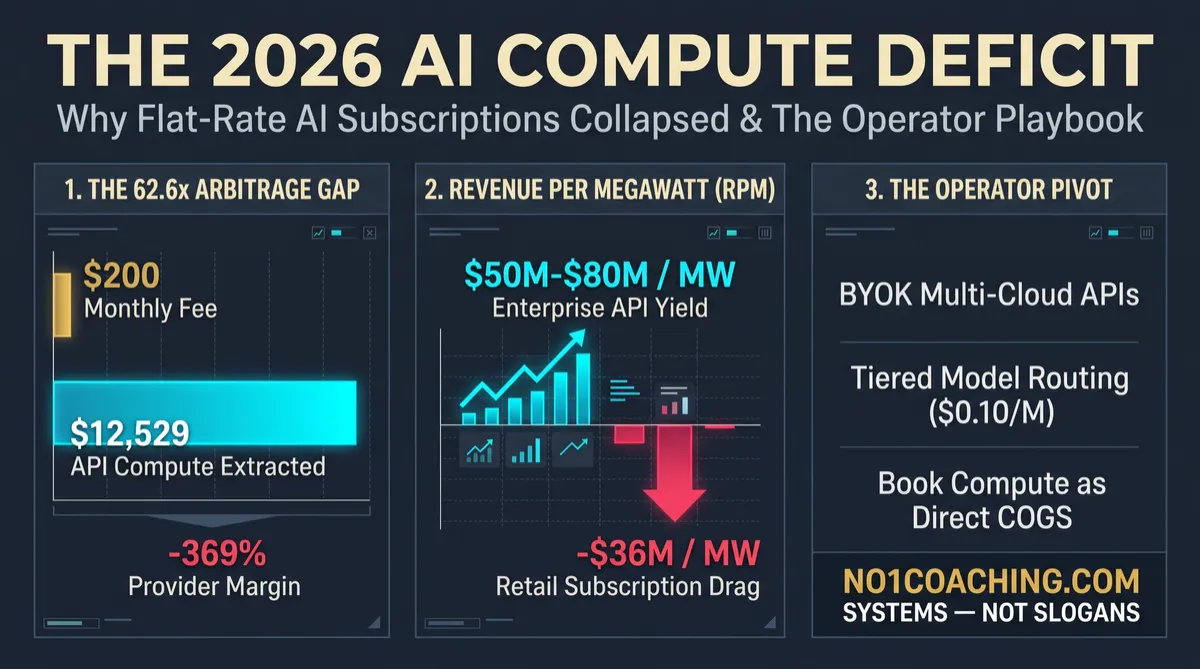
Having spent years in institutional finance managing valuation and risk analytics on an $80 billion portfolio and holding a Master of Science in Financial Engineering, I don't look at AI through the lens of a hype-cycle marketer. I look at it the way a quant looks at a mispriced options chain. According to October 2026 limit-testing by semiconductor research firm SemiAnalysis, power users were extracting up to $12,529 worth of monthly agentic compute for a $200 flat fee—a 62.6-fold arbitrage multiple. Now, the subsidy window is closing.
For founders running $1M to $25M businesses, this post-mortem is your wake-up call. Here is the forensic breakdown of the Autumn 2026 Compute Retraction, the quadratic token physics driving it, the Revenue Per Megawatt (RPM) mandate forcing the labs' hands, and the four-step architectural playbook to harden your operating system so your company grows—and sells—without a single point of failure.
What Happened During the Autumn 2026 AI Quota Retraction?
Between August 29 and November 2, 2026, the three leading frontier AI providers—Anthropic, OpenAI, and xAI—pulled back from unmetered and high-allowance flat-rate subscriptions.
Driven by the shift from linear chat prompts to continuous autonomous coding and workflow agents, all three labs instituted compute caps, 17% to 50% quota reductions, and steeper price tiers to halt severe margin erosion.
The commercial foundation of consumer and prosumer generative AI rested on an unsustainable economic model: charging flat monthly fees for frontier large language models whose underlying compute costs scale dynamically with workload volume and context depth. As soon as teams stopped using AI like a search engine and started running it as an autonomous background worker, the unit economics broke down across three sequential waves.
1. Anthropic and the Claude Code Compute Ceiling (August 29 – September 14, 2026)
Throughout the spring and summer of 2026 (after doubling 5-hour limits on May 6, 2026), Anthropic offered a temporary 50% weekly usage boost across its Pro, Max, and Enterprise tiers to accelerate adoption of its autonomous terminal interface, Claude Code. Indexing the original pre-boost baseline at 100, this summer promotion established a practical operational benchmark of 150. On August 29, 2026, Anthropic announced an operational realignment via @ClaudeDevs on X that took full effect on September 14, 2026, citing difficulty securing enough compute to sustain the boosted limits.
The expiration of the 50% promotional boost on September 13 coincided with a permanent 25% baseline increase over pre-boost levels on September 14 (moving the index from 150 down to 125). The net operational result was an immediate 16.7% (conventionally referenced as 17%) drop in effective weekly capacity relative to what engineering teams had utilized throughout the summer.
Alongside this structural cut, Anthropic enforced two overlapping rate throttles: a rolling five-hour prompt window (roughly 45 messages per five hours on standard Pro, scaling by 5x to ~225 messages or 20x to ~900 messages on Max tiers) and a hard weekly ceiling on "active compute hours". Rather than tracking wall-clock duration, the active compute metric measures the specific duration during which backend model weights execute reasoning, tool invocations, or code modifications—shared across regular Claude chat, Cowork, and Claude Code.
Developers operating in complex codebases frequently hit mid-task lockouts during peak business hours. By October 30, 2026, industry reports noted the $200 tier was rebranded to Claude Ultra, restructuring weekly limits to 10x Pro while removing the 5-hour limit for verified accounts and providing $200 in monthly API credits.
2. OpenAI and the ChatGPT Pro Realignment (September 29 – October 29, 2026)
OpenAI introduced its subscription realignment on September 29, 2026, during its annual DevDay conference. The company overhauled its top-tier consumer offering, the $200/month ChatGPT Pro 200 plan. New subscribers were immediately placed on a curtailed usage allowance, with external reports and independent SemiAnalysis limit-testing indicating that achievable API-equivalent token capacity was reduced by roughly 50%.
Grandfathered subscribers who maintained continuous active billing were permitted to retain legacy limits through October 29, 2026, after which their accounts transitioned to the lower allowance (though OpenAI also added up to $500/month in promotional API credits for Pro and Business users on October 29). Simultaneously, OpenAI launched the $500/month ChatGPT Pro 500 tier ($6,000 annually), establishing a published 25x allowance multiplier over baseline ChatGPT Plus and making it the sole tier that includes 300 tokens-per-second (TPS) "Ultrafast" execution speeds. However, SemiAnalysis testing indicated that on flagship GPT-6 Astra workloads, the $500 plan delivered roughly 21% more capacity than the legacy $200 tier. Furthermore, OpenAI announced that starting in December 2026, Plus, Pro, and Business plans will merge ChatGPT and Codex/Work quotas into a single shared token budget.
3. xAI (SpaceXSI) and the Grok Bot Capacity Wall (November 1–2, 2026)
The third phase of the industry-wide retraction unfolded over the weekend of November 1–2, 2026. Less than two weeks after SpaceX President Gwynne Shotwell reported that Grok Bot had more than doubled its subscriber base to 800,000 paying users per week in early October—and Elon Musk touted it via Forbes as his fastest-growing product—users and The Telegraph (as cited by The Decoder) reported that xAI cut Grok Bot tool quotas roughly in half.
Housed under newly public SpaceX's Super Intelligence division (SpaceXSI)—which A47 News reported generates 52% of SpaceX's total income and booked $431 million in net profit—xAI moved swiftly to protect its margins.
Because Grok Bot shares its quota pool with core Grok and the Cursor AI coding platform, subscribers running multi-step browser automation, email parsing, and coding workflows reported their weekly meters jumping from 50% to 100% overnight, resulting in multi-day waits for a quota reset. At 8:34 PM on November 1, 2026, in a reply on X that drew 11.4 million views, Elon Musk confirmed the throttling was driven by unit economics: "The cost of serving Grok Bot was unsustainably high relative to revenue," while asking complaining subscribers whether a larger, higher-priced subscription option would be too expensive.
Platform / Entity | Announcement Date | Effective Date | Stated Quota Adjustment | Primary Technical Mechanism | Underlying Business Driver |
|---|---|---|---|---|---|
Anthropic (Claude Code / Max / Ultra) | August 29, 2026 | September 14, 2026 (Ultra: Oct 30) | Net 16.7% (~17%) cut vs. summer boost | 5-hour rolling prompt cap + weekly active compute-hour ceiling | Subscriptions consumed >40% of compute for ~10% of revenue |
OpenAI (ChatGPT Pro / Codex) | September 29, 2026 | Immediate (New) / October 29, 2026 (Legacy) | ~50% reduction in $200 Pro allowance; $500 tier launched | Token allowance halved; 300 TPS "Ultrafast" gated to $500 tier; Codex/Chat pool merged | System strain from heavy agentic users; enterprise margin protection |
xAI / SpaceXSI (Grok Bot / Cursor) | November 1, 2026 | Immediate (Nov 1–2, 2026) | ~50% reduction in agent tool quotas | Hard weekly tool call caps shared with Cursor; multi-day quota resets | Autonomous agent serving costs outstripping subscription revenues |
Why Did Flat-Rate AI Subscriptions Collapse? Subscription Arbitrage vs. Inference Physics
Flat-rate AI subscriptions collapsed because software-as-a-service (SaaS) pricing conflicts with the physical economics of machine learning inference. While traditional SaaS enjoys 80% to 90% gross margins with near-zero marginal delivery cost, every AI token requires dedicated floating-point operations, high-bandwidth GPU memory, and megawatts of electricity. According to an October 2026 SemiAnalysis study, power users on $200 subscriptions were extracting up to $12,529 per month in API-equivalent compute—a 62.6x arbitrage ratio that pushed modeled provider gross margins on maxed-out Opus 5.5 accounts down to -369%.
To understand why the labs willingly absorbed subscriber backlash this autumn, look at the unit-economic film. The earliest warning sign appeared in Microsoft's GitHub Copilot. Industry reports from 2023 and 2024 disclosed that on a standard $10/month subscription, Microsoft absorbed an average loss exceeding $20 per user per month, with power-user software engineers generating up to $80 per month in backend compute costs. Microsoft tolerated that deficit as a customer-acquisition loss leader because it could subsidize developer seats with its enterprise cloud margins.
By late 2026, autonomous agentic loops multiplied that deficit by an order of magnitude.
According to Anthropic's figures cited by The Decoder, running an autonomous AI agent costs 4 to 15 times as much as a standard chat interaction. In October 2026, semiconductor research firm SemiAnalysis (in a study by Andrew Megalaa, Max Kan, and Dylan Patel) conducted a 7-step stress test of consumer and prosumer plans—using War and Peace and technical essays to isolate fresh input, cache write, cache read, and output token steps until the 0–100% usage meters stabilized within a ±5% range.
Their benchmark measurements revealed a massive subsidy gap between flat retail fees and first-party API list prices. On Anthropic's $200/month Claude Max (20x) plan, an operator configuring Claude Sonnet 5.5 ($2.00 input / $10.00 output per million tokens) inside an agentic loop could extract $12,529 per month in list API value (62.6x the fee), and $7,009 (35.0x) in standard chat workloads. Deploying Claude Opus 5.5 ($4.00 input / $20.00 output per million tokens) on complex refactoring tasks inside a $200 Max 20x plan yielded $11,726 per month in API-equivalent value (58.6x the fee) for agentic workloads and $9,200 (46.0x) for chat. Even on the entry-level $20/month Claude Pro plan, consistent users consumed $1,178 of Opus 5.5 compute (a 58.9x multiple). Assuming a 92% gross margin on list API pricing, SemiAnalysis modeled that a Max user running Opus 5.5 at 100% utilization generated a -369% gross margin for Anthropic, and only about a 6% gross margin at an assumed 20% average utilization.
By comparison, OpenAI enforced stricter utilization caps on its $200 ChatGPT Pro 200 plan, yielding $2,084 in API value on its mid-tier GPT-6.1 Sol model (a 10.4x multiple, meaning Claude delivered roughly 5.6x more mid-tier API value) and $2,897 (14.5x) on its flagship GPT-6 Astra model. When OpenAI cut GPT-6.1 Sol cache read pricing by 50% vs. GPT-6 Sol without raising token limits, the API-equivalent value of the $200 plan fell by roughly 30%. Meanwhile, Anthropic capped its flagship Claude Fable 5.1 at 50% of the plan's usage pool ($2,485 or 12.4x on Max 20x), preserving a +1% modeled gross margin at 100% utilization (~80% gross margin at 20% utilization) while leaving the other 50% of the subscriber's quota intact for Opus or Sonnet.
Individual telemetry and internal usage data corroborate these stress tests. Longitudinal tracking of high-output engineering teams showed developers consuming upwards of 10 billion tokens across an eight-month window via Claude Code Max subscriptions—paying roughly $800 in cumulative retail subscription fees while executing workloads valued at more than $15,000 at API rates. Across enterprise power users, the top 5% of agentic operators regularly generated $800 to $1,200 per month in compute expenses. Even inside Anthropic, reports in early November 2026 noted that internal employee Claude usage valued at retail API rates exceeded employee compensation after growing 250-fold between January and September 2026.
Subscription Tier | Monthly Retail Fee | Model Deployed (2026 API List Rate) | Measured Monthly API Value (Agentic) | Effective Arbitrage Ratio | Modeled Provider Impact |
|---|---|---|---|---|---|
Claude Max 20x (Anthropic) | $200 / month | Claude Sonnet 5.5 ($2 / $10 per 1M) | $12,529 ($7,009 Chat) | 62.6x (35.0x Chat) | Highest retail compute extraction in study |
Claude Max 20x (Anthropic) | $200 / month | Claude Opus 5.5 ($4 / $20 per 1M) | $11,726 ($9,200 Chat) | 58.6x (46.0x Chat) | -369% gross margin at 100% utilization |
Claude Max 5x (Anthropic) | $100 / month | Claude Opus 5.5 ($4 / $20 per 1M) | $5,725 | 57.3x | ~5.4x more API value than ChatGPT Pro 100 |
ChatGPT Pro 200 (OpenAI) | $200 / month | GPT-6 Astra (Flagship) | $2,897 | 14.5x | Exhausts 100% of plan pool; cut Oct 29 |
Claude Max 20x (Anthropic) | $200 / month | Claude Fable 5.1 (Flagship) | $2,485 ($2,480 Chat) | 12.4x | Capped at 50% pool; +1% margin at 100% use |
ChatGPT Pro 200 (OpenAI) | $200 / month | GPT-6.1 Sol ($2 / $10 per 1M) | $2,084 | 10.4x | Fell ~30% after Sol cache price cut |
ChatGPT Pro 100 (OpenAI) | $100 / month | GPT-6 Astra / GPT-6.1 Sol | $1,322 (Astra) / $1,055 (Sol) | 13.2x / 10.6x | Strict utilization caps enforced |
Claude Max 5x (Anthropic) | $100 / month | Claude Fable 5.1 (Flagship) | $1,273 | 12.7x | Capped at 50% of plan pool |
Claude Pro (Anthropic) | $20 / month | Claude Opus 5.5 ($4 / $20 per 1M) | $1,178 | 58.9x | ~5.6x more value than ChatGPT Plus |
ChatGPT Plus (OpenAI) | $20 / month | GPT-6.1 Sol / GPT-6 Astra | $211 (Sol) / $162 (Astra) | 10.6x / 8.1x | Baseline consumer allowance |
At the macro level, this imbalance became untenable: SemiAnalysis financial modeling estimated that while fixed-fee retail subscriptions generated roughly 10% of Anthropic's total corporate revenue, those subscribers consumed over 40% of the firm's available inference compute—degrading Anthropic's blended revenue per megawatt of data center power by approximately $36 million annually.
How Do Agentic Loops and Quadratic Token Compounding Break Subscription Math?
Autonomous AI agents break flat-fee subscriptions because they shift token consumption from linear O(N) scaling to quadratic O(N2) scaling. Because LLM inference is stateless, an agent executing a 25-step workflow must re-transmit the entire accumulated history of system instructions, tool schemas, file reads, and error logs on every single turn—saturating GPU High-Bandwidth Memory (HBM) via the Key-Value (KV) cache.
When your team used ChatGPT in 2024 to draft an email, context grew linearly: each turn appended a single user prompt and model response. In 2026, when an autonomous agent in Claude Code, Codex, or Grok Bot is instructed to inspect a directory, fix a bug, and run tests, every request initiates a recursive internal loop of thought generation, tool invocation, environment feedback, and synthesis.
1. The Quadratic Token Compounding Formula
Because transformer APIs operate in a stateless paradigm, the model retains no state between tool calls unless the entire accumulated history is re-transmitted. Prior to processing the user's task, the initial API call must load a substantial system payload (S) comprising behavioral parameters, runtime guardrails, output formatting constraints, and complete JSON schema definitions for every integrated tool—consuming between 1,500 and 3,500 input tokens before task-specific execution even begins.
As the agent navigates an environment—reading directory structures, retrieving source files, parsing logs, and evaluating errors—each intermediate step appends an average incremental payload of k tokens to the operational history. Across an N-step autonomous loop, the cumulative volume of tokens processed (Ttotal) compounds quadratically:
Ttotal = ∑i=1N (S + i · k) = N · S + k · N(N+1)/2
This O(N2) computational scaling means that an agent executing an extended 25-step debugging loop does not consume 25 discrete interactions; it processes an escalating cascade of hundreds of thousands of compounded context tokens. For instance, using the formula above, an initial payload of S = 3,000 tokens with an incremental step payload of k = 4,000 tokens over N = 25 steps processes 25(3,000) + 4,000 × [25(26)/2] = 1,375,000 cumulative tokens. SemiAnalysis workload modeling reflects this exact dynamic: in an agentic workload mix, 96.6% of all tokens processed are cached input reads, 2.6% are cache writes, 0.4% are fresh inputs, and 0.3% are model outputs—whereas a standard chat mix consists of 75% cached inputs, 13% cache writes, 2% fresh inputs, and 10% outputs.
2. The KV Cache Bottleneck and the 60-Minute TTL Cliff
This quadratic expansion places severe pressure on data center memory subsystems via the Key-Value (KV) cache. Transformer attention mechanisms must store intermediate key and value tensor representations across every layer of the network for every token in the active context window. For a model characterized by L layers, hidden dimension D, active context length C, batch concurrency B, and numerical precision bytes P, the memory footprint of the KV cache scales according to:
MemoryKV = 2 × B × L × D × C × P
When thousands of active subscribers maintain open context windows spanning 100,000 to 200,000 tokens, the physical High-Bandwidth Memory (HBM) on GPU clusters saturates long before raw arithmetic tensor processing reaches full utilization.
To manage this physical bottleneck, platforms rely on prompt caching, storing compiled attention states in memory and discounting cached reads relative to fresh input rates; for example, GPT-6.1 Sol prices cached reads at $0.10 per million tokens and Claude Sonnet 5.5 prices cached reads at $0.10 to $0.20 per million tokens compared to $2.00 per million for fresh input. However, prompt caching breaks down under common working patterns. On subscription accounts, prompt caches carry a strict 60-minute time-to-live (TTL) expiration window. If an engineer pauses work to review code or attend a meeting, the cached attention matrix is purged from VRAM, and the next prompt triggers a total cache miss—forcing the backend cluster to reprocess the entire context window at full computational intensity.
Furthermore, when users hit usage limits and draw down on paid credit balances, platforms actively reduce the cache TTL to 5 minutes to free up server memory, causing frequent cache misses during intermittent work. Compounding this strain, multi-agent workflows—where distinct sub-agents handle planning, code implementation, and unit testing in parallel—multiply token consumption by approximately 7 times compared to standard interactive sessions, rapidly draining memory and triggering automated concurrency throttles.
What Is "Revenue Per Megawatt" (RPM) and Why Does It Dictate AI Pricing?
Revenue Per Megawatt (RPM) is the infrastructure metric AI providers use to evaluate annualized gross inference revenue generated per megawatt of operational data-center power.
In late 2026, serving metered proprietary APIs yields $50 million to $80 million per megawatt against an infrastructure cost of $9 million to $25 million per megawatt, whereas flat-rate consumer plans depress blended yield by approximately $36 million per megawatt.
In institutional finance, you follow the physical constraint. In 2026, the primary constraint on artificial intelligence is energized data center megawatts. Global data center capacity allocated to generative AI expanded from approximately 60 gigawatts (GW) at the end of 2024 to more than 100 GW in late 2026. Demand for this capacity is heavily concentrated: OpenAI and Anthropic held a combined footprint of roughly 4 GW at the end of 2025, scaled to 10 GW in 2026, and are projected to exceed 20 GW in 2027—absorbing 30% to 40% (and potentially 40% to 50% next year, per SemiAnalysis founder Dylan Patel) of all newly commissioned compute capacity globally.
How that power is divided internally explains why inference quotas are tightening: out of Anthropic's estimated 4 GW footprint, only roughly 1 GW is dedicated to serving live model inference across its entire user base (including Claude Code), while the remaining 3 GW is committed to next-generation frontier training runs. Because live inference capacity is strictly constrained, AI labs evaluate operations using Revenue Per Megawatt (RPM):
RPM = Annualized Gross Inference Revenue / Total Power Consumption (MW)
The hardware economics of late 2026 establish a clear hierarchy of priorities. Constructing an owned accelerator cluster (such as Nvidia Blackwell B300 / GB300 infrastructure) amortizes to roughly $9 million per megawatt annually over a five-year lifecycle, while leasing comparable capacity from third-party cloud providers costs $14 million to $25 million per megawatt annually. During acute capacity crunches, compute owners such as Elon Musk even sold short-term compute capacity to labs like Anthropic and Google for $25 million to $40 million per megawatt, recouping CapEx in a single year. Meanwhile, secondary market rental prices for Hopper H100 clusters—which hit lows of $1.45 to $1.70 per GPU-hour in late 2025—rebounded to $2.40 to $3.20 per GPU-hour in late 2026 due to tightening power and silicon supplies.
On the monetization side, serving open-weight models (such as DeepSeek-V4 or Kimi variants) over a rented megawatt of compute yields approximately $70 million in annual gross revenue at 60% capacity utilization (a 5.0x gross yield over a $14M cloud lease), while serving proprietary models like Claude Opus yields $50 million to $80 million in annualized revenue per megawatt via metered APIs (up from roughly $16 million per megawatt a year earlier, when running GPT-4 on Hopper generated negative gross profit per token).
Infrastructure Deployment Model | Estimated Annual Cost per Megawatt | Typical Annual Revenue Yield per Megawatt | Implied Unit Economic Multiplier |
|---|---|---|---|
Self-Built Nvidia B300 Cluster | ~$9 million / MW (amortized over 5 years) | Internal Infrastructure Baseline | N/A (Internal Cost Center) |
Third-Party Hyperscaler Lease | $14 million – $25 million / MW (Up to $40M spot sale) | Market Rental Baseline | 1.0x (Baseline Cost of Compute) |
Metered Hosted Open-Source API | $14 million / MW (Cloud rental baseline) | ~$70 million / MW (at 60% utilization) | 5.0x gross yield over cloud lease |
Frontier Proprietary Metered API | $14 million – $25 million / MW (Blended) | $50 million – $80 million / MW | 2.5x – 4.0x gross yield over compute spend |
Flat-Rate Consumer Plans (20–200/mo) | Fixed Hardware & Power Allocation | Depresses blended yield by ~$36 million / MW | Sub-1.0x to Negative (-369% on max Opus 5.5) |
As Dylan Patel explained on the Dwarkesh Podcast, when a lab spends $10 on inference capacity and generates $50 of revenue, it can reinvest that $40 profit directly into training—a compounding loop that reportedly helped turn Anthropic cash-flow positive in Q2 2026 (prior to its July 2026 S-1 filing showing 900% net revenue retention) and OpenAI in Q3 2026. When a lab can generate $50 million to $80 million annually per megawatt via enterprise APIs, allocating 40% of its inference fleet to flat-rate retail subscribers extracting up to $12,529 in monthly compute for $200 creates an enormous opportunity cost. Every GPU cycle consumed by an unmetered developer running continuous terminal loops is a cycle that cannot be sold to enterprise customers at gross margins exceeding 70%.
How Do $1M–$25M Founders Eliminate AI Vendor Dependency and Build Exit-Ready Systems?
To eliminate AI vendor vulnerability, $1M–$25M founder-led companies must retire consumer subscription wrappers from core workflows and install a four-part operating architecture: (1) Bring-Your-Own-Key (BYOK) metered API routing with multi-cloud failover, (2) automated context pruning, (3) tiered model dispatching, and (4) booking compute as a direct Cost of Goods Sold (COGS) on team scoreboards.
At No1 Coaching, I tell every founder I work with the same truth: The more your business needs you, the less it's worth. Industry analysis from Value Builder indicates that owner-dependent businesses sell for about 2.9x earnings, whereas companies that run without the founder get closer to 3.9x—roughly 35% more—and companies that can run for at least three months without the owner are twice as likely to receive an acquisition offer above 6x EBITDA. Conversely, Quality-of-Earnings (QoE) diligence discounts owner-dependent businesses by 30% to 50%.
Yet across Q3 and Q4 2026, many founders have attempted to solve founder dependency by embedding a team member's flat-rate $200 ChatGPT Pro, Claude Max, or Grok Bot account directly into customer acquisition, client fulfillment, code generation, or automated operations.
An operational process that breaks because an employee's $200 subscription hits an unexpected five-hour usage cap is not an automated system; it is an unmanaged business bottleneck. When we install Sportify OS, RevEngine.ai, or ExitOS inside your company, we engineer your AI stack with the same technical discipline an elite catch wrestler brings to the mat—leverage, position, pressure, and control.
1. Decouple Operations via BYOK Metered APIs and Multi-Cloud Failover
Organizations must systematically retire consumer-grade web and desktop subscription logins (claude.ai, chatgpt.com, personal Pro/Max seats) from mission-critical workflows, migrating production pipelines—such as automated lead research, follow-up, and enrichment inside RevEngine.ai—to Bring-Your-Own-Key (BYOK) API routing frameworks. Direct API integrations provide contractually defined rate limits, high uptime guarantees, and insulation from live consumer A/B limit testing—where SemiAnalysis discovered that 1 out of 3 identical consumer accounts received ~20% lower limits due to silent provider testing.
Furthermore, API routing infrastructure enables automated multi-cloud failover, dynamically shifting workloads across Anthropic Direct, Amazon Bedrock, and Google Cloud Vertex based on real-time availability, latency, and cost parameters. While metered API calls convert fixed subscription fees into variable operating expenses, they eliminate unexpected midday lockouts, peak-hour throttling, and arbitrary policy resets. As an immediate hygiene check, engineering leads should also audit developer shell startup files for stray ANTHROPIC_API_KEY environment variables on machines using interactive Claude Code plans—an invisible billing error that charges interactive sessions to pay-per-token API accounts instead of the subscription.
2. Engineer Context Compaction and Exploit the "Good Enough" Model Arbitrage
To prevent runaway quadratic token compounding, operations teams must manage context architecture internally rather than relying on external vendor defaults. As detailed in Sportify: Beyond Business AI (Sportify OS Book 4), high-performing operators run a Labor Flip Audit, map tasks into the Four Arenas Matrix, and build agentic "relay" workflows where scoped tasks pass clean outputs rather than bloated histories:
Automated Context Pruning: Strip historical tool executions, raw terminal dumps, and verbose environment responses out of the conversation history once sub-tasks are validated, preserving only essential semantic state to prevent O(N2) context expansion.
Tiered Model Dispatching: Deploying frontier reasoning models like Claude Opus 5.5 ($4.00 input / $20.00 output per million tokens) or GPT-6 Astra for repetitive, low-complexity tasks introduces massive waste. Install lightweight routing layers that direct standard data extraction, structural classification, and preliminary drafting to high-efficiency models—such as Claude Haiku 5.5, GPT-4o mini, or DeepSeek-V3, which operate at roughly $0.10 to $0.15 per million input tokens (or open-weight models like Zhipu GLM-5.2 and local Qwen3.8-27B on a 24 GB GPU)—while reserving $4.00 to $10.00+ per million frontier models exclusively for complex synthesis and architectural planning.
Continuous 60-Minute Cache Batching: Group automated agentic runs into continuous operating windows under 60 minutes to take advantage of the 60-minute prompt-cache TTL, keeping cache hit rates above 80% so context reads cost $0.10 to $0.20 per million tokens instead of $2.00 to $4.00 per million.
3. Book Compute as Direct Cost of Goods Sold (COGS) on The Jumbotron
In a professionally managed business preparing for ExitOS, AI inference expenditures cannot be buried in general administrative software overhead; compute consumption must be tracked as a direct Cost of Goods Sold (COGS) with unit-level attribution. If an autonomous outbound sales agent consumes $35 of compounded inference tokens to qualify a lead, that expenditure must be booked directly against gross client acquisition margins.
Inside Sportify OS, we replace management by guesswork with The Jumbotron—a shared scoreboard putting three visible numbers per seat in front of the team to hold standards when you aren't in the room. Every AI-enabled workflow and engineering pod should track three core numbers on The Jumbotron: 1. Successful Task Completion Volume: Verified, closed units of work rather than prompt counts or activity motion. 2. Error and Retry Rates: Frequency of agent loops, hallucinations, or failed tool calls. 3. Marginal Compute Cost per Delivered Unit of Work: Exact API dollars spent per qualified lead, resolved ticket, or deployed feature.
If compute costs rise without a corresponding lift in delivered output, the operational system flags the efficiency breakdown immediately for review in your weekly Film Room.
4. Run the 30-Day Vendor Walk-Away Test
Every founder in our ecosystem knows The 30-Day Walk-Away Test: if you stepped away for 30 days, would revenue hold within 10%, or would the business stall? You can stall decisions for two weeks, but thirty days forces every hidden dependency into the open.
Apply that exact same 30-day resilience standard to your AI vendors: The 30-Day Vendor Resilience Standard: Could your business maintain its operational rhythms, client commitments, and gross margins over the next 30 days if a key AI provider abruptly halved its quotas or doubled its prices overnight?
If external pricing or capacity shifts threaten operational continuity, you have merely traded founder dependency for vendor dependency. Building a high-value, transferable enterprise under ExitOS requires installing documented, multi-vendor systems that protect operating margins during Quality-of-Earnings diligence.
The Post-Subsidy Horizon: Systems Beat Subsidies Every Time
The quota reductions implemented across Anthropic, OpenAI, and xAI throughout the autumn of 2026 signal the close of subsidized generative AI. The era of $20 and $200 all-you-can-eat cognitive labor was an artificial market environment sustained by venture capital subsidies, hyperscaler cloud credits, and aggressive customer acquisition strategies.
As the market rationalizes around physical power and metered billing, sustainable operational advantage will not belong to organizations that consume the highest volume of subsidized compute, but to those that engineer the most disciplined, computationally efficient, and transferable operating systems. Stop guessing. Look at the film, fix the system, and own the scoreboard.
How Do You Get Started?
If you lead a $1M–$25M founder-led company and want to see where owner dependency or unhedged tech bottlenecks are leaking margin and capping enterprise value, take these three steps:
Take the 30-Day Walk-Away Test (Free · 2 Minutes) → Answer 12 yes-or-no questions across six business areas (sales, management, decisions, finance, contracts, and relationships) to see where your company leans on you using a buyer's eye.
Run the Lethargy Tax Calculator (Free · 3 Minutes) → Put a weekly dollar figure on what owner dependency is costing your business right now.
Book a Free 30-Minute Diagnostic Strategy Call with Jake → No charge. No pitch. We read your numbers together, diagnose where your operating model is leaking performance, and map the installation sequence (Sportify OS, RevEngine.ai, or ExitOS) that fixes it. To read the frontier firm AI playbook first, Get Sportify: Beyond Business AI (Sportify OS Book 4) on Amazon →.
Stay obsessed.
Frequently Asked Questions About the 2026 AI Subscription Cuts and Token Economics
How much did Claude Code, ChatGPT Pro, and Grok Bot cut usage limits in Autumn 2026?
Between late August and early November 2026, all three major providers tightened flat-rate allowances. Anthropic ended its temporary 50% summer usage boost for Claude Code on September 13–14, 2026, replacing 150% of pre-boost capacity with a permanent 125% baseline—a net 16.7% (~17%) reduction in weekly capacity—alongside a 5-hour rolling window and a weekly active compute-hour ceiling. OpenAI reduced the achievable API-equivalent token allowance of its $200/month ChatGPT Pro 200 plan by roughly 50% (effective September 29, 2026, for new subscribers and October 29, 2026, for grandfathered accounts) while launching a $500/month Pro 500 tier. Finally, over the weekend of November 1–2, 2026, xAI (SpaceXSI) cut weekly Grok Bot agent tool quotas by roughly 50% after Elon Musk stated that serving costs were "unsustainably high relative to revenue".
Which $200 AI plan gives more API-equivalent value in 2026: Claude Max or ChatGPT Pro?
According to October 2026 limit-testing by SemiAnalysis, Anthropic's $200 plan delivered roughly 5.6x more API-equivalent value on mid-tier models than OpenAI's $200 plan ($11,726 or 58.6x on Claude Opus 5.5 and $12,529 or 62.6x on Claude Sonnet 5.5 agentic workloads, compared to $2,084 or 10.4x on OpenAI's GPT-6.1 Sol). On flagship models, the two plans were roughly comparable ($2,897 or 14.5x on GPT-6 Astra vs. $2,485 or 12.4x on Claude Fable 5.1, which is capped at 50% of the plan's usage limit).
Is OpenAI's new $500/month ChatGPT Pro 500 tier worth it for business operators?
For most $1M–$25M businesses, flat-rate $500 seats are an inefficient substitute for metered APIs. While the $500/month ($6,000/year) ChatGPT Pro 500 tier provides a 25x allowance multiplier over ChatGPT Plus and exclusive access to 300 TPS "Ultrafast" execution speed, SemiAnalysis testing indicated it delivers only ~21% more flagship GPT-6 Astra usage than the old $200 plan. Production workflows are better served via Bring-Your-Own-Key (BYOK) metered APIs with tiered model routing, where routine extraction tasks run on utility models costing $0.10 to $0.15 per million input tokens.
Why do AI coding and workflow agents burn through token quotas so much faster than chat?
Conversational chat grows linearly, whereas autonomous agents operate in stateless multi-step loops that compound token consumption quadratically (O(N2)). Every time an agent reads a directory, invokes a tool, or parses an error log, it re-transmits the entire accumulated history plus 1,500 to 3,500 input tokens of system and schema overhead. Because 96.6% of agentic tokens are cached input reads, pausing work for more than 60 minutes purges the prompt cache from GPU memory, forcing the cluster to reprocess the entire context window at full cost.
How does AI vendor dependency affect what a buyer pays for my business?
Buyers pay for future cash flow they trust will continue after the founder exits. Value Builder data shows that moving from an owner-dependent business to a founder-independent system lifts average acquisition multiples from 2.9x to 3.9x earnings (~35% higher) and avoids the 30%–50% valuation discount applied during Quality-of-Earnings (QoE) diligence. Under ExitOS, replacing fragile employee AI logins with documented multi-cloud API routing and tracking inference compute in Cost of Goods Sold (COGS) ensures buyers see transferable systems and clean unit margins.
About the Author: Coach Jake Shannon is the founder of No1 Coaching, a Certified Chief Data & AI Officer (CCDAO), and Grant Cardone's multi-time 10X Performance Coach of the Year. Holding a Master of Science in Financial Engineering, Jake previously managed valuation and risk analytics on an $80 billion institutional portfolio before founding Scientific Wrestling and authoring the best-selling Sportify OS series, including Sportify: Beyond Business AI. He installs custom operating systems (Sportify OS, RevEngine.ai, and ExitOS) for $1M–$25M founder-led companies so they grow—and sell—without the owner.
Sources
Claude Pro vs Max: Is the $200 Max Upgrade Worth It? - ClickRank AI
Musk says Grok Bot limits were cut because serving costs outran
SemiAnalysis: Claude $200 Plan Offers ~5x OpenAI's API Value
How OpenAI and Anthropic Turn Compute Into Profit - MindStudio
Dylan Patel – Anthropic & OpenAI will have most of the world's
Anthropic vs OpenAI Usage, Margins, Meta Compute, Future of MSL
Two AI Giants Capture 1/3 of Global Newly Added Computing Power
Entrepreneurship 101 in its first season, features Jake Shannon
