Owner-Dependent Business? Run the 30-Day Walk-Away Test
By Coach Jake Shannon, No1 Coaching
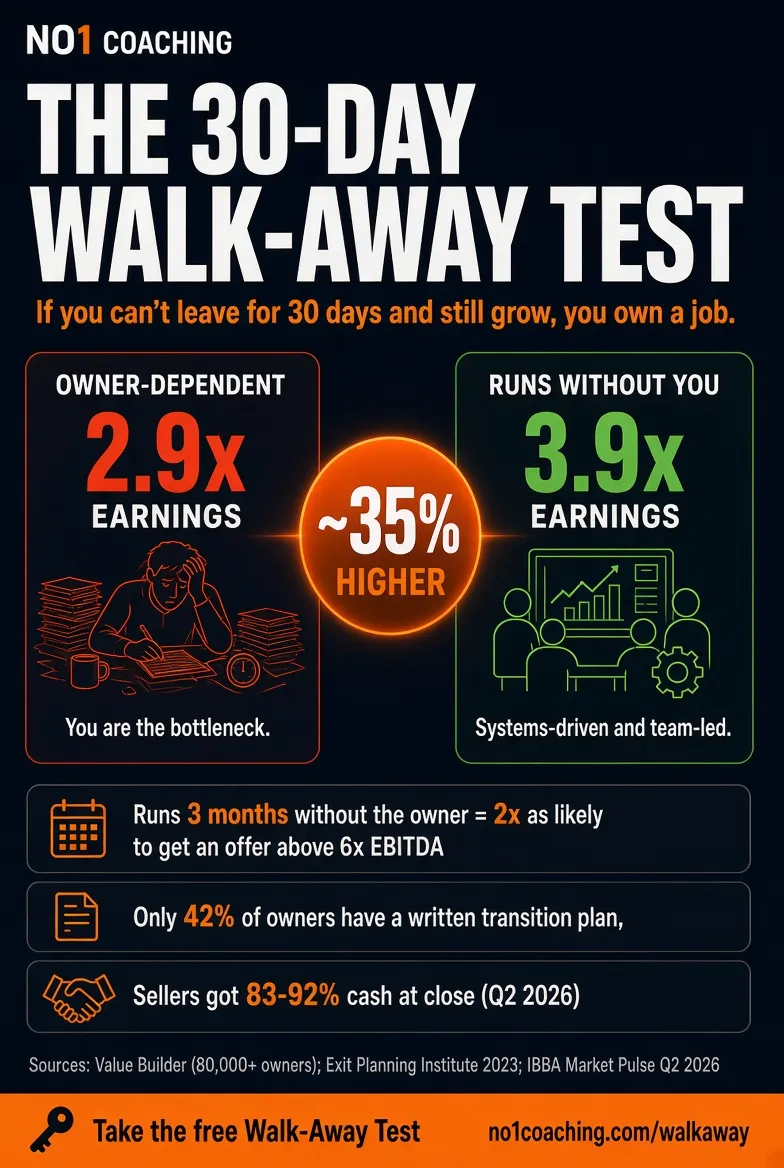
If you can't leave for 30 days and still grow, you own a job. I tell every owner I work with the same thing. I install the systems that take the owner out of the middle.
This post covers what an owner-dependent business is, how buyers treat it, how to measure it, and the first dependency to cut.
What is an owner-dependent business?
An owner-dependent business is one that stops working well when the owner steps away. Sales, decisions, key relationships, or the numbers live in the owner's head instead of in systems the team runs. Here's the test: swap in a competent operator on day one. If the business stalls, it depends on you.
Most owners feel this before they can name it. You see it in three places:
- Every tough decision comes back to you.
- The team waits for you before they move.
- Vacations go badly, or you don't take them.
None of that shows up on a P&L. The P&L shows how the business does with you in it. It says nothing about how it does without you.
How does owner dependence affect what a buyer pays?
Buyers pay for future cash flow they believe will keep coming once you're gone. Every dependency on you adds risk, and buyers account for that risk in price, terms, or both. Industry data shows founder-free companies tend to sell at higher multiples than owner-dependent ones.
The data is consistent:
- Value Builder's analysis found owner-dependent businesses sell for about 2.9x earnings, while companies that can run without the founder get closer to 3.9x, about 35% more (Value Builder Advisor News, Feb 2026). That's a dataset average, not a number for your business.
- BizBuySell's president, Bob House, said this month that buyers are "gravitating toward businesses with reliable cash flow, clean financials, limited owner dependence, and a clear path to financing" (BizBuySell Q3 2026 Insight Report release).
- In the IBBA and M&A Source Market Pulse for Q2 2026, sellers received 83% to 92% cash at close on average (Market Pulse Q2 2026). Buyers put cash up front when they trust what they're buying.
Owner dependency is a number, not a feeling. Buyers already price it, so you should measure it first.
How do you measure owner dependence?
Score it instead of guessing. Look at six areas: sales, management, decisions, finance, contracts, and relationships. For each one, ask whether it keeps working for 30 days without you. The free Walk-Away Test at no1coaching.com runs twelve yes-or-no questions and takes about two minutes.
A few of the questions on the Walk-Away Test:
- If you were gone for 30 days, would revenue hold within 10%?
- Can you pull last month's revenue and margin in under 5 minutes, without asking anyone?
If you hesitated on either one, that's useful information. You'll see where your company leans on you, using a buyer's eye. It's a readiness read. It is not a valuation or an appraisal.
Why 30 days instead of a week off?
You can stall decisions for two weeks. You can't stall them for thirty days. A month away forces every hidden dependency into the open: the approval only you give, the client who only calls you, the report nobody else can run. Value Builder uses an even higher bar of three months.
Value Builder's data from over 80,000 business owners found companies that can run without the owner for at least three months are twice as likely to get an acquisition offer above 6x EBITDA (Value Builder research via PivotPoint Business Solutions).
Thirty days is where you start. If you pass at 30, you've built something a team can carry.
What makes a business transferable?
A transferable business can be run by someone who didn't build it. That takes documented processes, visible numbers, and managers with real authority. Systems beat heroes. A scoreboard, a regular meeting cadence, and clear decision rights keep the business running when the owner is gone.
Three checks I run with owners:
- Management depth. Some managers hold meetings and some hold standards. Can each manager name their three numbers and say whether they're on pace?
- Decision rights. Delegating hands off the work. Handing off authority hands off the call. Write down who decides what, and up to what limit.
- Sales without the founder. Buyers pay for revenue that stays after you leave. If you're the closer, the pipeline leaves with you. Treat the sales call as a system you can measure. If you can't describe how your best calls work, you can't hand them off.
On the money side, watch for numbers that live in the owner's head, reports that run late, and personal and business spending mixed together. On contracts, watch for "recurring" revenue that is really habit, key accounts tied to you personally, and agreements that can't transfer. Get the legal specifics from your attorney or M&A advisor.
What is the first dependency to cut?
Stop being the scoreboard. Put three numbers per seat in front of the team where everyone can see them, and flag the ones that go stale. Push decisions down to the people closest to the work. Then take the 30-day test and see what breaks.
Visibility means numbers in a system. Chats with your reps don't count. In Sportify OS we call the shared board the Jumbotron: three numbers per seat, updated in the system, with stale numbers flagged. You can read more about the Sportify method on the blog.
One warning. Don't trade founder dependency for consultant dependency. If it leaves when I leave, I only rented it to you. The team has to own the system.
Why build for exit readiness if you never plan to sell?
A buyer is already pricing your business, whether you're selling or not. Being ready means you choose the timing. A transferable business also runs better day to day, because it doesn't wait on one person. Readiness gives you options: sell, step back, or keep growing.
Most owners don't have the plan on paper. The Exit Planning Institute found only 42% of owners had a written, formal transition plan (EPI 2023 State of Owner Readiness Report). In the Q2 2026 Market Pulse, retirement was the top reason owners sold, peaking at 72% of sales in the $1 million to $2 million range (Market Pulse Q2 2026). Retirement comes for everyone, so plan the handoff before you need it.
ExitOS asks a different question than growth consulting. Growth consulting asks how to get bigger. ExitOS asks what a buyer would discount and how to fix it.
How do you get started?
Take the free Walk-Away Test. Twelve questions, about two minutes, and you'll see where your company leans on you. If you want to go through your results, book a free 30-minute strategy call with me. We'll find your biggest owner dependency and the first system to fix.
What else do owners ask about owner dependence?
These are the questions owners ask most after they hear the 30-day standard. The short version: owner dependence is measurable, the Walk-Away Test is a readiness read and not a valuation, and the strategy call is a free 30 minutes with me.
What is the owner-dependency discount?
It's what a buyer takes off the price, or puts into the terms, because too much of the business lives in the owner. The more the business needs you, the more risk the buyer carries after closing.
Is the Walk-Away Test a business valuation?
No. It's a buyer's-eye readiness read. It shows where your company leans on you. It doesn't put a value on your business and it isn't an appraisal.
How long does the Walk-Away Test take?
About two minutes. It's twelve yes-or-no questions covering areas like revenue, numbers, decisions, and relationships.
How long is the strategy call?
30 minutes, with me directly, and it's free.
Do I need to be planning a sale to care about owner dependence?
No. A transferable business runs better whether you sell or not, and it lets you choose your timing instead of having it chosen for you.
About the author. Coach Jake Shannon is the founder of No1 Coaching and Grant Cardone's multi-time 10X Performance Coach of the Year. He installs the systems that take business owners out of the middle, so the company runs, sells, or grows without them. About No1 Coaching · What we do
