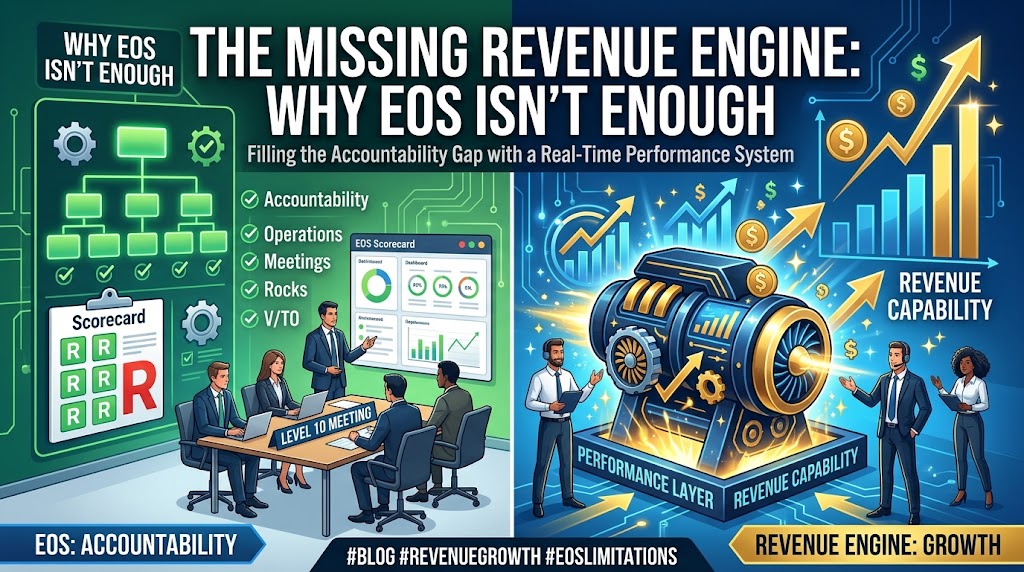
The Missing Revenue Engine: Why EOS Isn't Enough
Short answer, up front
EOS is an accountability system. It is not a revenue system. It was never designed to be one.
EOS tells you which number is red. It does not make the person responsible for that number better at moving it. That gap — the distance between knowing the number is red and having the capability to change it — is where most EOS companies stall out somewhere between year two and year four.
The fix is not more EOS. It is not less EOS either. It is a performance layer installed underneath the Scorecard, at the level of the individual.
First: EOS works. That's the problem.
Let's get this out of the way, because the internet is full of people attacking EOS to sell something else.
Gino Wickman did the entire lower-mid market a favor. Traction took operating discipline that used to require an expensive consultant and turned it into a system a 30-person company could actually run. Six Key Components. A two-page V/TO. An Accountability Chart with seats before names. Rocks. A Scorecard. The Level 10 meeting. IDS. GWC. Delegate and Elevate.
If you run it properly, it works. Your meetings get shorter. Your issues get resolved instead of relitigated. Your leadership team stops arguing about who owns what.
And then, usually around quarter six or eight, something uncomfortable happens.
The system starts working well enough to show you a problem it cannot solve.
The three gaps EOS was never built to close
Gap 1: The Scorecard is a diagnostic, not a treatment
Here's the actual sequence in a well-run EOS company.
A measurable goes red. It stays red for three weeks. Somebody drops it on the Issues List. It comes up in the L10. The team runs IDS — Identify, Discuss, Solve.
And IDS solves it using whatever knowledge is already sitting in that room.
That's the whole thing. IDS is a decision protocol, not a knowledge source. If nobody in the room actually knows how to build pipeline, IDS just recycles the same insufficient answer faster and with better documentation. You will identify the issue with real precision, discuss it efficiently, and solve it wrong every ninety minutes, every week, on schedule.
EOS is a superb diagnostic. It is not a treatment.
Gap 2: Rocks are projects. Revenue is a capability.
“Implement the new CRM” is a Rock. It has a start, a finish, and an owner. You can complete it and move on.
“Every rep can run a discovery call at the level the founder runs it” is not a Rock. It has no finish line. It is a capability, and capabilities are not installed by assigning them to somebody for ninety days.
There is no chapter in Traction on how to turn a mediocre closer into a good one. That is not a criticism of the book. It is a statement about scope. EOS answers what and who. It does not answer how well.
And “how well” is where all the money is.
Gap 3: Delegate and Elevate moves tasks off the founder. It does not move revenue off the founder.
This is the one that costs the most.
Every mature EOS company has done the Delegate and Elevate exercise. The founder got scheduling off their plate. Invoicing. Vendor management. They hired an Integrator. The Accountability Chart is clean and the seats are filled.
And the founder is still the best closer in the building.
Still on every deal over a certain size. Still the one who saves the account when it wobbles. Still the reason the number hits in the last week of the quarter.
That is not an operations problem. That is a valuation problem, and it has a name.
The Owner-Dependency Discount
Most businesses aren't undervalued. They're un-transferable.
A buyer does not ask whether your Level 10 meetings start on time. A diligence team asks one question in about fifteen different ways: what happens to revenue when you leave the room?
If the honest answer is “it drops,” you are not selling a business. You are selling a stranger a job at a discount, with an earnout attached, and with a two-year handcuff on the back end.
Here is the part that gets missed by owners who are otherwise sophisticated about money: every dollar of enterprise value you forfeit to owner dependency is taxed at zero percent. Because you never received it.
You can structure the entity perfectly, plan the transaction perfectly, place the proceeds perfectly — none of it matters if the asset doesn't transfer.
Operational systems reduce owner dependency in operations. They do very little about owner dependency in revenue. And revenue dependency is the dimension that survives every other fix. You can systematize the entire back office and still have every dollar routing through one person's face.
What's actually missing: the sports model
Business borrowed the scoreboard from sports and left everything else on the field.
Think about what a professional team actually has:
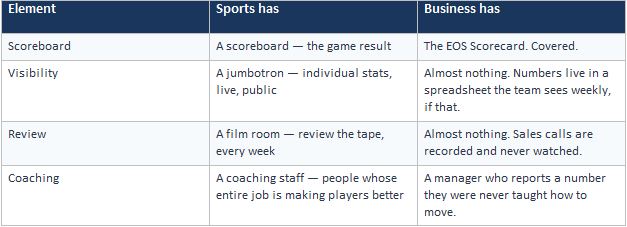
No serious team on earth would accept a scoreboard as their entire performance system. They'd be relegated in a season. But that is exactly the arrangement most well-run businesses have settled for — and EOS, by making the scoreboard excellent, has made the absence of everything else more visible, not less.
This is the missing revenue engine.
Where Sportify OS fits (and where it doesn't)
Sportify OS installs the other three layers. It sits underneath the Scorecard, at the individual level:
Jumbotron — three metrics per person, live and visible to the whole team. Not five to fifteen company measurables reviewed once a week. Individual performance, daily, in the open. Public individual numbers change behavior in a way that private aggregate numbers never have.
Film Room — structured review of actual sales calls, the way a team reviews tape. Not “how'd that go?” in a one-on-one. Specific moments, specific corrections, specific reps.
The coaching layer — turning your existing managers into actual coaches. This is the install that matters. Most managers were promoted for individual performance and then handed a number to report. Reporting a number is not coaching. Coaching is a teachable skill and almost nobody teaches it.
EOS is the front office. Sportify OS is the locker room. You need both.
To be direct about the boundary: keep your Implementer. They run vision, cadence, and organizational discipline, and a good one is worth every dollar. This is not a replacement and any consultant who tells you to rip out a working EOS install is selling you their own convenience. The handoff point is clean — when your Implementer hands your leadership team a red Scorecard line they can't fix from inside the room, that's the boundary of the system. That's where a performance layer starts.
Objections we get from serious EOS operators:
“Isn't this just competing with EOS?” No. EOS answers what and who. It doesn't answer how well. Different question, different system.
“We already have a Scorecard.” Good. Bring it. Two things will show up in about twenty minutes: how many of those measurables are lagging indicators you can only observe rather than move, and how many of your people can't personally move a single one of them.
“Our L10s are excellent.” Then meetings aren't your problem. Ninety minutes a week is roughly one percent of the work week. The question is what governs the other ninety-nine percent.
“Does this only work in sales?” It works anywhere performance is individual and observable. Revenue is where the money is, so that's where we start.
“We're pre-revenue / we're two people.” Then this isn't for you, and neither is EOS, honestly. This is built for founder-led companies doing $1M-$25M with 5-50 employees.
The one thing to do this week
Don't hire anybody. Don't buy anything.
Find out what the number is.
Run the Lethargy Tax Calculator at sportify.ai/Audit. It takes about four minutes and it puts a dollar figure on what owner dependency is costing you right now and what it will cost you at exit.
Run it for one reason: that is a number your future buyer already knows and you don't.
If the number makes you uncomfortable, that's the conversation.
FAQ
Is EOS bad? No. EOS is a well-designed accountability and organizational-clarity system. The limitation is scope: it structures who is responsible for which outcome and creates a cadence for surfacing problems. It does not build the individual capability required to change those outcomes.
Why isn't my EOS Scorecard improving revenue? Because a Scorecard measures results, and results are produced by behaviors the Scorecard doesn't observe. If a measurable is red and stays red, the constraint is almost always capability — someone doesn't know how to do the thing well — and no measurement system fixes a capability gap.
What does EOS not cover? Individual skill development, sales coaching, call review, real-time individual performance visibility, and revenue capability transfer away from the founder. EOS covers vision, structure, accountability, cadence, and issue resolution.
Do I have to choose between EOS and Sportify OS? No, and you shouldn't. They operate at different levels — EOS at the organizational level, Sportify OS at the individual performance level. Running both is the intended configuration.
How do I know if I have an owner-dependency problem? Ask what happens to revenue in the ninety days after you stop taking sales calls. If you can't answer confidently, you have one. Run the calculator at sportify.ai/Audit for a dollar figure.
Who is this for? Founder-led companies, $1M-$25M in revenue, 5-50 employees, already running some operational discipline and hitting the ceiling that operational discipline can't break. Not for startups, solopreneurs, sub-$1M businesses, or owners looking for motivation rather than installation.
_______________________________________________________________________
Jake Shannon is the founder of No1 Coaching & Consulting, a two-time 10X Performance Coach of the Year, and Chief Data & AI Officer for the 10X Performance Coaching Program. Current cohort results are published and updated monthly at stats.no1coaching.com.
Stay obsessed.
