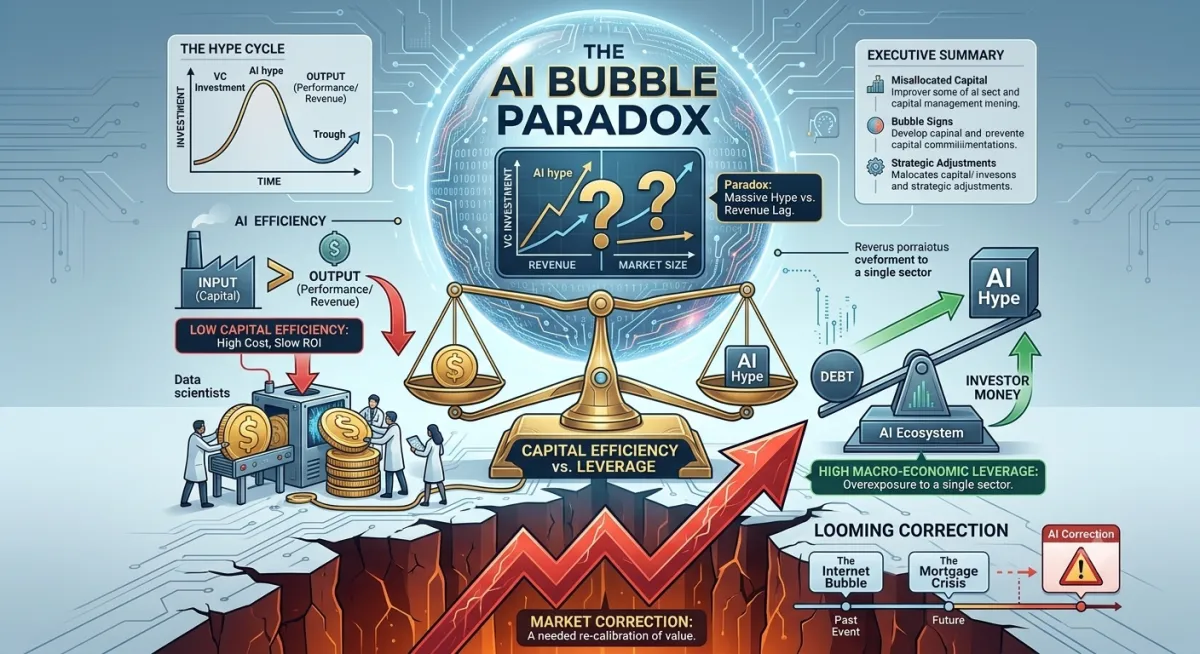
The AI Bubble Paradox: Capital Efficiency, Macro-Economic Leverage, and the Looming Correction
The global business landscape is currently consumed by the narrative of artificial intelligence, characterized by soaring valuations, massive capital expenditures, and an overwhelming consensus that generative AI is the definitive industrial revolution of the 21st century. In boardrooms, venture capital firms, and enterprise strategy sessions, the mandate is ubiquitous: integrate artificial intelligence immediately or face inevitable obsolescence. However, beneath the euphoria of record-breaking market caps and the promises of automated super-intelligence lies a fragile, deeply leveraged financial ecosystem that is exhibiting classic symptoms of hyper-financialization.
Recent macroeconomic analyses, notably the comprehensive investigations into the AI sector's underlying economics by financial analysts such as Andrei Jikh, suggest that the current trajectory of the American AI industry is structurally engineered for a massive market correction. The prevailing thesis posits that the United States technology sector is constructing a debt-fueled artificial intelligence bubble, driven by circular financing, unprecedented cash burn, an inherent misunderstanding of marginal costs, and a failure to account for rapid foreign commoditization.
Simultaneously, international competitors—most notably within China—are deploying aggressive capital efficiency, open-source disruption, and ruthless operational leverage to commoditize the exact technologies American firms are spending hundreds of billions to monopolize. This geopolitical and economic friction is creating a volatile environment where the cost of intelligence is plummeting toward zero, fundamentally undermining the high-margin business models that venture capitalists have underwritten.
For the modern entrepreneur, corporate executive, and dedicated reader of the No1Coaching philosophy, navigating this turbulent landscape requires far more than passive observation or blind technological adoption. It demands the rigorous application of financial engineering, a commitment to data-driven operational results, and the strategic foresight to recognize when a broader market is operating on speculative hype rather than sustainable, cash-flowing revenue. This exhaustive research report delivers a forensic analysis of the impending AI market correction, the complex financial mechanics driving the infrastructure boom, the geopolitical disruption accelerating the collapse of AI pricing power, and the tactical imperatives necessary to "Sportify" an enterprise to insulate and scale a business through the incoming volatility.
The Financial Mechanics of the Generative AI Illusion
To accurately diagnose the fragility of the current artificial intelligence ecosystem, one must first deconstruct the financial realities of its leading vanguard. The standard operating procedure for Silicon Valley software companies has historically relied upon a well-established and highly lucrative economic principle: substantial upfront research and development (R&D) costs, followed by near-zero marginal costs of distribution. Traditional Software as a Service (SaaS) companies consistently enjoy gross margins approaching 80% to 90% because serving the one-millionth customer requires virtually the same computational overhead as serving the first.
Generative artificial intelligence fundamentally breaks this established economic law.
Unlike traditional deterministic software, generative AI models require immense, continuous expenditures on electricity, hardware depreciation, cooling, and computing capacity for every single query processed. The costs of "inference"—the act of the AI generating an answer, writing code, or rendering an image—scale almost linearly with user adoption and revenue. If an AI company generates more text or images for its end users, its backend server costs rise in direct proportion. This dynamic eradicates the high-margin logic that historically made technology companies extraordinarily profitable, turning them instead into heavy-industry compute utilities masking as software firms.
The OpenAI Financial Case Study: Exponential Growth, Exponential Losses
The recently leaked and audited financials of OpenAI for the fiscal years 2024 and 2025 serve as the ultimate, glaring case study in the breakdown of AI capital efficiency. In 2024, the company recorded a massive net loss attributable to the company of $5.09 billion against $3.7 billion in total revenue, with total costs and operating expenses reaching an astonishing $12.48 billion.
By the conclusion of 2025, the organization had experienced explosive, historic market penetration and growth. Revenue surged by roughly 253% to reach $13.07 billion. However, this unprecedented top-line growth completely failed to yield the economies of scale expected from a maturing software enterprise. Instead, operating losses widened dramatically by 138%.
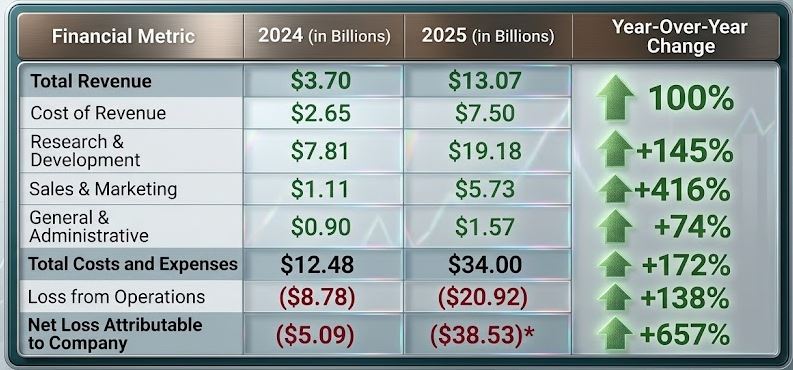
*Note: The 2025 net loss figure of $38.53 billion includes massive accounting adjustments related to the change in fair value of convertible interests and warrant liabilities as the company transitioned from a non-profit to a for-profit entity. However, the $20.92 billion operating loss represents the raw, unadjusted cash burn of the fundamental business model.
The fundamental systemic issue highlighted by these audited figures is that scaling the user base is actively destroying, rather than improving, profit margins. An enterprise burning $3.7 billion in a single quarter (Q1 2026) while generating $5.7 billion in revenue during that same period is operating a product that is inherently and massively subsidized by venture capital. The business model is fundamentally flawed, operating akin to a commercial restaurant that loses capital on every single plate of food served, attempting to solve its profitability crisis solely by accelerating the sheer volume of plates sold to the public.
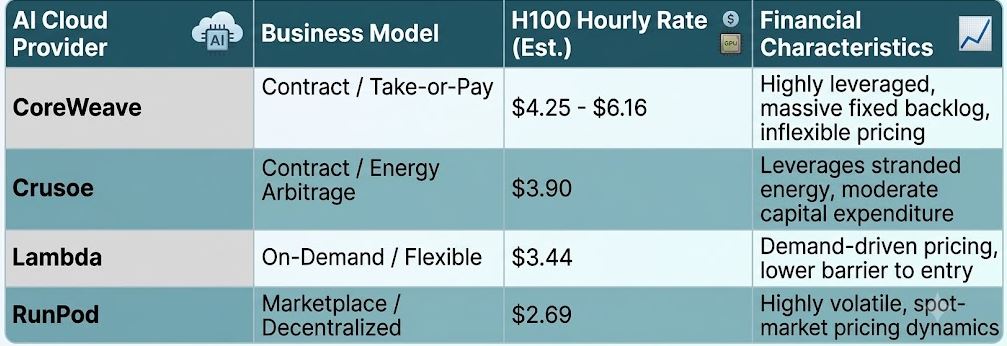
Data aggregated from 2026 compute marketplace pricing observations.
The Circular Financing Machine
The profound systemic risk within the NeoCloud ecosystem stems from a covert mechanism known within financial circles as "circular financing". The primary beneficiary of the AI hardware boom, Nvidia, is not merely a passive hardware supplier to these NeoClouds; it is deeply, structurally entangled in their financial engineering and risk profiles.
The circular model operates through several highly leveraged, interconnected layers:
Vendor Financing and Equity Injections: Nvidia actively provides debt financing or takes direct equity stakes in the NeoClouds it supplies. For instance, CoreWeave's IPO filings disclosed that Nvidia held a 1.21% equity stake in the business.
The Demand Backstop: Nvidia offers explicit demand guarantees, committing to purchase back unsold GPU capacity if customer demand falls short, essentially underwriting the NeoCloud's downside risk and allowing the NeoCloud to secure cheaper debt.
Hardware Procurement: The NeoCloud utilizes this debt (often collateralized directly by the underlying GPUs at 60% to 70% loan-to-value ratios) to purchase billions of dollars of additional hardware from Nvidia.
Revenue Sharing Agreements: Through separate cloud revenue-share programs, some NeoClouds pay Nvidia a percentage of their ongoing cloud revenue as a return on the initial financing provided, stretching the transaction far beyond a simple one-time hardware sale.
The practical macroeconomic effect: Nvidia sells GPUs to a company it has actively invested in, which purchased those GPUs using Wall Street debt backed by the promise that Nvidia will cover the financial downside, and then Nvidia takes a continuous cut of the operating revenue. This circular, closed-loop system artificially inflates demand metrics, creating an artificial financial floor for hardware sales that may not accurately reflect organic, end-user demand. If end-user demand falters, the debt cannot be serviced, the GPUs depreciate, and the liability bounces directly back to the hardware manufacturers and their lenders.
The Gigawatt Gamble: Project Stargate and the Data Center Boom
The sheer physical scale of these infrastructure commitments represents a colossal, generational financial liability. Traditional hyperscalers (Microsoft, Meta, Oracle) are actively underwriting the NeoCloud market to secure future capacity without carrying the massive capital expenditures directly on their own corporate balance sheets. Microsoft and Meta alone have committed over $122 billion to NeoClouds via long-term capacity deals, an amount approaching 90% of the trailing twelve-month revenue of Amazon Web Services (AWS).
Nowhere is this physical and financial footprint larger or more risky than the "Stargate" project. Initially announced as a staggering $500 billion, 10-gigawatt AI infrastructure initiative, Stargate represents an unprecedented partnership between OpenAI, Oracle, and the SoftBank Group.
Oracle is currently developing a massive 1,400-acre, $165 billion data center campus located in New Mexico (designated Project Jupiter) alongside an expanded flagship site in Abilene, Texas, to support an additional 4.5 gigawatts of capacity. SoftBank has joined the initiative to develop sites capable of scaling to 1.5 gigawatts over the next 18 months, pushing the total planned capacity of the Stargate initiative to nearly 7 gigawatts across five new US sites. The transaction volume is historically unprecedented—OpenAI is reportedly committing to a $300 billion overall deal with Oracle spanning a five-year period.
However, this scale introduces catastrophic single-point-of-failure risks. If OpenAI's accelerating $38.5 billion cash burn eventually forces a corporate restructuring, or if broad enterprise demand for premium AI models simply stalls, Oracle and its financial partners will be left holding gigawatts of highly specialized, rapidly depreciating physical infrastructure.
Furthermore, local municipalities and state regulators are already pushing back against the massive strain these AI data centers place on regional power grids and municipal water supplies. The public backlash regarding noise, skyrocketing electricity rates, and environmental degradation has prompted federal utility regulators to require grid operators to rework their rate plans for large load customers, ensuring residential ratepayers do not subsidize AI infrastructure. The specter of regulatory moratoriums on new data centers could instantly strand billions of dollars in allocated capital, rendering projects like Stargate financially insolvent before they even power on.
The Chinese Disruption: Capital Efficiency and the Open-Source Threat
The entire economic thesis justifying the trillion-dollar valuations of American AI firms relies upon a singular, critical assumption: the United States will maintain a monopolistic, unassailable grip on frontier AI capabilities, forcing global enterprises to rent access to American infrastructure at massive premium margins.
This assumption is currently being systematically dismantled by the Chinese technology sector, which is employing a radically different strategic framework prioritizing extreme capital efficiency, open-source deployment, and aggressive cost undercutting.
The Capital Expenditure Discrepancy
The United States is projected to spend approximately $764 billion this year on aggregate AI infrastructure, a figure poised to scale to roughly $1 trillion annually—amounting to an astounding 3% of the entire US Gross Domestic Product (GDP). In stark contrast, China's total AI infrastructure expenditure is estimated at just $102 billion for the current year, scaling to roughly $123 billion next year (representing only 0.6% of its GDP).
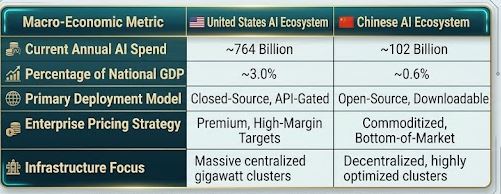
Despite spending over seven times more capital, the American tech sector is failing to establish an insurmountable technical moat. Recent reports from the US-China Economic and Security Review Commission explicitly indicate that Chinese open-source AI models are rapidly dominating global usage. Compelling estimates suggest that nearly 80% of American AI startups are quietly utilizing Chinese open-source architectures as their foundational layer due to their supreme accessibility and highly competitive performance.
The Distillation Subsidy and the Cost Collapse
The precise mechanism by which Chinese developers maintain pace with multi-billion-dollar American R&D budgets is an AI training technique known as "distillation". Rather than spending billions of dollars and gigawatts of power computing raw data from scratch to build a foundational model, Chinese laboratories train highly efficient, smaller models using the refined, high-quality outputs generated by American frontier models (like OpenAI's GPT-4 or Anthropic's Claude 3.5).
From a financial engineering perspective, this creates a devastating dynamic: every dollar spent by American firms on frontier research essentially acts as an indirect, highly effective subsidy for the Chinese AI ecosystem. American venture capitalists fund the exorbitant R&D; Chinese developers harvest the outputs to create lean, hyper-efficient, open-source competitors that immediately undercut the American firms' pricing power.
The market impact of this dynamic is catastrophic for US AI revenue projections. An examination of the coding benchmark performance between Anthropic’s premium Claude Opus model and Zhipu AI’s open-weight GLM-5.2 model perfectly illustrates this disruption.
In independent cybersecurity vulnerability testing (specifically IDOR detection), Zhipu's GLM-5.2 scored a 39% success rate on a bare prompt, actually outperforming Claude Code's 32% success rate. More importantly, the economic disparity between the two systems is staggering:
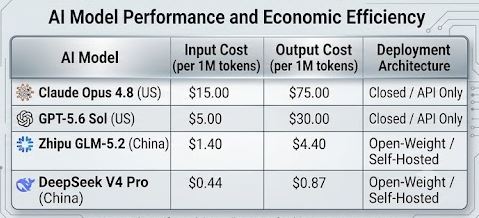
Chinese models like GLM-5.2 and DeepSeek are currently delivering comparable, and occasionally superior, performance in core enterprise tasks (such as code generation, dashboard scaffolding, and document analysis) at roughly one-tenth to one-fiftieth the cost of their American counterparts.
In the realm of B2B enterprise software, the absolute best, most philosophically capable model in the world is rarely required. Businesses operate strictly on return on investment (ROI). For high-volume generative tasks—such as scaffolding thousands of user interface components or processing millions of logistical documents—a "good enough" model that costs $0.15 per task will utterly eradicate a premium model that costs $15.00 for the exact same functional output. By rapidly commoditizing the intelligence layer, China is effectively popping the margin-expansion bubble that US venture capitalists are depending upon to service their massive NeoCloud debt.
The Enterprise Bottleneck and the Jevons Paradox
The profound friction between the massive infrastructure debt taken on by NeoClouds and the aggressive price undercutting by foreign open-source models is ultimately culminating in a severe enterprise demand bottleneck. Fortune 500 companies and mid-market enterprises are increasingly skeptical of deploying closed-source generative AI at scale, recognizing the hype cycle for what it is.
This hesitation is rooted in several non-negotiable corporate realities:
Data Sovereignty and the Threat of the Vendor-Competitor
Modern enterprises treat their internal processes, client data sets, and intellectual property as their most critical competitive moats. As Palantir CEO Alex Karp has highlighted, organizations are fiercely reluctant to hand this proprietary data over to external, closed-model providers. Trust is actively deteriorating between AI vendors and their clients. A high-profile example occurred when Anthropic launched Claude Design to directly compete with Figma, despite Anthropic possessing an active partnership with Figma. When enterprise leaders realize that the AI vendor they are paying is utilizing user interactions to train models that will eventually disrupt their own industry, adoption instantly halts. To mitigate this, technically sophisticated organizations are abandoning paid API endpoints and downloading open-weight models (like the Chinese GLM) to run on their own sovereign, internal infrastructure, starving the closed-model vendors of recurring revenue.
Flawed Tokenomics and the Hallucination Liability
The current billing infrastructure of the AI industry is fundamentally misaligned with corporate value creation. AI providers bill based on "tokens"—the raw volume of computational text processed—rather than business outcomes achieved. If an AI hallucinates a highly complex, fundamentally flawed legal document, the vendor still charges the enterprise for the heavy compute required to generate the useless text.
In critical enterprise workflows—legal analysis, medical diagnostics, financial auditing, and aerospace engineering—the tolerance for error is absolute zero. The persistent limitation of AI "hallucinations" (inventing facts with absolute syntactic confidence) prevents these models from operating autonomously in high-liability environments. Instead of replacing human labor, the AI requires constant, manual human review, completely failing to deliver the promised reduction in operational expenditure.
The Jevons Paradox in Action
Further complicating the economics of AI integration is the manifestation of the Jevons Paradox. First observed in the 19th century regarding coal consumption, the paradox states that as technological progress increases the efficiency with which a resource is used, the rate of consumption of that resource actually rises due to increasing demand.
Internally, enterprise engineering teams are seeing this play out in real-time with AI. While AI makes writing code faster and cheaper, it is not leading to a reduction in engineering headcount. Instead, companies are dramatically increasing their ambitions and correctness testing. Because code generation is a constraint that has been loosened, the total volume of software being produced is exploding, meaning that with more AI integration, enterprises actually need more software engineers to manage, review, and deploy the exponentially growing codebase. Consequently, AI is not a cost-cutting measure; it is a capability-expanding expense, further straining enterprise budgets and making CFOs hesitant to authorize massive AI API expenditures.
"Sportifying" the Business: Strategic Execution in a Tech Bubble
Understanding the macroeconomic fragility and systemic risk of the AI bubble is purely academic unless it translates into tactical, ground-level leverage for the business operator. For the dedicated readers of No1Coaching and adherents to Jake Shannon's methodologies, the current technological landscape represents a masterclass in what not to do regarding capital allocation, and presents an immense opportunity for those who maintain strict operational discipline.
Jake Shannon, a Master of Science in Financial Engineering, a two-time 10X Performance Coach of the Year, and the inventor of the Macebell, possesses a career defined by bridging the gap between rigorous financial metrics and elite athletic performance. Having revitalized the brutal sport of Catch-as-Catch-Can wrestling through ScientificWrestling.com, Shannon understands that the principles that win on the mat—leverage, position, pressure, and control—are the exact same principles required to win in the boardroom.
The core ethos of Shannon's Sportify framework is the application of elite athletic execution, raw physical leverage, and data-driven metrics to the corporate environment. It demands the eradication of operational waste, the implementation of "Brute Force" entrepreneurship, and the alignment of teams toward measurable, revenue-centric goals.
When applying the Sportify ethos to the integration of Artificial Intelligence amidst a collapsing tech bubble, corporate leaders must execute the following strategic imperatives:
1. Avoid the Shiny Object; Focus on the Scoreboard
Just as an amateur fighter might focus on flashy, low-probability techniques while a professional relies on fundamental leverage and positional dominance, businesses must absolutely ignore the AI hype cycle. Do not integrate AI simply for the sake of modernization or press releases. If a technological integration does not explicitly drive a measurable increase in sales conversions, drastically reduce operational friction, or directly enhance the guest/client experience, it is a financial liability, not an asset. Undercapitalization is simply the lack of revenue, and no amount of generative AI will save a business that cannot sell.
2. Exploit the "Good Enough" Arbitrage
The vicious pricing war between US frontier models and Chinese open-source architectures provides immense leverage for the lean enterprise. Do not lock your operational infrastructure into expensive, multi-year API dependencies with premium US models when open-weight models achieve 95% of the same utility at 10% of the cost.
Leaders must architect their digital workflows with modularity. For high-volume, low-complexity tasks (scaffolding internal dashboards, drafting standard emails, basic code generation), aggressively utilize commoditized open-source models like GLM-5.2. Reserve the expensive, premium models exclusively for multi-step, agentic reasoning tasks where extreme precision is undeniably required. This dual-routing strategy protects gross margins while maximizing output, utilizing physics-style leverage for premium deals.
3. Build Sovereign Moats, Not Vendor Dependencies
The ultimate objective of a founder is to transition from being the bottleneck to engineering a self-governing, scalable system that can run without the owner glued to the controls. Relying entirely on a third-party, closed-source AI ecosystem creates a catastrophic single point of failure outside the owner's control.
Instead of treating AI as a magical outsourced brain, treat it as an internal tool to amplify your proprietary data. Keep your intellectual property strictly siloed. Train smaller, highly specific open-source models strictly on your company’s historical data, successful sales scripts, and operational procedures. The enterprise value is not in the algorithm; the value is in the proprietary, localized data you feed it.
4. Capitalize on "Brute-Force" Aggressive Marketing
As generative AI lowers the barrier to entry for content creation, the digital ecosystem will be flooded with infinite, low-quality synthetic media. The internet will become a sea of automated noise. In this environment, organic reach will approach zero.
As Jake Shannon asserts regarding the Grant Cardone 10X mindset: "The way Grant puts that is 'best-known beats best every time'—is McDonald's the best burger? No. But they are the best-known burger... People see 1,500 ads a day, so you have to be aggressive; you have to get out there".
When weak competitors lean back and rely on automated, soulless AI outreach, the elite organization will double down on aggressive, highly personalized, omnipresent marketing. The principle of "best-known beats best" becomes exponentially more critical when the definition of "best" is being actively commoditized by software.
5. Cultivate a High-Trust, High-Performance Locker Room Culture
AI cannot replicate human culture. As massive organizations attempt to blindly automate their workforces, employee disenfranchisement will skyrocket. The Sportify methodology posits that a locker room culture rooted in a higher standard of fair play, integrity, and relentless drive is the ultimate competitive advantage.
Shannon argues that traditional business ethics are broken, relying on lazy, defensive legal box-checking. Instead, Sportify borrows the rigorous ethical frameworks of modern medicine—Autonomy, Beneficence, Non-Maleficence, and Justice—and fuses them with athletic fair play. People do not want to be managed by an algorithm; they want to be coached by a leader interested in their personal development. By applying these principles, leaders stop running an "adult daycare" and start engineering a self-governing competitive dynasty. The businesses that survive the AI disruption will be those that use technology to eliminate administrative drag, thereby freeing up human capital to focus exclusively on delivering a "7-Star" service experience, high-impact relationship building, and strategic negotiation.
Conclusion: Navigating the Compression
The financial architecture currently supporting the generative artificial intelligence market is mathematically unsustainable. A sector simply cannot sustain an annualized operating loss of nearly $28 billion at a single flagship company while its infrastructure partners concurrently pile on tens of billions of dollars in high-yield debt backed by circular demand guarantees.
The convergence of these compounding factors—the linear cost scaling of AI inference, the staggering operational losses of American AI labs, the inherent fragility of debt-fueled NeoClouds, the reluctance of enterprise B2B integration due to security and hallucination concerns, the manifestation of the Jevons paradox, and the aggressive commoditization of intelligence by highly-efficient Chinese open-source models—points inexorably toward a severe, impending market repricing.
We are not necessarily witnessing the death of Artificial Intelligence as a transformative technology, but rather the death of its current financialization. The market is currently in the heavy construction phase, yet equity valuations are priced as if the industry is already in the mature harvesting phase. When the inevitable "refinancing wall" hits the NeoClouds between 2026 and 2028, and the debt utilized to purchase rapidly depreciating hardware matures, the market will require a massive injection of liquidity. If enterprise B2B revenues have not materialized to cover those massive debt obligations, the circular financing loops will unwind rapidly, leading to a cascade of tech-sector consolidations, bankruptcies, and massive write-downs of stranded assets.
For the astute business operator and practitioner of the No1Coaching philosophy, the impending burst of the AI financial bubble is not a cause for panic, but a clear signal to prepare for massive wealth transfer and market opportunity. When the market corrects and the venture capital subsidies evaporate, the actual, unsubsidized cost of compute will be exposed. AI tools will cease to be treated as magical novelties and will become standard, ruthlessly priced operational utilities.
To prepare, business leaders must immediately audit their technological dependencies. Strip away any software expenditures that rely on the flawed assumption of infinite, cheap AI computation. Harden your operational systems to ensure that if a major API provider alters their pricing model or goes completely offline, your business continues to generate revenue uninterrupted.
Ultimately, technology is merely a lever. It does not replace the fundamental physics of commerce. Elite revenue generation, strict capital efficiency, brute-force visibility, and a relentlessly coached human team operating under the ethics of fair play remain the unbreakable laws of business gravity. While the broader market becomes intoxicated by the illusion of automated wealth, the disciplined entrepreneur will stick to the fundamentals, control their operational leverage, and prepare to dominate the landscape when the digital dust inevitably settles.
