
━ REVOPS + OPERATING SYSTEMS FOR FOUNDER-LED COMPANIES
More earnings. Less you.
I install the revenue operations and management systems that grow your earnings and run without you, whether you're scaling, stepping back, or getting ready to sell.
Grant Cardone's 10X Performance Coach of the Year, 2024 and 2025 · MSc Financial Engineering · Certified Chief Data & AI Officer
• FOUNDER-LED • $1M–$10M REVENUE • SERIOUS OPERATORS ONLY

Pipeline, sales process and RevOps that perform without you on the call.
Scoreboards for every revenue role and managers who coach.
Remove the owner-dependency discount before a buyer finds it.
━ START HERE - GET YOUR NUMBERS FREE
Three steps. Then we talk.
The numbers come before the call. Run the calculator, benchmark your bench, then review the results with Jake.
STEP 01
Lethargy Tax Calculator
30 seconds. See what disengagement costs your payroll.
30 SECONDS • FREE
STEP 02
Bench Assessment
Score your leadership layer against the standard that runs without you.
5 MINUTES • FREE
STEP 03
Review Your Results with Jake
The 30-minute diagnostic. We read your numbers together and map the fix.
30 MINUTES • FREE
This is not for everyone. It shouldn't be.
We work with a limited number of serious operators at a time. If the left side sounds like you, apply. If the right side sounds like you, keep shopping.

THIS IS FOR YOU IF:
✓ Revenue between $1M–$10M
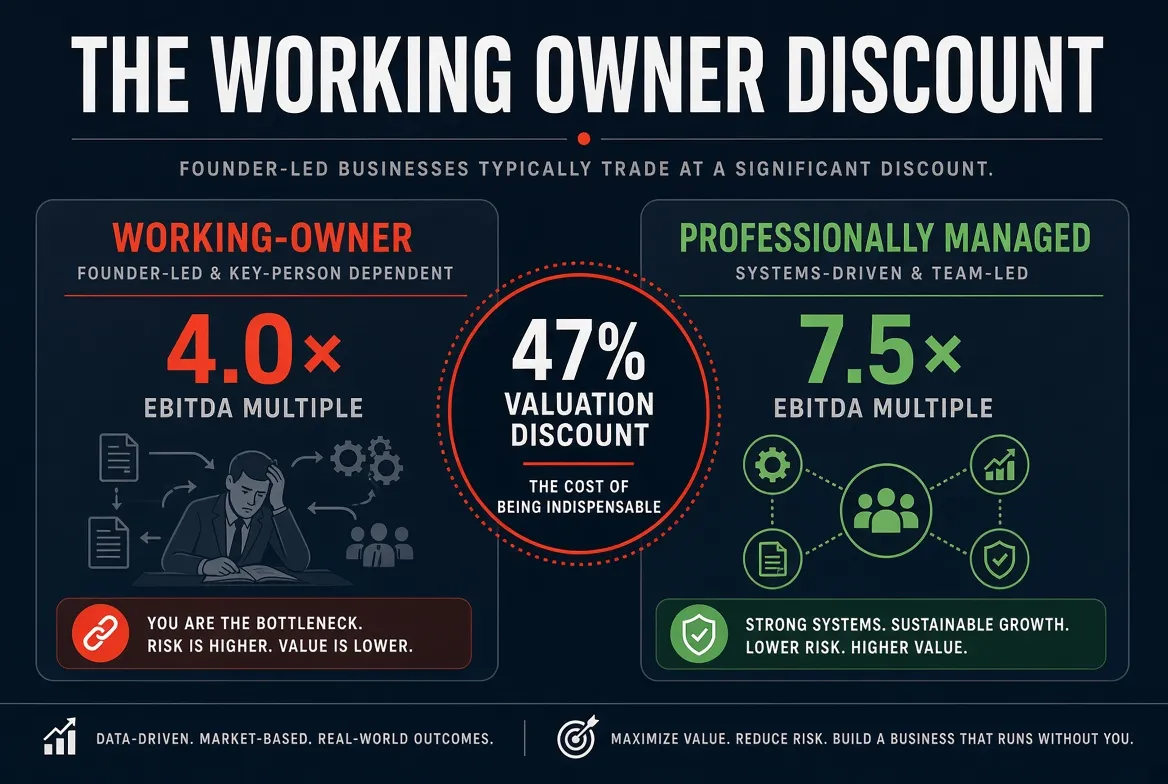
The Working Owner Discount: How Owner Dependency Cuts Valuations by Nearly Half (and the Systems That Close It)
If your company cannot run for 30 days without you, the market already knows. Buyers price that reality as a permanent discount.
Stratford Analytics examined more than 4,700 U.S. manufacturing transactions (DealStats, 2015–2025). Firms still run by a working owner sold at a median 4.0× MVIC/EBITDA. Professionally managed peers cleared 7.5×. That is a 47% gap—the Working Owner Discount.
Median MVIC/Sales was 0.49× versus 0.86×. Median SDE margins were 12.5% versus 20%. Median time to close stretched to 11.3 months versus 7.5 months. The pattern held across cycles. Documented SOPs correlated with roughly 0.25× higher sales multiples. Businesses that had already transitioned real leadership authority closed 27% faster.
A side-by-side case of two similar machine shops (~$8.9 million revenue, ~$1 million normalized EBITDA) illustrates the arithmetic. The owner-dependent shop cleared 5.4×. The professionalized shop cleared 8.5×. Roughly $3 million stayed on the table solely because one still depended on the owner.
While the sample is manufacturing, the mechanism is not. Across lower-middle-market service and founder-led businesses, Stratford estimates the Working-Owner Discount can reduce exit proceeds by 25–40%, and that owners who professionalize can capture valuation premiums of 1–3× EBITDA. The penalty shows up when the founder remains the operating system—through lower multiples, earnouts, longer diligence, or both. For companies in the $1–25 million revenue band with 5–50 employees, this is usually the single largest controllable gap between what an owner believes the business is worth and what a buyer will actually pay.
Why the Discount Exists
Buyers underwrite future cash flow, not past heroics. When continuity risk (tacit knowledge leaves with the owner), customer risk (relationships sit with one person), and scalability risk (growth is capped by the founder’s bandwidth) are all present, the buyer raises the discount rate or simply pays less. The earnings may be identical; the transferability is not.
Three structural risks drive the discount:
Continuity risk. The buyer models the probability that key operational knowledge, decision frameworks, and problem-solving heuristics disappear on day one after close. Without a documented transfer mechanism, that probability is high.
Customer risk. When primary relationships, pricing authority, and exception handling sit with the founder, revenue is partially personal. Post-close attrition risk gets priced in, often through earnouts or lower headline multiples.
Scalability risk. Growth is limited by the owner’s available hours. Buyers discount businesses that cannot expand without adding the founder’s time proportionally.
The discount is steepest under roughly $10 million in revenue, where institutional buyers see the highest key-person concentration. It is addressable precisely because it is structural rather than market-driven.
The Generational Exit Wave Makes Delay Expensive
Exit Planning Institute’s 2025 Generational State of Owner Readiness report (drawing on the 2023 national survey of 1,162 owners) shows 75% of owners plan to exit within ten years—potentially 4.5 million privately held businesses and $14 trillion in wealth.
Readiness is uneven by generation:
Baby Boomers show the lowest formal exit-planning education (~42%) and the lowest completion of pre-transition value enhancement (~22%). More than half plan near-term exits, yet substantial shares lack recent valuations or completed estate plans. Preference leans toward external sales. Personal, financial, and business readiness scores lag the other cohorts.
Generation X reports higher education (~70%) and moderate readiness. They value autonomy and adaptability, yet only about 11% have formed a full formal advisory team. Exit planning ranks as a priority for a majority, but written transition plans remain incomplete for many.
Millennials show the highest education rates (~85%) and strongest self-rated readiness. They favor internal transitions (family, management, ESOP) and “boomerang” sequences—build, exit, reinvest. Even here, formal written action plans and completed value-enhancement projects are not universal. “Too busy” remains the leading stated reason for inaction across all groups.
Education and intention do not close the Working Owner Discount. Systems do. Younger owners who treat exit planning as ongoing strategy still leave value on the table when the operating system lives in the founder’s head. Owners closer to exit who have delayed face compressed timelines and forced outcomes. Across the board, only a small minority have a complete advisory team (financial advisor, attorney, accountant, and value-growth specialist) in place.
The Systems That Remove the Discount
Stratford’s five-part framework maps directly onto the practices that correlate with higher multiples and faster closes:
Genuine second-tier management — Recruit or promote a non-family senior manager with real decision rights over customers, operations, or finance. Cosmetic titles do not count; the authority must be exercised and decisions allowed to differ from the founder’s within defined parameters. This signals maturity and reduces continuity risk.
Documented critical processes — A transfer binder of SOPs covering production or service delivery, quality standards, vendor protocols, customer histories, and decision frameworks. This converts tacit knowledge into institutional assets and is linked to the 0.25× sales-multiple lift. Focus especially on infrequent but high-impact scenarios where institutional memory normally lives only with the owner.
Manager-level performance systems — Visible KPIs (on-time delivery, margin variance, customer retention, scrap or error rates, pipeline conversion) that demonstrate repeatability beyond the founder’s intuition. Data visibility creates accountability that survives the founder’s absence.
Phased leadership transition — Begin transferring responsibilities 12–18 months before any process, with a documented period of independent operation (ideally at least six months of proven results without founder input). Pre-transitioned structures close deals faster and with fewer post-LOI surprises.
Clean financials — Remove personal expenses, owner leases, and family payroll well before marketing so normalized EBITDA is defensible and diligence friction drops. Overlap between personal and business spending is a common diligence red flag that slows deals and reduces normalized earnings.
These are operating-system installations, not advice sessions. For founder-led companies in the $1–25 million range, the practical sequence is diagnose the current dependency cost, design the architecture across people, revenue, and process layers, install standards and scoreboards the team owns, then coach the shift from operator to owner-investor.
What This Means for Operators Who Still Cannot Leave
Most external risks (industry cycles, customer concentration outside the founder, macro conditions) are only partially controllable. Owner dependency is not. The businesses that clear the higher multiple are those in which the team runs the standards, processes are documented and followed, and the founder’s role has already moved from daily operator to owner-investor.
If every escalation, key relationship, and exception still routes through you, the market is already applying the Working Owner Discount. The data is clear on both the size of the gap and the practices that close it. The only variable left is whether the systems get installed early enough for the higher valuation to be proven rather than promised.
Frequently Asked Questions
What is the Working Owner Discount? A valuation penalty buyers apply when the owner remains central to daily operations, customer relationships, and decision-making. In the Stratford Analytics manufacturing sample, median EBITDA multiples were 4.0× for working-owner firms versus 7.5× for professionally managed peers.
How much does owner dependency typically reduce a business’s sale price? In the large manufacturing dataset, roughly 43–47% on key multiples. Stratford Analytics estimates the discount can reduce exit proceeds by 25–40%, and that professionalizing can capture 1–3× EBITDA in valuation premium, plus longer closes and a higher share of deferred consideration.
Can the discount be removed? Yes. Documented processes, genuine management depth with decision rights, and a phased transfer of authority correlate with higher multiples and faster transactions. The changes must be demonstrated, not cosmetic.
Does this apply outside manufacturing? The magnitude varies by industry and size, but the mechanism is consistent: buyers discount continuity and scalability risk whenever the founder is the operating system. Founder-led companies in the $1–25 million range are the most exposed.
How long does it take to eliminate most of the discount? Meaningful reduction typically requires 12–24 months of deliberate professionalization so that independent performance can be shown to buyers.
What is the highest-ROI action for most founder-led companies in this range? Install genuine second-tier management authority and document the critical processes that currently live only in the founder’s head. These two steps address the largest share of continuity and customer risk and show up directly in diligence and multiple discussions.

✓ 5-50 employees
✓ Growth has slowed despite effort
✓ Team relies on you for decisions
✓ You cannot leave for 2 weeks without issues
✓ You want a company that grows without your daily involvement
NOT FOR YOU IF:
✓ Startups
✓ Solopreneurs
✓ Businesses under $1M
✓ Owners looking for motivation
✓ Owners unwilling to implement systems
━ THE ALTERNATIVES
Read this if you're comparing options.
You've read Traction. You've priced a fractional COO.
Here's why founders end up here instead.
Every serious operator shops. Good. Here's the honest comparison.
FRAMEWORK COACHES
(EOS / SCALING UP)
FRACTIONAL COO
NO1 COACHING
WHAT YOU GET
A generic framework and a facilitator. Same playbook for every company.
A rented operator who runs things while they're on the clock.
A custom operating system installed into your company.
WHO DOES THE WORK
You. The coach facilitates meetings; your team runs the install alone.
Them. The work gets done — but the capability leaves when they do.
Us with your team. We install alongside your leaders until it runs without us.
WHAT HAPPENS WHEN IT ENDS
Binders on a shelf. Most installs stall by quarter three.
Dependency moves from you to them. You've rented a bottleneck.
The system stays. Your team runs it. You measure it on the scoreboard.
MEASURED ON
Meeting attendance and rocks completed.
Hours and activity.
Revenue added and owner-dependency removed.
BUILT FOR
Companies that need basic structure.
Companies that need a body.
Founders building a company that grows — and sells — without them.
If a generic framework or a rented executive is what your company needs, use them.
If you need the system installed and owned by your own team, book the call.
━ THE PROBLEM
Why good companies stall
The more your business needs you, the less it's worth.
Buyers don't pay more for founder dependency. They discount it. Every decision, approval, escalation, and client issue routes through one person until growth becomes impossible. Let's move you from Owner-Operator to Owner-Investor. Here's what's actually breaking:

01
Sales Inconsistency
Revenue swings month to month. No repeatable process. Deals close or die based on who's on the call, not how the system runs.
02
Managers who can't manage
Your leadership team holds meetings but not standards. Accountability only works when you're personally in the room.
03
Owner dependency
Every hard decision, every escalation, every big client — all roads lead back to you. You can't take two weeks off without the place wobbling.
04
Team drag
The C players set the pace. Your A players are frustrated. Nobody's clear on what winning actually looks like this quarter.
05
Growth plateau
You've doubled revenue, doubled headcount, doubled chaos — and margins didn't move. Scaling is making things worse, not better.
06
Zero transferability
If you stepped out tomorrow, the business wouldn't run. Which means it isn't worth what you think it's worth — and a buyer would prove it.
━ NUMBERS, NOT NARRATIVE
The scoreboard speaks for itself.
• LIVE CLIENT RESULTS
Updated automatically. No cherry-picked screenshots.
The scoreboard speaks for itself.
Dashboard snapshot captured November 6, 2026: $19.61M total revenue added · 52% revenue growth rate · 1.5x aggregate revenue multiple. See the live dashboard →
━ THE MECHANISM
Four systems. One ecosystem.
Four phases. No guesswork.
Diagnose → Design → Install → Coach. We don't hand you a binder and wish you luck. We install the operating system alongside your team until it runs without us — one ecosystem, four layers.
01 / FRONT DOOR
No1 Coaching
Strategic advisory and transformation oversight — direct work with Jake. The entry point to the stack.
02 / PEOPLE LAYER
Sportify OS
The management and culture OS: scoreboards, standards, and coaching cadence that hold the line when you're not in the room.
RevEngine.ai
03 / REVENUE LAYER
RevEngine.ai: lead generation, a sales process your team runs without you, pipeline visibility and AI automation, installed inside your CRM. Start with the $4,997 Revenue Audit.
04 / VALUE LAYER
ExitOS
Exit readiness and value creation: remove owner dependency, professionalize financials, build a company that sells without you.
━ THE INSTALL
Four phases. No guesswork.
Diagnose. Design. Install. Coach.
Every engagement runs the same four phases — real rollout alongside your leadership, not a framework left on a shelf.
01 / DIAGNOSE
Performance audit across sales, management, ops, financial controls, and owner dependency. Deliverables: Performance Audit, Leverage Map, Gap Analysis.
02 / DESIGN
Engineer the operating model. Deliverables: Operating Model, System Blueprint, Scorecards.
03 / INSTALL
Real rollout alongside leadership. Deliverables: Team Onboarding, Operating Cadence, Automation Stack.
04 / COACH
Ongoing performance coaching. Deliverables: Weekly Cadence, Quarterly Reviews, Standards Enforcement.
━ THE BENCH
Who's in the room with you.
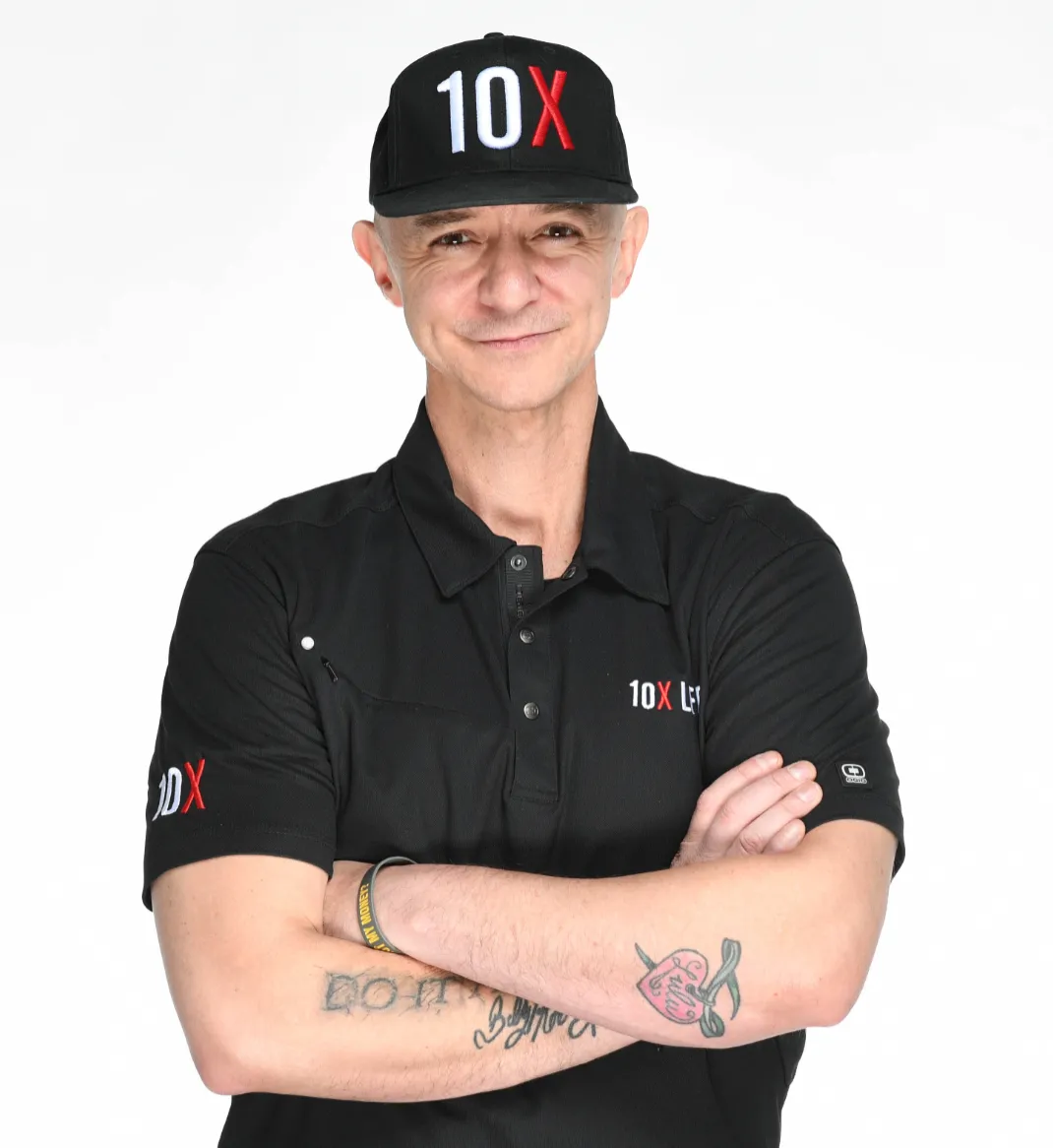
Founder, No1 Coaching
Jake Shannon
STRATEGIC ADVISORY & TRANSFORMATION
Grant Cardone's 10X Performance Coach of the Year, 2024 and 2025. MSc Financial Engineering. Certified Chief Data & AI Officer.
Same systems mindset: diagnose, design, install, coach, until the business runs without you. Grant Cardone's 10X Performance Coach of the Year, 2024 and 2025.
━ THE LIBRARY
The Sportify OS Book Series
The operating model, in print.
Jake Shannon's Sportify OS series goes beyond business coaching. Four books. Four dimensions of the operating system every serious founder needs to install. Read the theory — then install it with Jake.

COACHING
Beyond Business Coaching
The foundation volume. Why traditional coaching fails high-performance operators — and what installing an actual operating system looks like instead.

GAMIFICATION
Beyond Business Gamification
How to build scoreboards, accountability structures, and performance incentives that make your team run like a championship sports franchise.

ETHICS
Beyond Business Ethics
The standard most founders avoid. What real accountability and ethical infrastructure look like inside a company built to last — and built to sell.

AI
Beyond Business AI
How serious operators are integrating AI into their operating model — not as a productivity gimmick, but as a leverage multiplier built into every system.
Available now. Read the series. Then install the system with Jake.
━ HOW ENGAGEMENTS START
Install: Sportify OS, RevEngine.ai, or ExitOS ($25K).
AIVA Year: $75K, for owners with $5M+ in revenue. Twelve months of done-with-you help.
Your $4,997 Revenue Audit fee is credited once toward any install if you sign within 90 days of your audit readout.
What does RevOps mean for a $1M–$10M company?
One pipeline, one sales process, one scoreboard and a CRM that tells the truth, so revenue stops depending on the founder's calendar. Automation goes only where it saves real hours.
Do I have to be selling my business?
No. Predictable revenue, managers who coach and clean numbers raise earnings now and raise the price later. ExitOS is one of three systems, not the entry requirement.
How is this different from EOS or a fractional COO?
EOS gives you a framework to run yourself; a fractional COO runs things while they're on the clock. We install the system with your team and measure it on revenue added.
Where do I start?
A free 30-minute strategy call, then the $4,997 three-week Revenue Audit, then the install the audit points to. The audit fee is credited once toward any install if you sign within 90 days of your readout.
How big does my company need to be?
Founder-led, $1M–$10M in revenue, 5–50 employees.
━ TAKE THE NEXT STEP
Start with a Strategy Call. Install what the call shows.
30 minutes with Jake directly. Structured. Honest. We diagnose where your operating model is bleeding revenue, leaking performance, or capping enterprise value — and tell you the installation sequence that fixes it. If we're a fit, we tell you how to start. If we're not, we tell you that too.
CALL DURATION
30 minutes • Structured
DELIVERABLE
Performance & Leverage Map
INTAKE
Limited, by application.
LED BY
Jake Shannon, Founder

Contact Us
5610 Ward Road #300
Founder of No1 Coaching. Systems that let your business run without you.


