Elon Musk Says We’re Probably in a Simulation. Here’s How Operators Actually Win It.
Four recent conversations with Musk, SpaceX insiders, and a DOGE veteran reveal the same operating rules: create more value than you extract, remove every bottleneck with urgency, and install systems that compound without you.
November 15, 2026
Elon Musk was asked, point-blank, whether he thinks we live in a simulation. His answer: “Probably pretty high.”
The odds, he argued to Nikhil Kamath, come from the speed of progress. Fifty years ago games were Pong. Today they are photorealistic multiplayer worlds. If that trajectory continues, base reality becomes the less likely option. Boring simulations get shut down. Interesting ones survive.
Most founders hear “simulation” and tune out. Operators should hear a clear set of rules for building a company that is worth more when you are not in the room.
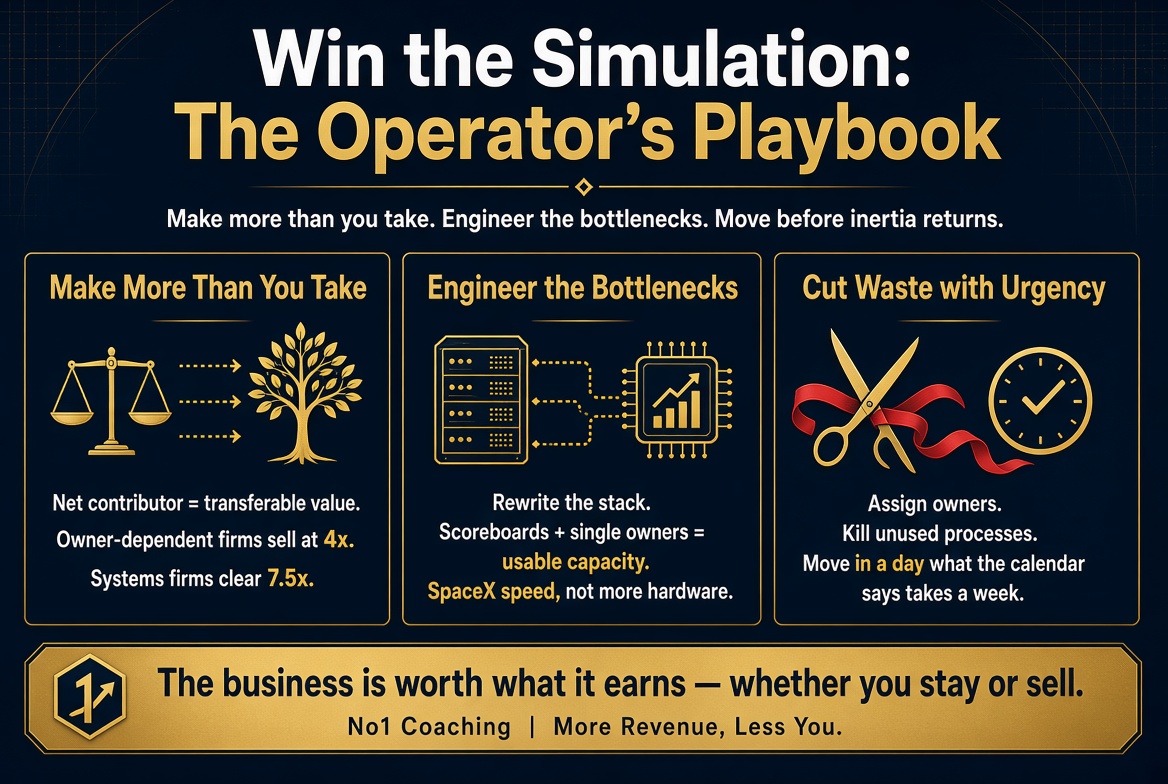
Across four recent videos—Musk on the simulation, two deep dives on SpaceX’s AI and data-center strategy, and an insider account of DOGE—the same pattern appears. The people who win do three things:
- They create more value than they take.
- They treat bottlenecks as engineering problems, not personality problems.
- They move with urgency before inertia reclaims the system.
That is the operating system for founder-led companies between $1M and $25M that want to be worth what they earn, whether the founder stays or sells.
The Rules of the Game: Make More Than You Take
In the simulation conversation, Musk is blunt. Money is only the score—an information system that allocates labor. Civilizations that murder indiscriminately fail. The practical rule is simple: be a net contributor. Make more than you take.
For a founder, this is not a motivational poster. It is a valuation question.
If your company only produces revenue when you are on the call, in the room, or making the exception, you are extracting. The business has no independent capacity to create value. Buyers see this immediately. In one study of manufacturing deals (Stratford Analytics, DealStats 2015–2025), owner-dependent firms sold at a median 4.0× EBITDA. Professionally managed peers cleared 7.5×. The difference is the Working Owner Discount.
Musk’s second observation is that interesting simulations survive. In a business, “interesting” means the company keeps generating value after the founder steps back. The systems—revenue gates, role scoreboards, decision rights, financial clarity—are what make the enterprise more interesting than the founder’s personal heroics.
A curious AI, Musk said, would find humanity more interesting than not. A curious buyer or manager finds a company with installed systems more interesting than one that only works when the owner is present. Truth, beauty, and curiosity are his three AI values. For operators they translate to: accurate numbers, elegant processes, and continuous improvement that does not require the founder’s attention.
The Bottleneck Reality: SpaceX’s Edge Is Engineering, Not Hype
Two recent Farzad videos show how SpaceX is positioned to become the most profitable company on earth precisely because everyone else is stuck.
AI demand has exploded. Agents now drive the majority of token consumption on open platforms—up 37× in months. Corporate AI spend has jumped fivefold. Yet data-center vacancy is 1.4%. Power interconnection waits run 4–15 years. Local opposition has delayed or canceled dozens of projects. Wholesale GPU lease rates have risen 66–106% even as retail prices fell.
SpaceX’s response is vertical integration and software-level efficiency. After acquiring xAI, the company discarded existing AI frameworks and reportedly rebuilt Grok’s reinforcement learning and inference stack in C and C++ using code originally written for Starlink satellites. The goal is not more hardware. It is more usable compute from the hardware already paid for. Custom packet handling, precise timing (including leap seconds), and direct memory control reportedly remove the waste that normally consumes more than half of chip power.
They are also building capacity at rocket speed. Colossus data centers went from dirt to operational in 91–122 days using on-site generation and batteries. Capacity has tripled. Plans call for 13–20 GW by the end of 2027—work that took hyperscalers twenty years, compressed into eighteen months. Dual monetization follows: lease scarce GPUs to Anthropic, Google, and others at fixed monthly rates while running their own models at far lower internal cost.
The operator parallel is exact.
Most $1M–$10M companies are not limited by capital or talent. They are limited by founder attention, unclear ownership, slow decision cycles, and process debt. The “power grid” is the founder. The “vacancy rate” is the percentage of work that waits for one person. The fix is the same: rewrite the stack.
- Map every revenue-touching process and assign a single owner.
- Install scoreboards with one outcome number and two activity numbers per role so managers can make the call without you.
- Remove the middlemen—status meetings, exception queues, founder-only pricing—so work moves at the speed of the system, not the speed of the bottleneck.
SpaceX did not wait for the grid. They brought their own power. Operators who want the company to run without them do not wait for better people. They install the operating system that makes ordinary people effective.
Cut the Waste Before Inertia Returns: Lessons from DOGE
The fourth video is an interview with Tyler Hassen, a former DOGE staffer who spent nearly six months inside the Department of the Interior. The public narrative is that DOGE failed. Hassen’s account is more useful for operators: the waste was real, the speed mattered, and the personal cost was high.
Examples from Interior:
- Fifty HR offices for 65,000 employees.
- Eighteen chief information officers producing nineteen disconnected permitting systems, a $1.2 billion spend, and a 160,000-permit backlog averaging four years.
- An $830 million (five-year) customer-satisfaction survey contract that had not yet launched; earlier spending of $100–200 million produced unused Excel and Word surveys.
Hassen’s method was operational, not rhetorical. He emailed every contract officer and asked what was mission-critical. He reviewed contracts line by line with the Secretary on weekends. He required personal approval above $50,000 so new waste could not start. The culture he imported was Musk’s: do in a day what the calendar said would take a week.
Most of the headcount reductions were voluntary deferred resignations—paying people not to work while the organization restructured. The point was not cruelty. It was that the system had no clear owners and no urgency.
Founder-led companies have their own Interior Departments. The unused survey is the CRM no one updates. The eighteen CIOs are the six people who can all “approve” a discount. The four-year permit is the deal that dies because no one owns the next step. The personal cost shows up as the founder who cannot take a vacation without revenue dropping.
The operator move is the same one Hassen used: assign single owners, kill the contracts and processes that do not serve the mission, and move before the organization reasserts its old rhythm. Systems installed with urgency protect the team later. Systems deferred protect nothing.
What Winning Actually Looks Like
Musk’s simulation rules, SpaceX’s engineering response to scarcity, and DOGE’s speed against waste converge on one outcome: a company that creates value independently of its founder.
That is the definition of winning the game for a $1M–$25M operator.
- Revenue continues when you are not on the call (revenue gates and stage definitions).
- Managers make decisions from visible scoreboards instead of waiting for you.
- Financials and processes are clear enough that a buyer, a key manager, or an AI system can understand them in minutes.
- The business is more interesting—and more valuable—than your personal involvement.
This is not a motivational claim. It is the difference between a job that pays well and an enterprise that compounds. The Working Owner Discount is real. The data-center bottleneck is real. The unused $830 million survey is real. The operators who treat these as engineering problems and install the systems that remove them are the ones who keep the simulation running after they step away.
If your company still waits for you, the next move is not more effort. It is a precise diagnosis of where the work is stuck and a sequenced plan to install the gates, scoreboards, and cadence that let it move without you.
That is how you make more than you take. That is how the business becomes worth what it earns.
Sources
- Elon Musk: How to Win the Simulation (Andres Reibel / Nikhil Kamath interview) — youtu.be/-ltJCgb3mAk
- Elon’s Insane Super Intelligence Plan (Farzad) — youtu.be/58f_MQSKYBU
- Everyone Has Underestimated SpaceX (Farzad) — youtu.be/Vurp9tJuECE
- Everyone Says DOGE Failed. An Insider Says You Got the Story Wrong (Rob Montz / Tyler Hassen) — youtu.be/-Vb_nnsZ6Cw
Jake Shannon is Grant Cardone’s multi-time 10X Performance Coach of the Year and the founder of No1 Coaching. He installs operating systems that let founder-led companies run—and sell—without the founder in every chair.
