
The Margin Architecture
Strategic Pricing, Operational Leverage, and Capital Preservation
The Volume Trap and Operational Fragility in Scaling Companies
In founder-led enterprises scaling between $1 million and $25 million in annual revenue, top-line sales expansion is frequently conflated with commercial health and enterprise durability. When market friction intensifies or quarterly sales targets face headwinds, executive leadership teams routinely resort to price concessions as an immediate tactical mechanism to secure volume. This commercial impulse stems from a foundational misunderstanding of operating leverage: the assumption that unit volume expansion will naturally compensate for compressed profit margins. In operational reality, chasing top-line billing revenue through aggressive price discounting introduces systemic inefficiencies that degrade balance sheets, exhaust working capital, and constrain organizational enterprise value.
Accelerating transaction volume at lower unit pricing fundamentally alters the cost structure of the enterprise. While gross margins contract immediately upon granting a price concession, the operatioInal demands of order execution do not diminish; rather, they scale in direct proportion to physical unit output and account volume. Higher transaction velocity increases administrative overhead, strains supply chain logistics, accelerates production wear, and triggers exponential surges in customer support ticketing. Because post-sale fulfillment, account governance, and quality management require dedicated labor hours, discounting forces the business to expand operational headcount merely to service low-yield revenue.
This structural misalignment initiates a cycle of operational firefighting. As capacity becomes saturated by low-margin volume, delivery schedules slip, error rates in fulfillment rise, and employee fatigue sets in across key operational units. In founder-dependent organizations, customer escalations and operational exceptions inevitably route directly back to senior leadership, consuming executive bandwidth that should be deployed toward strategic positioning and systems architecture. The resulting dynamic produces an illusion of expansion—characterized by bustling facilities, rising headcount, and expanding top-line billings—while the enterprise becomes financially fragile, cash-depleted, and structurally exposed to the slightest market contraction.
The Mathematical Leverage of Price Optimization
The financial leverage inherent in pricing decisions represents one of the most thoroughly documented principles in financial engineering, yet it remains one of the least utilized levers among middle-market operators. Foundational corporate performance research conducted by McKinsey & Company across the Global 1200 demonstrates that strategic pricing exerts roughly four times the leverage on operating profit compared to operational cost reduction.
Holding sales volume constant, an average price improvement of just 1% generates an 11.1% expansion in operating profit. By comparison, an identical 1% improvement across other standard management levers yields substantially weaker profit gains: variable cost reductions generate a 7.3% profit increase, sales volume expansion produces a 3.7% lift, and fixed overhead reductions yield merely a 2.7% gain.
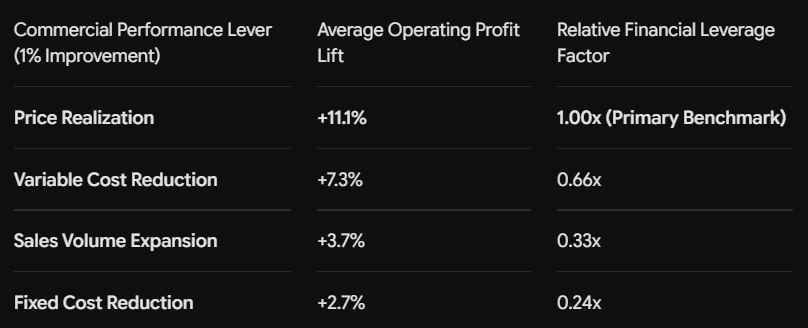
The underlying mechanism driving this leverage differential is structural: incremental price realization incurs zero additional cost of goods sold (COGS) and requires zero operating expenditure additions. Every marginal dollar gained through price realization falls directly to the net operating margin. Conversely, attempting to expand net earnings through sales volume requires absorbing proportional variable production costs, customer acquisition expenses, and administrative overhead.
When an organization concedes discounts, this mathematical relationship operates in reverse with destructive asymmetry. The percentage increase in sales volume (\Delta V) required to preserve absolute gross profit following a price discount is defined by the formula:
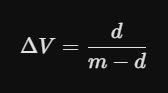
Where d represents the fractional price discount applied to the initial selling price, and m represents the enterprise's baseline gross profit margin percentage prior to discounting.
Evaluating this equation across typical commercial margins exposes the severe operational burden created by even modest price concessions. Consider an organization operating at a 30% baseline gross margin that grants a 10% price discount to secure a commercial contract. Substituting these values into the break-even volume formula yields:

The commercial team must increase unit sales volume by exactly 50% simply to maintain the identical gross profit dollars achieved prior to the discount. If an enterprise operating at a 40% gross margin concedes a 20% discount, the required unit volume surge reaches 100%:

Under this scenario, the organization must double its operational throughput, double its physical packaging, and double its shipping velocity merely to remain economically flat. Similarly, for a company maintaining a 31.3% baseline gross margin, conceding a seemingly negligible 5% discount demands an immediate 19.0% surge in unit sales volume to prevent gross profit erosion:

Calculated Break-Even Volume Requirements
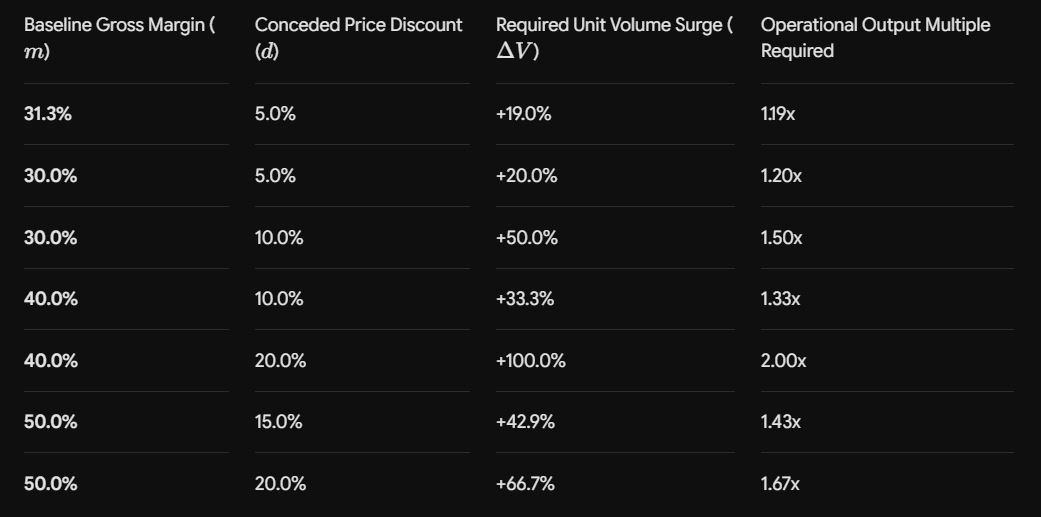
To produce and deliver a 50% to 100% surge in volume, an operating business must commit working capital to purchase raw materials, expand warehouse footprint, run overtime shifts, or onboard additional labor. The enterprise assumes severe operational risk and drains liquidity to achieve zero economic expansion. Chasing top-line revenue through margin discounting is an operational treadmill that accelerates founder exhaustion while eroding the firm's balance sheet.
Procurement Behavior and the Fallacy of Price Primacy
Commercial sales teams routinely justify price discounting by asserting that enterprise buyers make decisions based strictly on cost. However, empirical procurement research published in the Harvard Business Review and cross-industry buyer studies indicates that pure price-driven purchasers constitute a distinct minority in commercial transactions. Approximately 15% of business buyers base purchasing decisions strictly on the lowest quoted unit price. The remaining 85% prioritize operational reliability, fulfillment consistency, technical responsiveness, and institutional trust.
Corporate procurement professionals frequently use aggressive pricing challenges as a standard negotiation tactic. When a vendor's commercial representatives lack value articulation capabilities, they misinterpret standard procurement positioning as absolute price sensitivity and immediately collapse their pricing structure. In enterprise environments, corporate buyers are judged not merely on short-term purchasing cost, but on risk containment and operational continuity. A supply failure, delayed delivery, defective input, or failed implementation threatens internal operations, damaging the buyer's professional standing far more than a nominal price savings could justify.
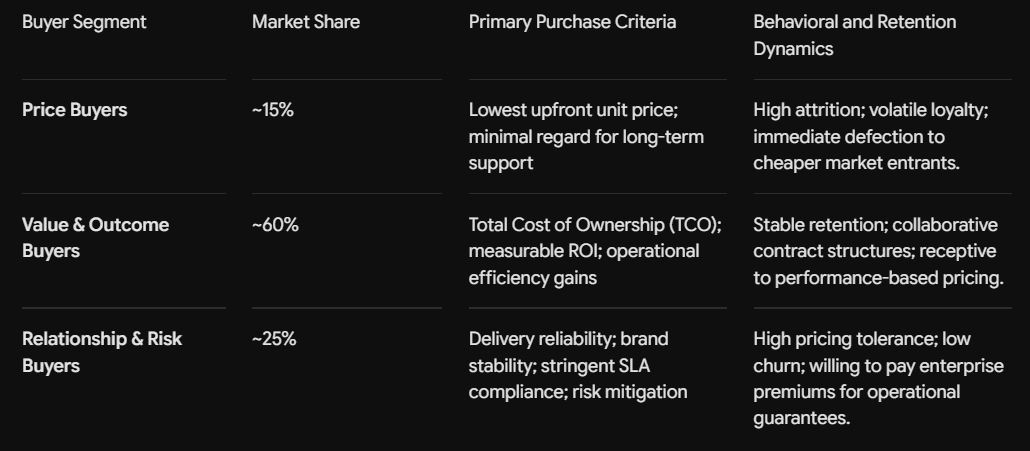
When a company relies on discounting as its primary sales strategy, it inadvertently filters out the 85% of high-value, risk-sensitive clients and populates its ledger with the 15% transactional buyer segment. These transactional accounts exhibit the highest churn rates, generate continuous delivery friction, demand extensive custom concessions, and abandon the supplier the moment an alternative vendor offers a lower bid. Competing strictly on price attracts the market's least profitable clients while creating structural churn that prevents sustainable compounding.
Whale Curve Economics and Ledger Subsidization
The hidden cost of tactical price cutting becomes evident when analyzing client ledgers through the lens of Activity-Based Costing (ABC). Research pioneered by Harvard Business School professors Robert S. Kaplan and V.G. Narayanan demonstrates that corporate profitability distributions do not follow standard Pareto distributions, but instead manifest as a "Whale Curve".
In a standard enterprise client ledger, cumulative profitability peaks far above reported net profits. The top 20% of high-margin accounts generate between 150% and 300% of the organization's entire net profit. The middle 60% of accounts contribute marginal economic value, largely breaking even by covering direct costs and allocated baseline overhead. Meanwhile, the bottom 20% of accounts actively destroy between 50% and 200% of total reported profit, dragging the firm's cumulative performance down to its final reported figures.
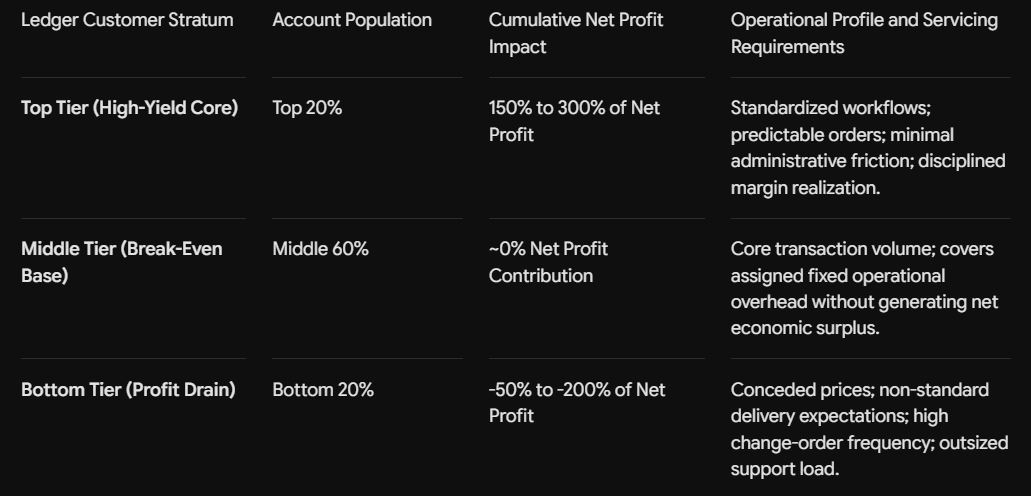
This structural profit erosion occurs because discounted clients rarely maintain low-touch operational profiles. Price-sensitive accounts frequently request specialized fulfillment accommodations, trigger emergency change orders, delay accounts payable payments, and consume extensive customer success resources. Standard financial reporting masks this drain by applying aggregate overhead averages across all revenue lines. When fully loaded activity costs are traced to individual accounts, leadership discovers that its most reliable, full-margin clients are directly subsidizing the operational friction generated by deeply discounted accounts.
Conducting an annual customer margin audit across the account ledger allows executive teams to separate nominal billing revenue from true net gross margin contribution. Identifying and addressing the bottom 20% of profit-destroying accounts—either by transitioning them to standardized non-negotiable service tiers, instituting necessary price increases, or offboarding them entirely—releases constrained capacity and improves bottom-line profitability without requiring new sales acquisitions.
Structural Alternatives: Tiered Packaging, Risk Reversal, and Margin Governance
To eliminate reliance on transactional discounting, organizations must install commercial systems that defend price integrity, satisfy diverse buyer requirements, and insulate profit margins. This operational transformation relies on three foundational mechanisms: structured value bundling, risk-reversal sales communication, and margin-aligned governance protocols.
Tiered Value Bundling and Good-Better-Best Architecture
Rather than conceding across-the-board discounts during sales negotiations, commercial organizations should deploy structured tiered packaging frameworks, such as the Good-Better-Best (GBB) architecture. Behavioral pricing research indicates that when enterprise buyers are presented with clearly differentiated value tiers, approximately 35% of premium B2B purchasers readily select the higher-tier bundled option.
Structured tiering alters the underlying buyer psychology. A single, unbundled quote prompts a binary purchasing evaluation focused on cost: whether the quoted price is acceptable or warrants a discount request. In contrast, presenting a three-tier structure shifts the commercial interaction into an evaluation of capability: the buyer assesses which operational level matches their strategic priorities and risk tolerance.
To protect headline price realization, organizations can bundle high-perceived-value services that incur minimal marginal delivery costs. These components may include dedicated technical account management, guaranteed delivery windows, extended warranty terms, customized batch staging, or accelerated service-level turnaround times. By placing these operational enhancements behind clear value boundaries, the business extracts full economic value from premium, risk-averse buyers while establishing a firm price floor that safeguards standard offerings against price degradation.
Risk Reversal Over Price Concessions
Sales representatives frequently resort to discounting because they mistake buyer risk aversion for price resistance. In enterprise environments, price pushback is rarely about the absolute capital outlay; it is an expression of perceived operational and financial risk.
Commercial teams must be trained to shift client interactions from raw technical specifications or generic rates toward quantified economic outcomes. Effective value communication translates operational capabilities into tangible financial impacts, including direct operational expense reduction, revenue acceleration, supply-chain risk abatement, and working capital cycle compression.
When prospective buyers challenge pricing parameters, commercial teams should counter with risk-reversal mechanisms rather than price concessions. Deploying verified client case studies, auditable performance track records, transparent delivery timelines, and binding quality-performance guarantees neutralizes buyer risk without sacrificing margin. By removing execution risk from the transaction, the enterprise eliminates the primary driver of price resistance while reinforcing its position as a premium, reliable partner.
Margin-Aligned Governance and Incentive Architecture
Commercial sales teams will continue to offer price concessions as long as incentive structures reward aggregate top-line revenue rather than net margin generation. Because discounting accelerates deal closure, revenue-based commission models incentivize sales representatives to trade the firm's long-term operating profitability for immediate contract signings, shifting delivery friction entirely onto the operations team.
Aligning sales compensation with realized gross margin dollars establishes an operational defense against indiscriminate discounting. When commission payouts are tied directly to gross margin contribution, sales representatives bear financial accountability for price concessions, encouraging them to defend price integrity throughout negotiations.
Furthermore, executive leadership must establish formal discounting governance within the customer relationship management (CRM) architecture. Implementing automated approval gates—where minor price adjustments require commercial director sign-off and deeper exceptions require executive committee authorization—introduces necessary institutional friction, ensuring price concessions are governed by strategic policy rather than individual rep discretion.
Commercial Strategy Comparison
Commercial Strategy Dimension | Transactional Discounting Approach | Structured Margin Architecture Approach |
Primary Commercial Objective | Maximizing gross top-line billings and short-term transaction velocity | Maximizing realized gross margin dollars and durable enterprise EBITDA |
Response to Price Resistance | Immediate across-the-board percentage reductions on core offerings | Deployment of risk guarantees, auditable SLAs, and economic value frameworks |
Packaging Architecture | Monolithic offer structure with ad-hoc line-item concessions | Structured Good-Better-Best tiering incorporating high-value service add-ons |
Client Portfolio Management | Unaudited account ledger; accumulation of low-margin, high-touch accounts | Annual margin audits; systematic repricing or offboarding of the bottom 20% |
Sales Force Incentives | Commission calculated purely on gross top-line transaction volume | Commission tied directly to realized gross margin contribution |
Operational and Capital Impact | Fulfillment bottlenecks, working capital depletion, severe founder dependency | Balanced capacity utilization, protected working capital, transferable enterprise value |
Structural comparison between transactional volume chasing and disciplined margin architecture.
Operational Roadmap for Strategic Margin Protection
Transitioning an enterprise from reactive price discounting to disciplined margin architecture requires installing systemic commercial operational routines. Rather than treating pricing as an ad-hoc negotiation tactic, executive leadership must implement a structured, multi-phase operational roadmap to build lasting pricing power into the business model.
The transformation begins with an Activity-Based Costing margin audit across the preceding twelve months of account data. Fully loaded servicing expenses—including administrative hours, engineering modifications, non-standard logistics, and post-sale technical support—must be allocated to individual customer ledgers. Plotting cumulative net operating profit against ranked customer accounts constructs the corporate Whale Curve, isolating the firm's peak cumulative earnings and identifying the specific 20% of client accounts that actively consume capital.
With portfolio profitability clearly mapped, the leadership team restructures monolithic offerings into a formalized Good-Better-Best packaging model. Foundational product capabilities are maintained in the entry tier, while high-value operational services—such as priority delivery queues, dedicated account management, and extended warranties—are packaged into premium tiers. Simultaneously, formal discount governance rules must be integrated into the CRM platform, establishing clear authorization thresholds to eliminate unauthorized field discounting.
The commercial sales engine must then be realigned around margin defense. Sales compensation structures should be decoupled from gross revenue and tied directly to gross margin contribution. Commercial representatives must be trained to identify the 85% of risk-averse buyers, articulate quantified return on investment, and address client hesitation using verified case studies and operational guarantees rather than price reductions.
Finally, the organization must systematically rationalize its legacy account ledger. The bottom 20% of profit-destroying accounts must be transitioned to standardized, high-margin service tiers, subjected to necessary price increases, or systematically offboarded. Removing margin-destroying accounts releases constrained operational capacity, stabilizes fulfillment workflows, and refocuses organizational resources on serving and expanding relationships with high-margin enterprise clients.
Cultivating Enduring Enterprise Value
Competing on low price represents an unsustainable commercial strategy. As demonstrated by empirical economic research, a 1% price improvement drives roughly four times the operating profit impact of cost reductions, whereas conceding minor discounts demands massive volume surges merely to preserve baseline profitability. For founder-led middle-market enterprises, unmanaged price concessions deplete working capital, overburden operational teams, and erode organizational value.
Enterprise durability is built on premium positioning, disciplined margin protection, and consistent operational execution. By identifying the 85% of commercial buyers who prioritize operational reliability over lowest cost, disaggregating offers into tiered value bundles, and realigning sales incentives around gross margin contribution, organizations build resilience against economic volatility. Defending margin architecture protects the enterprise's financial health, eliminates founder-dependent firefighting, and establishes the foundational operating systems required to scale enterprise value profitably over the long term.
