
The Frequency of Nurturing for Dominance in the Age of AI
Why Your High-Ticket Sales Funnel Is Dead (And What to Do About It)
Let’s be completely direct: the traditional, linear sales funnel is dead.
If your high-ticket revenue strategy relies on driving a cold stranger to a booking link, getting them on a discovery call, and expecting your closers to do 100% of the heavy lifting, you are playing a losing game. The market has mutated. The gap between a prospect realizing they have a problem and actually signing a contract has widened into a massive trust chasm, and most businesses are falling straight into it.
The good news? The data tells us exactly how the game is being won right now. The bad news? If you don’t adapt your ecosystem immediately, your competitors are locking you out of deals before you even know the prospect exists.
The New Reality of High-Ticket Touchpoints
For years, digital marketing operated on the classic "7-11-4 Rule" (7 hours of content, 11 touchpoints, 4 locations to build trust). It was a beautiful, clean framework.
Today, that number looks like ancient history. Thanks to massive content saturation, algorithmic noise, and AI-driven market research, a buyer’s attention is profoundly fragmented.
Data from enterprise tracking firms like HockeyStack and 6sense shows that full-journey touchpoints—the total number of digital impressions, content views, web visits, and interactions a buying group makes before closing—have exploded.
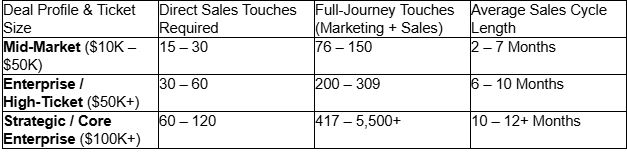
Look at those numbers. For a true high-ticket or enterprise deal, a buying committee is racking up hundreds of touchpoints before pulling the trigger.
If you think a 3-part email sequence and a PDF lead magnet are going to build absolute certainty in a buyer’s mind, it’s time for a reality check.
The "Day-One Shortlist" Locked Door
The most critical shift in modern B2B and high-ticket buying behavior isn’t just how many touchpoints are happening—it’s when they are happening.
Buyers are intentionally locking sales teams out of the early research phase. They are self-educating in the shadows, using large language models, anonymous content consumption, and private networks to evaluate solutions before they ever talk to a live human being.
The data surrounding this shift is staggering:
94% of buying groups create and rank their vendor shortlist before they ever initiate contact with a sales rep.
95% of the time, the company that ultimately wins the deal was already on that initial "Day One" shortlist.
The vendor ranked #1 on Day One wins the business 80% of the time.
The Brutal Truth: If your digital footprint isn't actively selling for you 24/7 in the background, you are eliminated from 95% of your market’s buying cycles before the first conversation even begins.
The 3-Step Blueprint to Own the Shortlist
To dominate a high-ticket space today, you have to stop treating sales and marketing as separate departments. Your entire digital ecosystem must be engineered to project absolute certainty and command authority automatically.
Here is how you position your brand at the absolute top of the Day-One Shortlist.
1. Build a "Binge-Portfolio" of Digital Assets
Because human memory decays rapidly, a prospect needs to encounter your frameworks frequently within a compressed timeframe to cross the trust threshold. You must build low-cost, high-leverage digital assets—comprehensive video libraries, published books, proprietary frameworks, and deep-dive case studies.
When an interested buyer finds you, they shouldn't just see a landing page; they should stumble into an ecosystem that allows them to spend hours deep in your world, consuming your philosophy on their own terms.
2. Speak the Language of Opportunity
Money does not move toward your passion, your credentials, or your requests. Money moves toward the clear articulation of opportunity for the person putting the money in.
Every asset, video, and piece of sales collateral you own must focus on revenue velocity, asset creation, and predictable outcomes. Structure your offers with flawless clarity so that the ROI is mathematically undeniable.
3. Attack the Multi-Channel Matrix
Modern buyers do not live in a single linear funnel. They bounce between scrolling on social feeds, searching on Google, streaming video content, and reading documentation.
Your frameworks must be distributed across a matrix of at least 4 to 5 distinct channels simultaneously. When you appear across multiple environments, the buyer’s brain registers your brand as a market leader, drastically cutting down the time it takes to build absolute certainty
The game hasn't gotten harder; it has simply gotten more sophisticated. The winners today are the ones who stop hiding in the shadows, stop waiting for permission, and build a digital asset engine that commands attention, enforces alignment, and closes the deal before the phone even rings.
