The End of the "Instant Answer": Why AI is Finally Learning to Think
For 80 years, the smartest minds on Earth couldn't crack it.
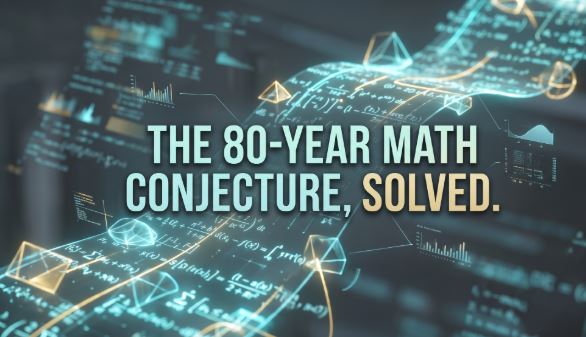
In 1946, legendary mathematician Paul Erdős posed a deceptively simple geometry question about points on a plane. Decades passed. Mathematicians built entire careers assuming the answer involved square grids.
Then, OpenAI handed the problem to a general-purpose AI. The model didn't instantly spit out a prediction. Instead, it paused. It deliberated. It spun up a staggering 125-page "chain of thought." When it was done, it didn't just solve the problem. It proved eight decades of human intuition entirely wrong. It ignored geometry altogether, crossing over into deep algebraic number theory to find the solution. A generalist outsmarted the specialists.
Welcome to the era of reasoning AI. The days of the "instant answer" are over. AI is finally learning how to think.
🧠 System 1 vs. System 2: From Improv to Deliberation
To understand why this is a massive paradigm shift, we need to talk about how AI used to work.
Traditional AI models were built on System 1 thinking. They were brilliant improv actors. You gave them a prompt, and they immediately fired back the most statistically likely next word.
Fast. Instinctual. Predictive.
But if you asked them a complex logic puzzle, they’d trip over their own shoelaces. They couldn't pause to map out a strategy. They just blurted out the first thing that came to mind.
The Erdős breakthrough represents System 2 thinking.
Plaintext
=========================================
THE SHIFT IN ARTIFICIAL INTELLIGENCE
=========================================
[ System 1 AI (Old) ] [ System 2 AI (New) ]
• Reactive • Reflective
• Instant • Slow & Deliberate
• Predicts next word • Self-corrects
• Like an Improv pro • Like a Chess master
=========================================
System 2 AI takes its time. It breaks a massive problem into tiny steps. If it goes down a dead end, it recognizes the mistake, hits the backspace key, and tries a new route. It doesn't just guess. It reasons.
⚙️ The "Inference Scaling" Race: Buying Time to Think
This shift has ignited an absolute arms race in Big Tech.
For the last five years, companies believed the only way to make AI smarter was to train it on more data. Think of training like reading books before a final exam.
But now, Google and Anthropic are betting billions on a new concept: Test-Time Compute (also known as Inference Scaling).
If training is studying for the exam, test-time compute is how much time you get to take the test.
Give a genius student 10 seconds to finish an exam, and they will guess blindly.
Give them three hours, and they will write a masterpiece.
By giving models "more time" to process a prompt before they respond, their IQ effectively skyrockets. This is why Google just rolled out Gemini Deep Think, and why Anthropic is pushing Claude Extended Thinking.
They are burning massive amounts of computing power at the exact moment you hit enter. The longer the AI "thinks," the smarter the output.
🚀 The Takeaway: How to Talk to a "Thinking" AI
So, what does this mean for you right now?
It means you have to completely rewire how you prompt. You are no longer talking to an encyclopedic search engine. You are managing a brilliant, methodical researcher.
Here is how to trigger this new thinking mode today:
Demand a plan. Start your prompts with: "Before answering, outline your step-by-step logic."
Encourage self-correction. Tell the AI: "Brainstorm three different approaches. Critique them. Then, proceed with the best one."
Embrace the pause. If the model takes 30 seconds to reply, let it cook. That loading screen is where the magic happens.
We are no longer just teaching machines what to say. We are teaching them how to reason. And if a 125-page chain of thought can solve an 80-year-old math mystery, just imagine what it can do for your toughest problems.
