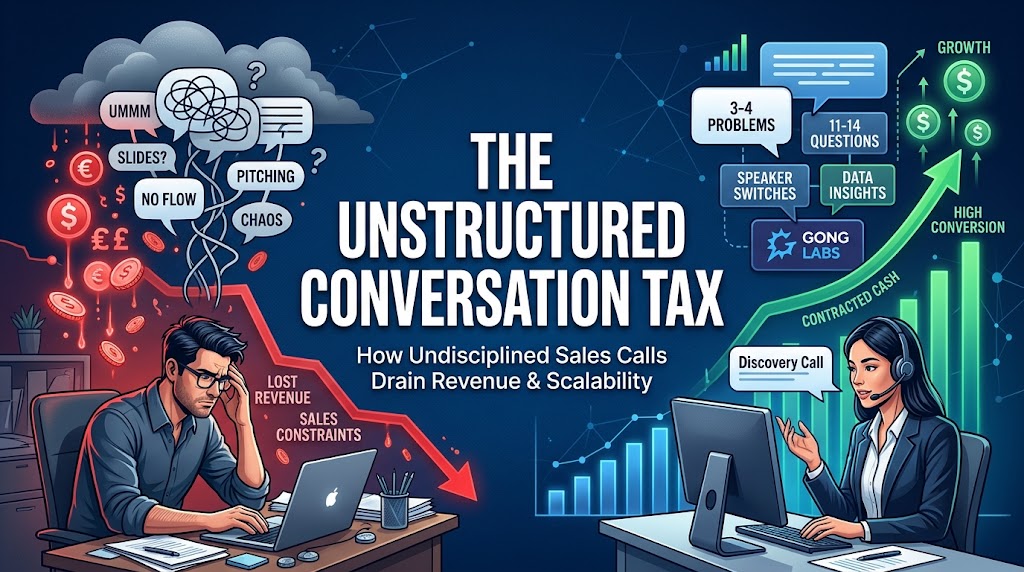
The Conversation Architecture of Revenue
The Unstructured Conversation Tax
Revenue in founder-led enterprises is rarely constrained by addressable market. It is constrained by the quality of the conversations that convert interest into contracted cash.
Most $1 million to $25 million organizations treat the sales call as craft. A charismatic closer is hired. A list of “good questions” is circulated. Discovery is declared complete when the calendar slot expires. Pipeline reviews then debate product, price, and “fit,” while the actual mechanism of conversion — the recorded, measurable conversation — remains ungoverned.
That is not a sales problem. It is an operating-system problem.
Gong Labs has spent a decade converting anonymized B2B conversations into statistical distributions. The corpus now spans from the original 25,537-call cohort in 2016 to 300 million cold calls in 2024, 1.8 million opportunities in 2025, and 7.1 million opportunities in the 2026 State of Revenue AI report. The findings are not motivational. They are architectural. They specify the load-bearing dimensions of a revenue conversation: how many problems to open, how many questions to ask, how talk time should behave under win and loss conditions, when price should enter the room, what happens when a slide deck replaces a question, and why a single-threaded deal over $50,000 is a structural defect rather than a personality issue.
This article installs those findings as an operating standard for founder-led commercial organizations. It is not a recitation of “sales tips.” It is a specification.
A methodological note is required before the specification. Gong Labs research is observational. It is drawn from Gong’s own customer base, correlated against CRM outcomes, and is not a randomized controlled trial. Correlation is not causation. The correct use of the data is as a constraint set — a set of ranges inside which high-performing conversations statistically cluster — not as a script that manufactures closed-won deals by arithmetic. Organizations that treat the numbers as commandments will interrogate buyers. Organizations that treat them as design tolerances will build a conversation system the team can run without the founder in the room.
Layer 01 — Discovery Architecture
The 519,291-call specification (2017)
The canonical discovery study remains Gong Labs’ analysis of 519,000-plus recorded B2B discovery calls — cited in primary sources as 519,291 conversations. Calls were captured on web-conferencing platforms, transcribed, and processed with unsupervised machine learning for topic detection.
Four load-bearing findings survive every subsequent recap:
1. Open three to four business problems. Not two. Not seven.
Topic-detection models showed that the highest probability of advancing a deal to a firm next step clustered on calls that went deep on three or four discrete business problems. Fewer than three typically failed to generate sufficient organizational pain. More than four fragmented priority. The buyer left with a list, not a decision.
This is a governance rule, not a suggestion. A discovery call that “covers everything” is a call that decides nothing. In a founder-led firm, the instinct is to demonstrate range. The data penalize range. Depth on a constrained problem set is the conversion mechanism.
2. Ask eleven to fourteen targeted questions.
Success peaked between 11 and 14 questions. Below that threshold, information remained superficial. Above it, the call crossed into interrogation and success rates reverted toward the mean. The questions that moved revenue were not product questions. They were questions about the buyer’s issues, challenges, goals, and consequences.
Top performers asked approximately 10.1 “problem questions” per hour against 6.3 for average performers. Volume without target is noise. Target without volume is theater.
3. Distribute questions across the entire call.
Average representatives front-loaded discovery: roughly six questions in the first ten minutes and two across the remaining thirty. Top performers inverted the pattern — approximately three questions in the first ten minutes and nine across the rest. Discovery is not a phase that precedes the pitch. It is the continuous structure of the conversation.
A founder who “gets the questions out of the way” so they can present is running the average architecture.
4. Force speaker switches.
Successful discovery calls behaved like a tennis rally, not a lecture. Higher speaker-switch rates correlated with advancement. Long, uninterrupted seller monologues correlated with loss. The practical test is simple: if the buyer has not spoken for two minutes, the system is already off-spec.
The 803,402-call correction: slides are a defect in discovery (2021)
A later Gong Labs analysis of 803,402 recorded meetings isolated a practice most founder-led teams treat as professionalism: putting a deck on screen during discovery.
Using slides on a discovery call reduced the probability of a follow-up meeting. Two mechanisms explained the damage. Question volume fell by 21 percent. Average seller monologue length rose by 25 percent. The deck converted a two-way diagnostic into a one-way presentation.
The operating rule is binary. Slides are prohibited in discovery. They are permitted in mid- and late-stage calls, where the buyer has already framed the problem and the conversation has earned the right to show architecture. Discovery is for extraction. Demonstration is for proof. Combining them collapses both.
The executive exception: 39,105 deals (2018) and the 1M+ executive-cycle refresh (2026)
The 11–14 question specification does not transfer to the C-suite.
Gong analyzed recorded meetings across 39,105 deals in which only an SVP-or-higher buyer was present. Additional discovery questions produced a strong negative correlation with close rates. Successful first meetings with executives averaged four questions. Unsuccessful but qualified meetings averaged eight.
A 2026 collaboration analyzing more than one million executive sales cycles confirmed the directional finding and added structure: operators are 22 percent less likely to earn a next step with an executive than with a non-executive after discovery. Skipping rapport reduced next-meeting rates by as much as 8.3 percent. One to two minutes of rapport increased them by 3.8 percent.
The architectural implication is not “ask fewer questions everywhere.” It is role-based conversation design.
- With operators, managers, and directors: run the 11–14 / 3–4-problem diagnostic.
- With SVP and C-level buyers: arrive with a point of view. Ask four strategic questions. Do not conduct research in the room. The research was supposed to happen in the calls below them.
Founder-led companies routinely invert this. The founder takes the executive meeting and improvises discovery because no one else in the firm is trusted to extract the problem set. That is owner-dependency expressing itself as a conversation failure.
Layer 02 — Conversational Physics
Original specification: 25,537 calls (2016–2017)
Gong’s first published cohort — 25,537 B2B conversations across 17 mid-market SaaS organizations, average duration 43 minutes — established the ratio the industry still quotes: 43 percent seller talk, 57 percent buyer talk.
Most representatives in the same corpus spoke 65 to 75 percent of the time. Increasing buyer talk time from 22 percent to 33 percent produced a sharp lift in win rates. Uninterrupted buyer responses correlated with closed-won outcomes. The physics is not mystical. A buyer who is talking is a buyer who is constructing their own case.
2025 refresh: 326,000 calls
The 2025 re-measurement, across 326,000 calls of at least ten minutes, did not retire the original ratio. It refined it.
Average talk-to-listen across all calls remained approximately 60/40 — the market has not internalized the 2016 finding. Closed-won calls sat at 57 percent seller talk time. Lost calls sat at 62 percent. The gap between win and loss on raw talk percentage is modest.
The discriminating variable was consistency.
High performers maintained approximately the same talk-to-listen ratio whether the deal was won or lost. Low performers swung by ten points — 54 percent talk time on wins, 64 percent on losses. Low performers were reactive. They talked more when the conversation deteriorated. High performers ran a system.
The 2025 cohort also revised the question-count interpretation. Sellers who won asked 15 to 16 questions. Sellers who lost asked approximately 20. More questions did not produce more revenue. Interrogation produced loss.
How to reconcile 11–14 (2017 discovery) with 15–16 (2025 won deals): treat 11–14 as the discovery-call specification and 15–16 as the all-call won-deal average. The governing principle is identical. There is an upper bound. Crossing it is not rigor. It is loss of conversational control.
Operating tolerances
| Dimension | In-spec | Off-spec | Structural meaning |
|---|---|---|---|
| Discovery talk / listen | 43–46% seller | >60% seller | Diagnostic has become a pitch |
| Talk-ratio stability | Same ratio on win and loss | 10-point swing between outcomes | Rep is reacting, not running a system |
| Discovery questions | 11–14 targeted | <11 or >14; 20+ on lost deals | Surface-level or interrogation |
| C-suite questions | ~4 strategic | 8+ discovery-style | Research being done in the wrong room |
| Speaker switches | Continuous rally | Monologues >2 minutes | Control has left the buyer |
| Slides in discovery | None | Deck on screen | Question volume −21%; monologue +25% |
Layer 03 — Pipeline Architecture: Who Is in the Conversation
Conversation quality is necessary and insufficient. The composition of the conversation determines whether quality can compound.
Team selling: 21,392 opportunities / 53,249 calls
Gong analyzed 21,392 B2B opportunities containing 53,249 recorded conference-platform calls, with speaker-separation identifying seller-side and buyer-side headcount at each stage.
Having at least one call with multiple participants from the selling organization correlated with a 258 percent higher likelihood of closing, versus opportunities where the representative flew solo on every call.
On the buying side, at least one multi-buyer call correlated with a 32 percent higher close rate — material, but an order of magnitude smaller than the seller-side effect.
The exception is discovery. Multiple buyers on the discovery call correlated with a 23 percent lower probability of stage progression. Early discovery with a crowd dilutes extraction. The diagnostic should be run with the operator who owns the problem. Expansion of the buying group belongs after the problem is specified.
Multi-threading at scale: 1.8 million 2024 deals (published 2025)
The 2025 analysis of 1.8 million new-business deals closed in 2024 established the current standard.
- 77 percent of deals already involve multiple contacts. Multi-threading is no longer differentiation. It is the base rate.
- Closed-won deals contain twice as many buyer contacts as deals that do not close.
- Large strategic won deals average 17 contacts.
- Multi-threading lifts win rates by approximately 130 percent on deals over $50,000.
A founder-led firm that routes every serious conversation through the founder is running a single-threaded architecture on both sides of the table. The 258 percent seller-side lift and the 130 percent buyer-side lift are unavailable until the founder is no longer the only person the account knows.
Decision-maker presence: 9,056 opportunities
A separate cohort of 9,056 opportunities defined decision-maker as VP, CXO, or Managing Director. Absence of that title from the deal crushed win rates. Access to power is not a late-stage courtesy. It is a pipeline-quality field.
The correct sequence for a $1–25 million operator:
- Discovery with the problem owner — one buyer, 11–14 questions, 3–4 problems, no slides.
- Expansion of the buying group as soon as the problem is specified.
- Executive meeting as a briefing, not a second discovery. Four strategic questions. Point of view already formed.
Layer 04 — The Outbound Engine
Discovery architecture is irrelevant if the calendar is empty. Gong has published two generations of cold-call research. Use the newer corpus for capacity planning. Use the older corpus for conversational mechanics inside the connect.
Generation 2: 300 million-plus cold calls (2024)
This is the largest Gong call study in the public record.
| Metric | Average rep | Top-quartile rep |
|---|---|---|
| Connect rate | 5.4% | 13.3% |
| Connect-to-meeting | 4.6% | 16.7% |
| Dials to one conversation | 19 | 8 |
| Dials to one meeting (implied) | ~402 | ~45 |
| Meetings per 800 dials / month | ~2 | ~18 |
Cold calling nearly doubled email reply rates even when the live connect failed: 3.44 percent versus 1.81 percent. Leaving a voicemail lifted email replies from 2.73 percent to 5.87 percent. The phone is not a replacement for email. It is a multiplier of email.
Top-quartile connect rates were not produced by charm. They were produced by list architecture — prioritizing direct dials and marking bad numbers rather than burning activity against a polluted file.
For a founder-led firm, the implication is operational rather than motivational. An “outbound culture” that celebrates 200 dials without governing connect rate, direct-dial density, and voicemail-to-email linkage is measuring labor, not yield.
Generation 1: 90,380 connected cold calls (2018)
The 2018 study remains the specification for what happens after the prospect answers.
- Opening with “How have you been?” produced a 10.01 percent success rate against a 1.5 percent baseline — 6.6 times the baseline. The mechanism is a pattern interrupt, not implied familiarity. The dataset was first interactions only.
- “How are you?” still beat baseline by 3.4 times.
- “Did I catch you at a bad time?” made a meeting 40 percent less likely.
- Stating “the reason for my call is…” lifted success 2.1 times.
- Successful connected cold calls ran approximately 5 minutes 50 seconds. Unsuccessful calls ran 3 minutes 14 seconds. Duration here is a consequence of control, not a target to pad.
- Successful cold calls inverted the discovery talk ratio. The seller owned more of the conversation — educate, do not interrogate — because the objective is a meeting, not a diagnosis.
Do not import discovery physics into a cold connect. They are different machines.
Layer 05 — Deal Mechanics Inside the Call
These studies govern what happens after the meeting is booked and before legal paper.
Pricing (25,537-call first cohort, 2017). Highest win rates clustered where price was discussed three to four times in a long-form call. Top performers concentrated price in the 40–49 minute window. Average and low performers sprinkled price throughout. Saying “list price” later correlated with a 19 percent longer cycle in the Orlob synthesis of the early corpus. Price too early and the conversation collapses into procurement. Price too late and the buyer builds a case without a number.
Competitor mentions (2016–2017). Competitor discussion in prospecting, discovery, or first demos correlated with a 49 percent higher close probability versus greenfield. Competitor discussion in mid-to-late stages correlated with a slight decline versus greenfield, and with smaller deal sizes. Early competition is a buying signal. Late competition is often a stall dressed as evaluation.
Objections (67,149 demo recordings, 2018). Star representatives paused longer after an objection — Gong’s “patience score.” They answered objections with questions 54 percent of the time against 31 percent for weaker representatives. A 2024 Orlob synthesis of the broader corpus held the same pattern. An objection is not a speech opportunity. It is a diagnostic prompt.
Email velocity (500,000-plus sales emails, 2019). The cleanest leading indicator of close in that cohort was email frequency between representative and buyer. Closed-won deals exchanged approximately eight emails per week. Prospects are either in motion or they are not. CRM stage is a lagging description of that fact.
First-call duration versus show-up (30,000 AE first calls, 2017). Call length of the first meeting had no statistically significant relationship with securing a second meeting. Calendar architecture did. A 30-minute invite produced 12 percent higher show-up than a 60-minute invite. Optimize for attendance first. Optimize for depth second.
Risk-reversal language (early corpus). Language that reduced buyer risk — opt-outs, guarantees, SLAs — correlated with a 32 percent average lift in win rate. “About us” content beyond approximately two minutes correlated with a sharp drop.
Video presence. Closed deals had webcams on 41 percent more often, seller and buyer combined, than deals that died. Presence is a conversion variable, not a courtesy.
Feature dumping. Long feature monologues dropped win rates from 26 percent to 5 percent in the early corpus. That is not a coaching note. That is a process failure.
Layer 06 — AI as Operating Leverage
The recent Gong Labs work is no longer only about what a representative says. It is about whether the firm has installed an intelligence layer on top of the conversation system.
ROI of AI: 1 million-plus opportunities, 1,418 organizations (2024)
Deals in which Smart Trackers were used showed a 35 percent higher win rate than deals without them. Deals using Ask Anything showed a 26 percent higher win rate. Completing AI-recommended to-dos showed a 50 percent higher win rate. Generative email-composer usage inside Gong rose 464 percent from February 2023.
These are not claims about generic chatbots. They are claims about domain-specific AI sitting on top of recorded revenue conversations.
Multi-threading and orchestration: 1.8 million 2024 deals (2025)
Covered above. The 2025 interpretation is that top representatives do not merely conduct better calls. They orchestrate buying groups, and AI is the only scalable way to keep seventeen contacts in a coherent state.
State of Revenue AI 2026: 7.1 million opportunities, 3,613 companies, plus 3,048 revenue leaders
This is the current flagship.
After the 2024 rebound, average annual revenue growth among surveyed U.S. organizations decelerated to 16 percent in 2025 — a three-point decline. Quota attainment fell from 52 percent to 46 percent. Win rates and cycle length were stable. Representatives worked fewer opportunities. The constraint is attempts, not close skill.
Against that backdrop:
- Sellers who frequently use AI generated 77 percent more revenue per representative than sellers who used none.
- Organizations with AI as a core GTM strategy reported 31 percent higher revenue growth than organizations running limited pilots, and were 65 percent more likely to increase win rates.
- Revenue-specific AI outperformed general-purpose AI on growth and commercial impact.
Gong Labs Trends, running across 33.5 million deals worked since February 2024, adds the buyer-side complement: 94 percent of buyers now use AI before they speak to a representative. The representative who arrives at discovery to “educate” on facts the buyer already generated from a model is late.
The 2026 operating conclusion is blunt. Conversation architecture without an AI utilization standard leaves capacity on the table. AI utilization without conversation architecture automates a broken motion. The firms that will expand in a decelerating growth environment install both.
The Installed Standard: A Conversation Operating System for Founder-Led Firms
A founder-led company between $1 million and $25 million does not need another framework. It needs a conversation specification the team can execute when the founder is not on the call.
Pre-call
- 30-minute first-meeting invites, not 60, unless the account has already earned a working session.
- Direct-dial density governed on the outbound file. Bad numbers marked. Connect rate reviewed weekly, not dial count alone.
- Discovery calls carry no slides. Mid- and late-stage calls may.
- Role is declared before the meeting starts: diagnostic (problem owner) or briefing (executive).
In-call — problem owner
- Rapport, then 3–4 problems, then a dated next step.
- 11–14 targeted questions, distributed, not front-loaded.
- Questions attach to business issues, goals, and consequences.
- Seller talk time 43–46 percent. Monologues under two minutes. Speaker switches continuous.
- Price is not the opening subject and is not avoided. In a long-form call, three to four price touches, with the serious number late enough that the problem is specified.
- Early competitor mentions are logged as intent, not treated as threat. Late competitor mentions are treated as risk.
In-call — executive
- One to two minutes of rapport.
- Approximately four strategic questions. No operational interrogation.
- Point of view first. The founder or senior seller brings the problem set already extracted from below.
- Next step is a decision architecture, not “let me send something over.”
Outbound
- Cold connect is education, not discovery. Seller talks more than on a discovery call.
- Pattern-interrupt open. Reason for the call stated. “Bad time?” prohibited.
- Every dial, connected or not, is chained to email. Voicemail is written for the email reply, not the callback.
- Capacity math uses top-quartile and average columns separately. An average-rep motion that requires ~400 dials per meeting is a different business than a top-quartile motion that requires ~45.
Pipeline
- Single-threaded opportunities over $50,000 are flagged as defective, not “early.”
- At least one multi-seller call exists on every serious opportunity.
- Decision-maker title is a required field, not a hope.
- Email velocity is inspected weekly. Deals exchanging nothing are not “nurture.” They are stalled.
- 80 percent of B2B closures historically sit at touch five and beyond. Cadence is a system, not a personality trait.
Intelligence layer
- Every customer-facing call is recorded, transcribed, and scored against the tolerances above.
- Trackers exist for the concepts that actually move the book: authority, budget timing, competitor, next-step date, multi-thread count — not vanity keywords.
- AI-recommended next actions are closed or explicitly rejected. Open recommended to-dos are process leakage.
- Coaching is weekly and specific to off-spec dimensions. “Better energy” is not a coaching object. Talk-ratio swing, question bunching, missing decision-maker, and slide use in discovery are.
Implementation Sequence (90 Days)
Days 1–14 — Instrument.
Record 100 percent of customer-facing calls. Establish the scorecard: talk ratio, question count and distribution, problems opened, speaker switches, slide use, next-step date, buyer-contact count, decision-maker present. No coaching theater yet. You cannot govern what you have not measured.
Days 15–45 — Constrain.
Install the discovery prohibition on slides. Install the 30-minute first-invite default. Install the executive-versus-operator call types. Kill “bad time” as an opener. Require a dated next step on every live conversation. Review the first twenty scored calls against the table in Layer 02.
Days 46–75 — Expand the graph.
Mandate the second buyer contact on every opportunity above the firm’s midpoint deal size. Put a second seller on at least one call per serious deal. Assign an owner for email-velocity inspection. Begin using domain-specific AI to extract authority, competitor, and next step into the CRM so the founder is not the system of record.
Days 76–90 — Audit yield, not activity.
Report connect rate, meeting rate, discovery-to-next-step rate, multi-thread count on won versus lost, talk-ratio stability by representative, and revenue per representative with versus without AI utilization. Activity that does not move those numbers is retired.
At the end of ninety days the founder should be able to leave for two weeks and watch the same conversation architecture run. If the motion collapses when the founder leaves, the firm does not have a conversation system. It has a founder who is good on the phone.
What the Decade of Data Actually Says
Strip the marketing language off a decade of Gong Labs and the residue is a short list of engineering constraints.
Conversations have an optimal question load, and it is lower than ambitious representatives want and higher than lazy representatives deliver.
The load changes when the buyer’s altitude changes.
Talk time matters less as a single number than as a stable property of the representative.
Discovery dies when it becomes a presentation.
Outbound yield is a function of file quality and channel linkage, not of exhortation.
Deals over $50,000 that live in one relationship are structurally weak.
Seller-side collaboration is a larger close-rate lever than most firms budget for.
Price, competitors, and objections are timing problems as much as content problems.
AI does not replace this architecture. It makes the architecture inspectable at a volume no founder can coach by sitting in.
The organizations that will add enterprise value over the next planning cycle are not the ones collecting more frameworks. They are the ones who treat the sales conversation as a designed subsystem of the company — specified, instrumented, coached, and transferable.
If the conversation cannot run without you, you do not own a revenue engine. You own a job that talks.
Sources and primary documents
2025–2026
- The State of Revenue AI 2026 — 7.1M opportunities, 3,613 companies, 3,048 leaders. PDF
- Gong Labs Trends — 33.5M deals since February 2024
- Mastering the talk-to-listen ratio — 326,000 calls (2025)
- Top reps orchestrate with AI — 1.8M deals (2025)
- 3 proven ways to book your next executive meeting — 1M+ executive cycles (2026)
- The best sales insights of 2025
2024
- The hidden power of cold calling — 300M+ cold calls. PDF
- The ROI of AI in sales — 1M+ opportunities, 1,418 orgs
- The best sales insights of 2024
- The State of Revenue 2025
2021
- Slides on discovery calls — 803,402 meetings
2018
- Selling to the C-suite — 39,105 deals, SVP+
- Cold call opening lines — 90,380 connected cold calls
- Handling sales objections — 67,149 demos
- Team selling — 21,392 opportunities / 53,249 calls
2016–2017 canon
- Nailing discovery calls — 519,000 / 519,291 discovery calls
- Deal-closing discovery
- First-call duration — 30,000 AE first calls
- Call effectiveness / 9 trends — 25,537 calls, 17 orgs
- Pricing conversations
- Competitor mentions
- Winning sales conversations
- Conversation science manifesto
Hubs
- Gong Labs
- Gong Labs Trends
- Discovery cheat sheet
- Discovery checklist
No1 Coaching installs operating systems inside founder-led companies until the company runs without the founder in the conversation. If the motion above is not currently inspectable in your firm, start with a structured diagnostic.
