The AI-First Playbook: How Elite Executives Use Agentic Systems to Kill Zombie Labor
Most companies are buying AI like crazy—and still losing. Seats are licensed, tools are switched on, dashboards light up, but the revenue needle barely moves.
The problem is not the tech. It is leadership psychology, broken workflows, and a growing army of what this article calls Zombie Labor—people on full-time salaries delivering part-time effort because nobody has rewired how work actually gets done.
This playbook shows how to use executive strategy, agentic AI, and the new CIO mandate to eliminate Zombie Labor and transform a business into a Sportified, championship-caliber machine.
What Leaders Are Really Fighting
Most executives hope AI will fix their organization. It will not.
When a company has customers and capable people but still hits a revenue wall, the bottleneck is usually leadership behavior: fear, ego, indecision, and vague direction. Adding AI on top of that is like spray-painting over rust; the surface may look better, but the structure is still failing underneath.
BCG’s latest findings make this point clearly: only about 10% of successful AI scaling effort is about algorithms, 20% is infrastructure, and 70% is people, process redesign, and change management. Tools are increasingly commoditized; behavior is what separates winners from everyone else.
The New CIO Mandate
For years, CIOs and CTOs were asked to manage scarcity—limited developer capacity, expensive infrastructure, and long software timelines.Their role was to deliver systems, manage risk, and keep the lights on.
AI has inverted that model. The modern threat is no longer scarcity; it is unmanaged abundance. Every team can now deploy tools, create workflows, and spin up agents without waiting for centralized approval, which creates shadow systems, runaway costs, and governance problems.
That is why the modern CIO must become an orchestrator of enterprise intelligence rather than a service desk for technology requests.The role now includes turning buried institutional knowledge into machine-readable context, linking token spend and AI workflows to business value, and building a shared agentic platform that translates business intent into software and execution.
The Digital Labor Ecosystem
As AI agents evolve from simple chat assistants into autonomous workers, they must be managed with the same rigor as human team members.Technology leaders need visibility into which agents are running, which models power them, what permissions they have, who owns them, and how they are performing.
This shift also creates new operating roles, including Business Intent Owners, Context Engineers, Harness Engineers, and Technical Orchestrators. These roles matter because AI value does not come from buying software alone; it comes from coordinating human and digital labor inside a governed system.
Why Only a Few Companies Are Pulling Away
A small group of companies has already moved from basic generative AI into Agentic AI. These systems do not merely generate text; they reason, use tools, execute multistep workflows, and adapt while pursuing defined goals.
BCG reports that AI agent usage in corporate workflows more than doubled from 13% to 30% in one year, and 61% of knowledge workers believe agents could perform at least half of their jobs within the next three years. At the same time, adoption remains split between a small cluster of advanced organizations and the majority that still have not created the conditions for meaningful experimentation.
The mistake most lagging firms make is using agents for simple, rule-based work.Standard automation can already do that cheaply. Agentic systems create real value when work is ambiguous, cross-functional, and decision-heavy, such as procurement, vendor management, and complex customer operations.
Honest Data and Socratic Agents
Agentic systems do not require perfect data. They require honest data: trusted, governed information that matches the actual business context.That distinction matters because companies often delay progress while chasing impossible data perfection.
The strongest organizations also do not buy generic agents and hope for the best.They build agents alongside their top performers and encode the questioning patterns, judgment frameworks, and high standards of those performers into the system.
That is the practical meaning of Socratic programming: instead of creating agreeable AI that speeds up mediocre output, firms create AI that forces better thinking and raises the baseline quality of execution.
The Graduated Autonomy Framework
Top organizations do not throw autonomous agents directly into production.They use a graduated model that allows systems to earn more authority over time through measured performance.
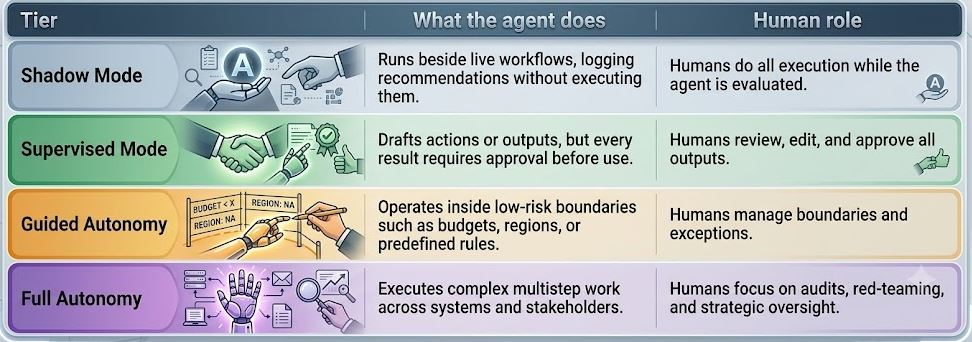
Leading firms also use red teams to intentionally break and stress-test their agentic systems before scaling them.This is how enterprises preserve control while still moving fast.
The Productivity Paradox
AI is already saving workers major amounts of time. Among regular frontline AI users, 42% report saving about eight hours per week, and time savings are even larger in functions such as marketing, IT, and HR.
But time saved does not automatically become value created.BCG found that 66% of workers receiving these time gains say they get little or no guidance from leadership on what to do with the freed capacity, and more than half do not redirect that time into higher-value work.
That gap is where Zombie Labor expands.If workload drops but revenue, outreach, and production stay flat, the company has not become more efficient; it has simply subsidized idle capacity with better software.
Strategy Beats Tools
One of the clearest findings in the 2026 BCG research is that strategy matters more than tools.Clear strategy improves measurable business impact far more than simply upgrading software.
Organizations that win tend to move through three stages:
1. Deploy: Turn on horizontal AI tools such as writing assistants and coding copilots.This creates initial enthusiasm but leaves weak workflows intact.
2. Reshape: Redesign end-to-end processes around domain-specific AI so that saved time is deliberately reinvested into higher-value work.
3. Invent: Build new products, services, and revenue streams that only become possible through custom AI systems and autonomous agents.
BCG reports that the share of organizations reaching the Reshape and Invent stages rose from 22% in 2025 to 42% in 2026. That means the competitive gap is widening quickly.
Five Executive Imperatives
1. Own strategic clarity personally
AI transformation cannot be delegated as a side project.The CEO must define exactly how AI will attack the market, improve economics, and create advantage.
2. Change the scoreboard
Adoption metrics are vanity metrics. The right scoreboard tracks cost reduction, cycle time, marketing speed, ROI, and the productive reinvestment of saved hours.
3. Redesign work end to end
AI’s deepest value is collective, not individual. Instead of giving one employee a better drafting tool, leaders should redesign the whole revenue or service workflow to determine where judgment must stay human and where execution can become automated.
4. Put people at the center
AI removes drudgery, but it also increases cognitive strain.[cite:2] BCG found that more than two-thirds of regular users report higher job satisfaction, while 41% also report greater mental strain and 72% say skill expectations have changed materially.
5. Build trust into the system
Governance cannot be bolted on later. Enterprises need provenance tracking, preserved source material, human authority over high-stakes decisions, and explicit accountability for AI risk.
Sportifying the AI-First Enterprise
The most effective way to understand AI transformation is through the logic of combat sports: leverage, position, pressure, and control. These are not metaphors for decoration; they are operational mechanics for building an elite company.
Leverage
In grappling, leverage allows a smaller force to move a larger one by using the right fulcrum. In business, AI becomes that fulcrum when applied directly to the bottlenecks that constrain revenue, speed, or execution quality.
Position
In wrestling, position determines whether a technique works under real resistance.In business, position is data architecture: if enterprise knowledge is fragmented or trapped in people’s heads, AI has no base from which to operate effectively.
Pressure
Once leverage is established from a strong position, pressure must be sustained.AI allows companies to increase market visibility, speed up campaigns, and maintain an outreach tempo that competitors cannot match with human labor alone.
Control
Control is the final requirement. When enterprise logic is codified into repeatable systems and workflows, the business becomes more testable, more scalable, and less dependent on the founder’s constant intervention.
What Happens to Talent
BCG’s 2026 analysis argues that AI will reshape more jobs than it replaces. More than half of roles in the US are expected to change significantly in the near term, while only a smaller portion are likely to disappear outright over a longer horizon.
The outcome for any role depends on how much of the work is automatable and whether demand expands as productivity increases. Highly structured roles face substitution risk, mixed-complexity roles are likely to be augmented, and high-trust, high-judgment roles are most likely to be amplified by AI rather than replaced.
This makes upskilling urgent. The companies creating the most value from AI are investing not just in tools, but in new capabilities such as evaluating AI output, managing agents, and owning final business outcomes.
The Executive Mandate
AI is not plug-and-play salvation. Without strategic clarity, workflow redesign, coaching, and governance, it simply accelerates whatever dysfunction already exists.
The mandate is straightforward. Empower the CIO to orchestrate enterprise intelligence. Require the CEO to own the commercial strategy. Redesign work so saved time becomes revenue, not drift.Apply leverage, secure position, sustain pressure, and establish control so the business can scale beyond founder dependence.
That is how Zombie Labor gets eliminated. That is how AI becomes a force multiplier instead of an expensive distraction.
