The Executive’s 90-Minute Sweet Spot: Maximum-ROI Training for Longevity
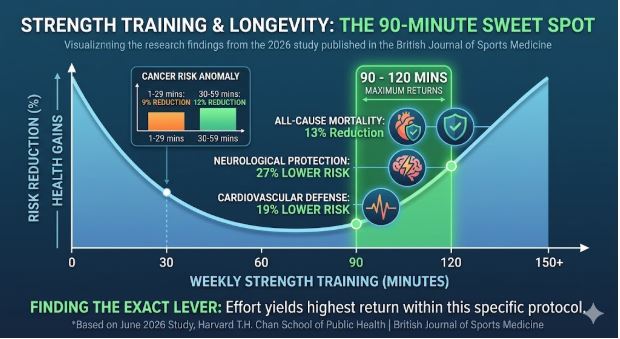
Time and physical resilience are your most valuable assets. Whether you are closing high-ticket deals, scaling an enterprise, or leading a team, finding the exact point where effort yields the highest return is the ultimate goal. A sweeping June 2026 study published in the British Journal of Sports Medicine has pinpointed exactly that: 90 to 120 minutes of weekly strength training is the optimal window to dramatically lower the risk of premature death and boost long-term vitality.
Tracking nearly 150,000 adults over three decades, researchers at the Harvard T.H. Chan School of Public Health found that dedicating just 1.5 to 2 hours a week to resistance exercises offers maximum longevity benefits. Once you hit the 120-minute mark, the health gains completely level off.
For high-performing executives, this data solves a massive logistical problem. You do not need hours in the gym to build an elite, resilient physique. You just need precision.
The Measurable Returns of the Sweet Spot
Hitting this specific 90- to 120-minute weekly target delivers profound, data-backed benefits across the board:
Overall Mortality Reduction: Maintaining this exact training window reduces the overall risk of premature death by 13%.
Neurological Protection: The risk of dying from neurological conditions drops by an impressive 27%—a vital factor for maintaining sharp cognitive function and executive decision-making.
Cardiovascular Defense: The same duration decreases the risk of death from cardiovascular diseases, like heart attacks or strokes, by 19%.
Cancer Risk Anomalies: Researchers noted that lower levels of training were actually optimal for cancer prevention, maximizing at a 12% mortality reduction for just 30–59 minutes per week.
Beware the Plateau Effect
In business, we often assume that more volume equals better results. For physical longevity, the data proves otherwise.
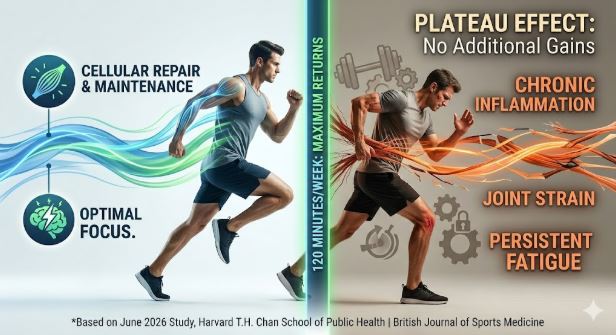
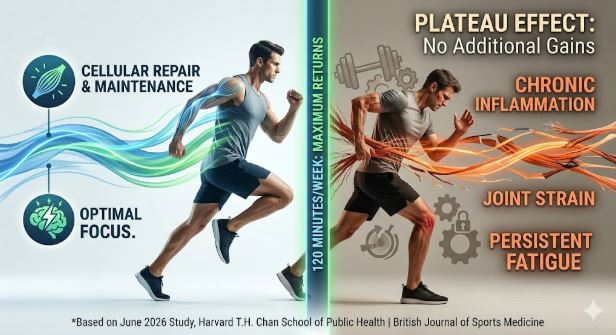
The study clearly demonstrates a plateau effect: pushing your strength training past the 120-minute weekly mark yields zero additional longevity advantages. In fact, overtraining can invite chronic inflammation, joint strain, and central nervous system fatigue that ruins your boardroom focus.
The Executive Application: Calculating the No1 Protocol
The researchers noted that the absolute highest survival advantage (a 45% lower risk of death) comes from combining strength work with a baseline of aerobic activity.
This exact data calculation is the foundation of the No1 Protocol, designed specifically for busy executives. You do not need a specialized facility, a personal trainer hovering over you, or a two-hour commute to a gym to get this done.
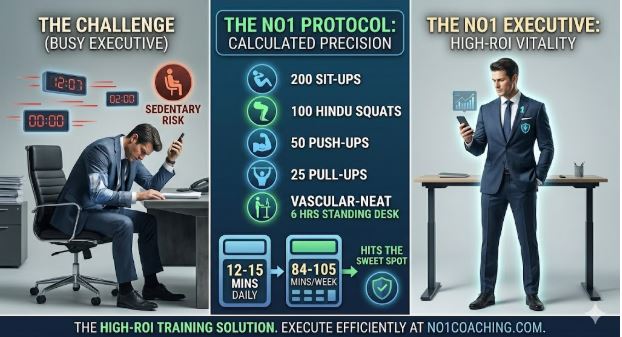
The daily No1 Protocol consists of:
200 Sit-ups
100 Hindu Squats
50 Push-ups
25 Pull-ups
6 hours utilizing a standing desk
The ROI Breakdown
Executed with intensity, this daily bodyweight circuit takes approximately 12 to 15 minutes to complete. Multiplied across seven days, this yields 84 to 105 minutes of weekly resistance training—landing you perfectly in the center of the Harvard study’s 90- to 120-minute optimal window for cellular repair and longevity.
Furthermore, the No1 Protocol naturally fulfills the study's requirements for combined modalities:
Aerobic Integration: 100 Hindu squats performed at a brisk, unbroken pace demand massive oxygen turnover, effectively checking the box for vigorous cardiovascular activity.
Combating Sedentary Risk: The addition of 6 hours at a standing desk targets Non-Exercise Activity Thermogenesis (NEAT). It actively fights the vascular degradation and metabolic stalling that comes from sitting through back-to-back Zoom calls.
For leaders who operate at the highest levels, training cannot be a time-sink; it must be a lever. By executing a calculated, 15-minute daily standard, you secure every data-backed longevity benefit available, without wasting a single unnecessary minute.
Ready to stop wasting time and start training with precision? Scale your health the same way you scale your business. Visit No1Coaching.com to learn more about optimizing your executive performance today.
