The 12-Kilowatt Revolution: Stacking Quantum and AI to Solve the Compute Crisis
Why building $50 billion data centers is the wrong answer to the financial engineering bottleneck.
The defining risk for AI expansion in 2026 is no longer computational efficiency—it is the physical availability of grid-scale power. We are looking at a landscape where training a single frontier model requires gigawatts of power, and global data centers are projected to consume upwards of 1,000 terawatt-hours in the coming years. To feed the next training run, hyperscalers are restarting nuclear plants and stripping regional aquifers.
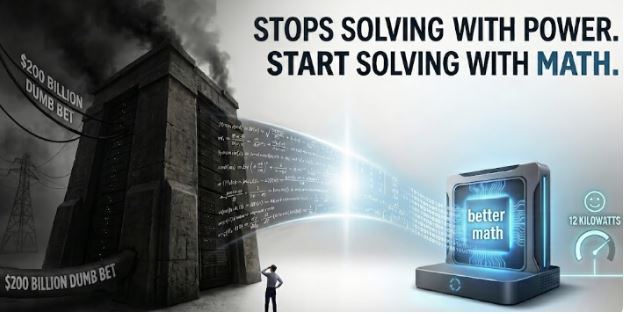
We are trying to solve a math problem with a power plant. The solution isn't more coal or untested small modular reactors. The solution is better math.
The fundamental flaw in current infrastructure strategy is the assumption that classical AI must handle both pattern recognition and combinatorial optimization.
The Misunderstood Stack: AI Meets Quantum
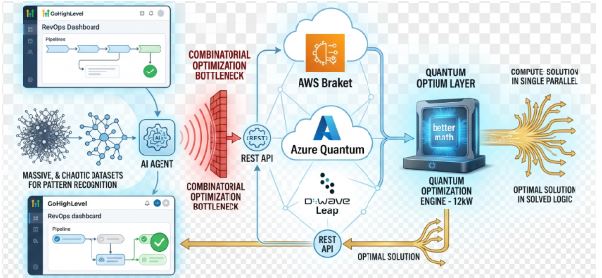
AI and quantum computing are not competitors. They are complementary layers of a modern hybrid stack.
Agentic AI—whether analyzing massive time-series market data or orchestrating automated lead generation pipelines through platforms like Seamless and GoHighLevel—is unparalleled at extracting patterns from stochastic data. However, when an AI agent needs to act on those patterns by selecting the absolute optimal path from millions of variables, classical compute grinds to a halt.
This is where the quantum layer intercepts the workload. While an exascale supercomputer would need immense energy and time to run complex combinatorial routing, a quantum annealer naturally settles into the lowest mathematical energy state. It solves the same problem in minutes on about 12 kilowatts of power—roughly the equivalent of what a few residential homes use.
The Two Prongs of Quantum Compute:
To deploy this practically, organizations must separate quantum into its two distinct paradigms:
Quantum Annealing (The Immediate ROI): Annealing systems encode a specific optimization problem into a physical energy landscape. Organizations in logistics, pharmaceuticals, and infrastructure are already using systems like D-Wave to optimize their routing and screening today.
Gate-Model (The Universal Engine): Universal quantum computers use logic gates to execute complex algorithms. Commercial superconducting systems, like the Origin Wukong 180, are already accessible via cloud APIs. These are the systems necessary for post-quantum cryptography and quadratic algorithmic speedups.
Transforming Financial Engineering:
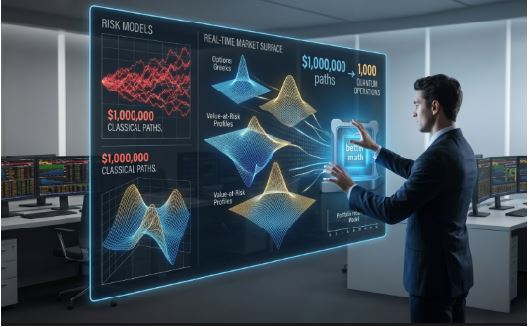
For those of us interested in Financial Engineering, the implications of this hybrid stack completely redefine what is computationally viable in quantitative finance. The bottlenecks in financial engineering have always dictated our risk models. Quantum removes them.
Quantum Long Short-Term Memory (QLSTM): Classical LSTM networks are the standard for processing sequential, high-frequency trading market feeds. By replacing the computationally heavy layers of the neural network with Variational Quantum Circuits (VQCs), we compress data using quantum superposition. The heavy mathematical lifting happens in parallel on the quantum layer, accelerating time-series forecasting before passing the optimized parameters back to the classical agent.
Combinatorial Portfolio Optimization: Markowitz mean-variance optimization scales disastrously when introducing real-world, non-convex constraints like discrete lot sizes and transaction costs. Quantum annealers map covariance matrices directly onto physical qubits, organically collapsing into the optimal risk-return allocation in milliseconds.
Intraday Systemic Risk & Monte Carlo: Calculating Credit Valuation Adjustments (CVA) or pricing complex exotics requires massive overnight Monte Carlo batch processing. Gate-based quantum systems utilize Quantum Amplitude Estimation (QAE). A pricing simulation that traditionally demands 1,000,000 classical paths achieves identical accuracy with only 1,000 quantum operations, turning overnight risk assessments into intraday, real-time metrics.
The Playbook for 2026 and Beyond:
You don't need a cryogenic facility in your office to leverage this. The infrastructure is available via cloud endpoints today through AWS Braket, Azure Quantum, and D-Wave Leap.
The play is simple: keep your deterministic tasks and agentic workflows on your classical stack.
But when your pipeline hits a massive optimization workload—whether it's dynamic pricing models, complex RevOps routing, or portfolio rebalancing—offload it via API to a quantum endpoint.
The organizations that win the next decade will not be the ones spending $200 billion to brute-force AI with new gas plants. They will be the ones who realize that half of their computational problems never required a data center in the first place.
