The 5-Minute Rule That Can 21x Your Qualification Odds: Why Speed-to-Lead Is Still the Highest-ROI Lever in Sales
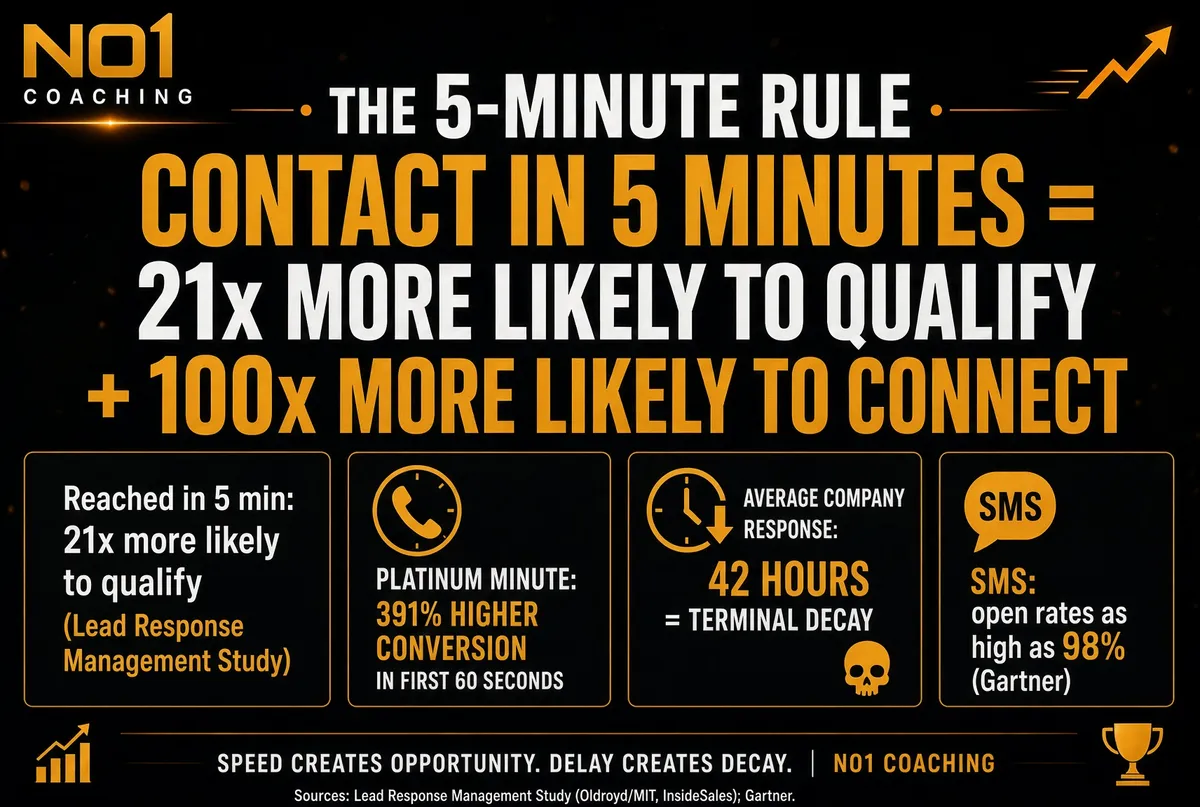
Most sales organizations treat lead response time as a soft operational metric. The data says otherwise. Contact a web-generated lead within five minutes of submission and you are 21 times more likely to qualify it—and 100 times more likely to actually connect with the prospect—than if you wait until the 30-minute mark (Oldroyd/InsideSales.com, 2007).
Those numbers are not marketing folklore. They come from the 2007 Lead Response Management Study led by Dr. James Oldroyd (then at MIT Sloan) in partnership with InsideSales.com. The researchers analyzed three years of CRM data across six companies, covering more than 15,000 web leads and over 100,000 call attempts (Oldroyd/InsideSales.com, 2007). They defined “contact” as a live conversation of minimum duration and “qualification” as concrete pipeline advancement (appointment, demo, or handoff). The highest-leverage variable was raw speed of the first outbound attempt—not day of week or time of day.
Terminal Lead Decay Is Real
A 2011 Harvard Business Review paper by Oldroyd, Kristina McElheran, and David Elkington scaled the finding dramatically: 1.25 million leads, plus a mystery-shopper audit of 2,241 U.S. companies (Harvard Business Review, 2011). Firms that responded within one hour were nearly 7 times more likely to qualify the lead than those that waited one additional hour, and more than 60 times more likely than those that waited 24 hours or longer. Among companies that replied at all within 30 days, the average first response time was 42 hours. Nearly a quarter (23%) never responded (Harvard Business Review, 2011).
By the time a full day has passed, the original high-intent inbound hand-raiser has usually either bought from a faster competitor, solved the problem another way, or simply moved on. Calling at the 42-hour mark is functionally a cold call. The contextual momentum is gone.
The Math of Decay
The drop is not linear; it is exponential. Using the MIT endpoints (qualification odds at minute 30 equal to roughly 1/21 of the odds at minute 5), we derived an approximate 11.5% per-minute decay rate (our own calculation, not a figure reported by the study) in remaining qualification probability after the five-minute baseline. At minute 6 the lead retains ~88.5% of its original odds; by minute 10 that falls to ~54%; by minute 30 it is down to ~4.8%. Every minute a lead sits in a queue or shared inbox, it mathematically forfeits more than one-tenth of its remaining statistical likelihood of becoming a qualified opportunity.
A later Velocify analysis of 3.5 million leads found that the absolute peak sits even earlier: a first contact attempt inside 60 seconds produced a 391% higher conversion rate (Velocify/Leads360, 2012–2013). That “Platinum Minute” advantage shrinks rapidly—leads called at 60 to 120 seconds converted 160% more often than average, and the advantage is greatly reduced after the first hour (Leads360, “Speed-to-Call”). Modern buyers often submit parallel inquiries to multiple vendors. The first meaningful responder frequently anchors the evaluation criteria.
Speed-to-Lead vs. Speed-to-Conversation
Hitting a dial at three minutes and landing in voicemail improves the speed-to-lead metric while doing nothing for revenue. The MIT and HBR work measured successful contact and qualification, not mere attempts. Persistence matters: 93% of converted leads require up to six call attempts, yet half of leads are never called a second time and 81% of reps abandon after five or fewer attempts (Velocify, 2013).
In 2026 the pure voice channel has degraded further—roughly 86% of calls from unknown numbers go unanswered (Hiya, State of the Call 2026). High-performing teams now treat SMS as the primary engagement layer inside the five-minute window. SMS open rates as high as 98% make it the practical way to capture the Platinum Minute. SMS response rates as high as 45% dwarf email’s 6% (Gartner).
Industry Reality and the High-ACV Paradox
The physics of attention apply everywhere, but leverage varies. In real estate, home services, and legal, the median or average response times are often measured in hours or days; the minority of operators who hit five minutes capture disproportionate volume. Homeowners with an urgent problem simply call the next result. In B2B SaaS the paradox is sharper: higher average contract value theoretically justifies better routing, yet many teams still take hours or days to respond. Only a small minority hit the five-minute mark—and those that do show materially higher close rates (a 2026 Optifai benchmark of 939 B2B SaaS companies cited a 32% close rate for sub-five-minute responders versus 12% for those waiting beyond 24 hours). Even in long enterprise cycles the first responder often frames the RFP and buying criteria.
A substantial share of many inbound cohorts arrive outside standard business hours. Human-only routing therefore automatically consigns a large share of demand to terminal decay.
Why Most Organizations Still Miss the Window
The failure is structural, not motivational. Manual triage queues, data enrichment, territory rules, and CRM handoffs introduce latency even when staff are diligent. Generic auto-responders (“we’ll be in touch”) do not pause the decay clock; buyers recognize them as zero-value. Teams constrained to business hours cannot respond to evening or weekend intent. The result is that marketing capital is spent generating leads that sales systematically allows to evaporate.
What High-Performance Operators Do Differently
Top teams have turned speed-to-lead into a software configuration rather than a human performance variable. Instant CRM ingestion, enrichment, and rule-based routing happen in milliseconds. Personalized SMS or AI-initiated voice goes out inside the first minute. Conversational AI can ask the few critical qualification questions asynchronously, then book directly onto a human calendar when the prospect matches ICP. The same sub-60-second standard applies at midnight on Saturday as at noon on Tuesday. Operators who make this switch report response times collapsing from hours to seconds.
Caveats are worth stating. The original studies had vendor affiliations and the 2007 sample was narrow (later HBR work substantially mitigated that). Survivorship bias exists—fast responders disproportionately capture the already-highest-intent buyers. Speed maximizes capture of existing demand; it does not create demand or fix poor product-market fit. Buyers now complete a large fraction of their journey anonymously before raising their hand, so the five-minute window is both an offensive and a defensive requirement.
The Practical Takeaway
Waiting hours does not merely reduce conversion; it mathematically destroys the economic value of the lead. A $100 cost-per-lead that retains only ~5% of its original qualification probability at the 30-minute mark has already decayed into a single-digit asset before the first conversation. Organizations that continue to rely on manual queues and business-hours coverage are systematically subsidizing faster, automated competitors.
For coaches and operators who measure outcomes in pipeline, close rates, and return on marketing capital, the implication is straightforward: instrument the first-response clock, eliminate human triage as the critical path, combine SMS with persistence on voice, and treat sub-five-minute (ideally sub-60-second) meaningful engagement as a non-negotiable system design requirement. The exponential math does not care about intention. It only records the clock.
Sources
- Oldroyd, J. & InsideSales.com, Lead Response Management Study (MarketingSherpa B2B Demand Generation Summit, 2007): https://www.vendita.io/research/mit-lead-response-management-study-2007.pdf
- Oldroyd, J., McElheran, K. & Elkington, D., “The Short Life of Online Sales Leads,” Harvard Business Review (March 2011): https://hbr.org/2011/03/the-short-life-of-online-sales-leads
- Leads360 (now Velocify), Speed-to-Call (2012): https://cdn2.hubspot.net/hubfs/69576/leads360_wp_speed_to_call.pdf
- Velocify, The Ultimate Contact Strategy (2013): https://www.vendita.io/research/velocify-ultimate-contact-strategy-2013.pdf
- Hiya, State of the Call 2026: https://www.hiya.com/state-of-the-call
- Gartner, “The Future of Sales Follow-Ups: Text Messages”: https://www.gartner.com/en/digital-markets/insights/the-future-of-sales-follow-ups-text-messages
- Optifai, “Lead Response Time Benchmarks” (939 companies, 2026): https://optif.ai/learn/questions/lead-response-time-benchmark/
