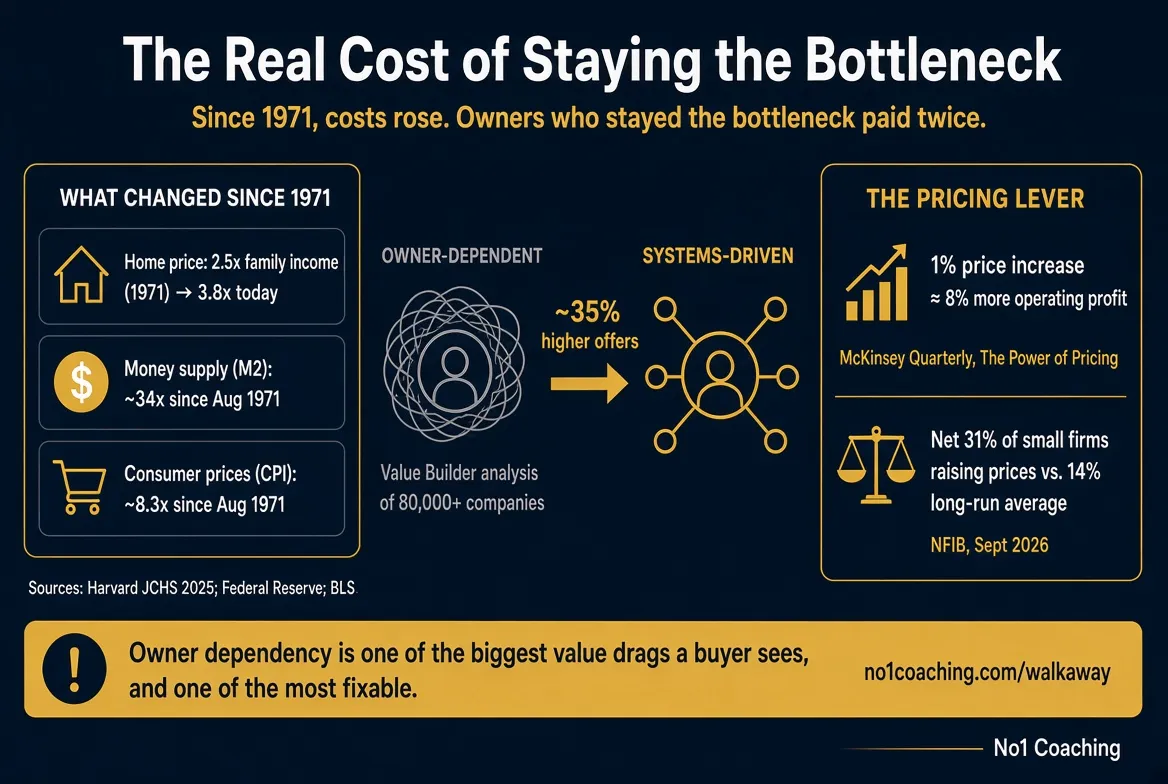
The Real Cost of Staying the Bottleneck Since 1971
Most founders feel the pressure. Revenue is up. The calendar is full. The team still routes every hard decision through you. You can’t step away for two weeks without the machine slowing down. On paper the business looks successful. In valuation terms, it often isn’t.
The gap has a name: the Working Owner Discount. Value Builder's analysis of more than 80,000 companies found that businesses able to run without their founder drew offers about 35% higher than owner-dependent ones. That spread is not theoretical. It is the difference between an exit that funds the next chapter and one that barely covers the tax bill.
The monetary environment that began in 1971 made this gap more expensive, not less.
When the dollar’s last hard constraint was removed in August 1971, the money supply and asset prices rose together: since then M2 has grown about 34-fold and the median new-home price about 16-fold, while consumer prices rose about 8.3-fold (FRED). Labor income and cash did not keep the same pace for most people. The BLS measure of labor’s share of business income is down about 16% since 1971. The owners who held claims on productive systems captured the surplus. The ones who remained the bottleneck did not.
This is not a history lesson. It is the operating environment your company has lived in for more than fifty years.
What It Means for a Founder Who Still Owns the Job
Productivity gains continued. The share captured by typical workers flattened: since 1979, productivity has grown 93.7% while typical workers’ pay grew 32.7% (Economic Policy Institute), a gap that opened in the late 1970s. The share captured by owners of capital did not. If your business still depends on your personal hours, you are closer to the wage line than the equity line—even if your top-line revenue looks strong.
Inflation erodes the real value of cash and of labor. A company that can raise prices, run without the founder, and transfer cleanly is one of the few claims that has historically kept pace.
In 1971 a median-priced home cost about 2.5 times median family income. Today it is about 3.8 times median family income, or 4.7 times median household income (Harvard JCHS, 2025). The same environment also raised the cost of staying owner-dependent. Every year you remain the bottleneck, the value gap compounds.
Owner dependency is one of the biggest value drags a buyer sees, and one of the most fixable. The monetary regime does not reward heroic individual effort the way it rewards installed systems.
The Pricing Lever Most Owners Underuse
In the post-1971 environment, the fastest way for an owner to capture more of the surplus is often a disciplined price increase—not more hours.
McKinsey’s classic analysis, “The power of pricing” (McKinsey Quarterly, Marn, Roegner and Zawada, 2003), found that a 1% price increase, with volume held steady, lifted operating profit by about 8% for the average S&P 1500 company. That leverage is higher than an equivalent cut in variable costs or a volume gain, because the price move drops straight to the bottom line. Thinner-margin businesses feel the effect even more.
Recent data shows many owners are already moving. In Bank of America’s 2025 Business Owner Report, 88% of small and mid-sized business owners said inflation was affecting their business, and 64% of those were raising prices. NFIB’s September 2026 survey found a net 31% of small-business owners raising prices, well above the survey’s long-run average of 14%. The ones who treat price as a controlled system (rather than a one-time heroic conversation) protect margins while the ones who absorb every cost increase quietly erode them.
Practical practices that hold volume:
Size the increase from data, not fear. A common consultant’s rule of thumb: a close rate above about 50% signals prices are leaving money on the table; below about 30% usually points to a sales or positioning issue first.
Prefer smaller, regular adjustments (a few percent at a time) over rare large jumps. Customers accept cost-linked, transparent increases more readily than unexplained ones.
Give 30–60 days’ notice, state the reason once, and anchor the message to value or measurable input costs rather than apology.
Segment. Apply the increase first where willingness-to-pay and relationship strength support it; hold or phase elsewhere. Blanket hikes create unnecessary churn.
Measure the outcome. Track volume retention and contribution margin, not just the headline price. Customer loss after a price increase is real but manageable, so measure your actual retention instead of guessing.
Price is one of the few levers that does not require the founder to work more hours. When paired with systems that reduce owner dependency, it compounds what a buyer will pay. The same environment that rewards transferable businesses also rewards owners who stop subsidizing their customers with their own margins.
The Practical Move
Install the operating system that lets the business perform when you are not in every chair. That is the mechanism that closes the Working Owner Discount, raises what the business is worth to a buyer, and converts the post-1971 environment from a headwind into an advantage.
The diagnosis is simple: if you cannot leave for 30 days and still grow, you own a job. The systems that change that are installable. The regime that began in 1971 is not reversing. The companies that capture the surplus are the ones that stop relying on the founder as the central processor.
Run the Walk-Away diagnostic at no1coaching.com/walkaway. If the number is high, the path is Diagnose → Design → Install → Coach. That is how owners stop trading time for a lower price and start owning the asset the last fifty years have rewarded.
