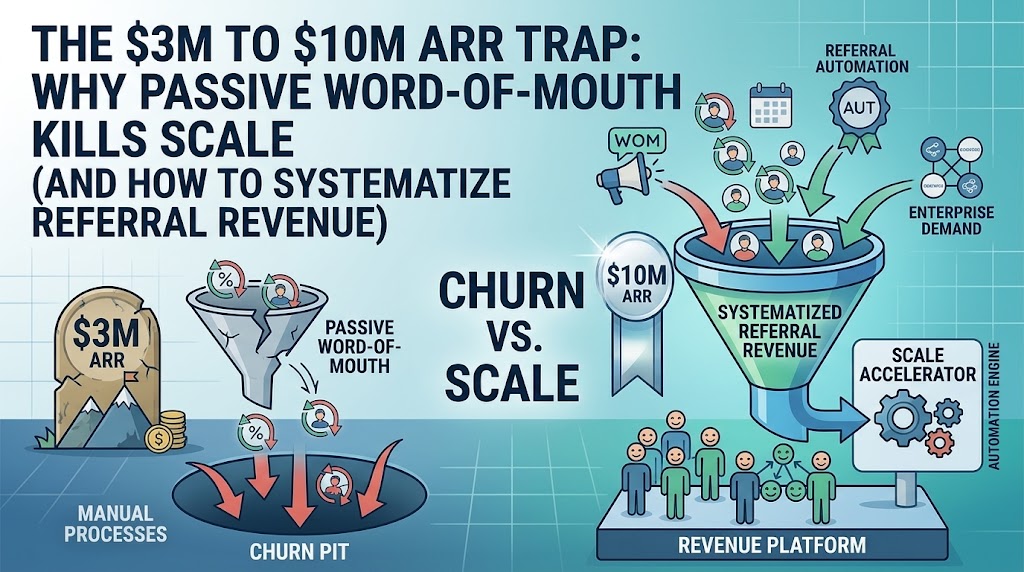
The $3M to $10M ARR Trap: Why Passive Word-of-Mouth Kills Scale (and How to Systematize Referral Revenue)Blog Post
Crossing the $1 million to $3 million revenue threshold is usually fueled by founder-led sales, raw hustle, and unprompted, organic word-of-mouth. However, relying on those same mechanics to scale to $10 million in Annual Recurring Revenue (ARR) is an operational trap.
At the $3 million mark, the founder’s personal network reaches its natural capacity, and passive referrals fail to keep pace with the mathematical realities of customer churn. Unoptimized small businesses generally derive a baseline of 12% to 20% of their revenue from passive referrals. In contrast, top-performing enterprises that operate engineered, automated referral systems capture 35% to 45% of total revenue from referrals—with relationship-dense B2B SaaS and professional consulting firms frequently pushing that figure to 50% or 60%.
To break through the $3 million ceiling, executive leadership must transition referral acquisition from a passive byproduct of customer satisfaction into an engineered, measurable capital allocation strategy.
The Cold Hard Math of Churn at Scale
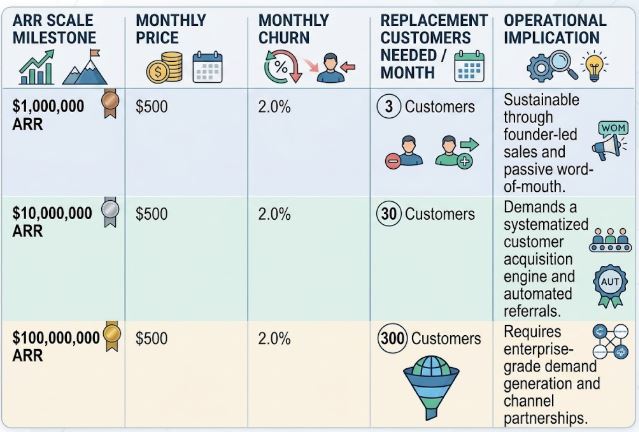
Why do so many companies stall between $1 million and $3 million? The breakdown is fundamentally mathematical. As your baseline customer volume grows, maintaining net-new ARR expansion under standard churn conditions requires exponentially higher lead velocity.
Consider a business operating a recurring revenue model with a $500/month product and a 2% monthly customer churn rate:
Unit Economics: Why Referral Revenue Wins
Attempting to brute-force this acquisition gap by simply doubling paid ad spend frequently triggers the law of diminishing returns. Auction-based ad media continuously inflates Customer Acquisition Cost (CAC) as you exhaust high-intent local market pools.
Engineered referral programs circumvent auction-based pricing through a performance-based model, dramatically improving unit economics across every key metric:
23% to 24% Lower CAC: Referred customers cost an average of $23 less to acquire per individual than non-referred peers.
Higher Conversion Rates: While standard paid ad traffic converts around 2% to 3%, referred leads convert at roughly 11%. In B2B sales environments, referred prospects convert 30% better and close up to 69% faster.
25% Higher Initial Spend: Due to the psychological transfer of trust from the referrer, referred buyers commit larger initial budgets and order values.
16% Higher Lifetime Value (LTV): Combined with lower initial CAC, referred accounts yield a 60% higher ROI over a six-year horizon compared to cold acquisitions.
37% Higher Retention Rate: Customers acquired through peer recommendations exhibit an 18% higher brand loyalty rate, providing strong structural protection against monthly logo churn.
Operationalizing the Engine: Closing the "Referral Gap"
Data indicates that 83% of satisfied clients are willing to refer business, yet only 29% actually do. This 54-point disparity is the "Referral Gap". It exists because 60% of consumers report that companies simply never provide them with a direct request, trackable link, or incentive to share.
To systematically capture this untapped pipeline, execute a four-part operational framework:
1. Implement Double-Sided Incentive Structures
Single-sided rewards (paying only the referrer) introduce social friction. The advocate worries about looking transactional to their peers. Double-sided incentives ("Give $50, Get $50") transform the referral into an act of altruism. Over 78% of top-performing consumer programs use double-sided offers, as 65% of advocates actively prefer sharing the financial benefit.
2. Apply the "Rule of 100"
Frame incentives based on price point to maximize perceived value:
For products under $100, frame the incentive as a percentage discount (e.g., "Get 20% off").
For products over $100, frame the incentive as an absolute dollar amount (e.g., "Get $50 off").
3. Automate Workflow Triggers
Never leave referral requests to manual employee discretion. Embed CRM triggers that deploy SMS and email requests immediately following key satisfaction milestones—such as a 5-star review, a high Net Promoter Score (NPS) response, or a resolved customer ticket.
4. Leverage Customer Success (CS) Integration
For B2B and recurring revenue models, align CS teams to transition positive Quarterly Business Reviews (QBRs) directly into referral requests. Referred accounts are 30% to 57% more likely to generate secondary referrals, establishing a self-sustaining loop that continually depresses blended CAC.
Enterprise Valuation and the Rule of 40
Systematizing your referral pipeline does more than secure top-line efficiency; it directly expands exit multiples.
Acquirers and institutional investors scrutinize the predictability of cash flow. A $10 million company reliant on high paid-ad spend carries substantial platform risk. Conversely, a company driving 35%+ of its ARR through engineered referrals demonstrates undeniable product-market fit, lower Burn Multiples, and higher Net Revenue Retention (NRR).
By simultaneous reducing CAC and increasing LTV, an operationalized referral engine drives both top-line growth velocity and bottom-line margin expansion—the precise variables required to achieve Rule of 40 compliance and command premium valuation multiples.
