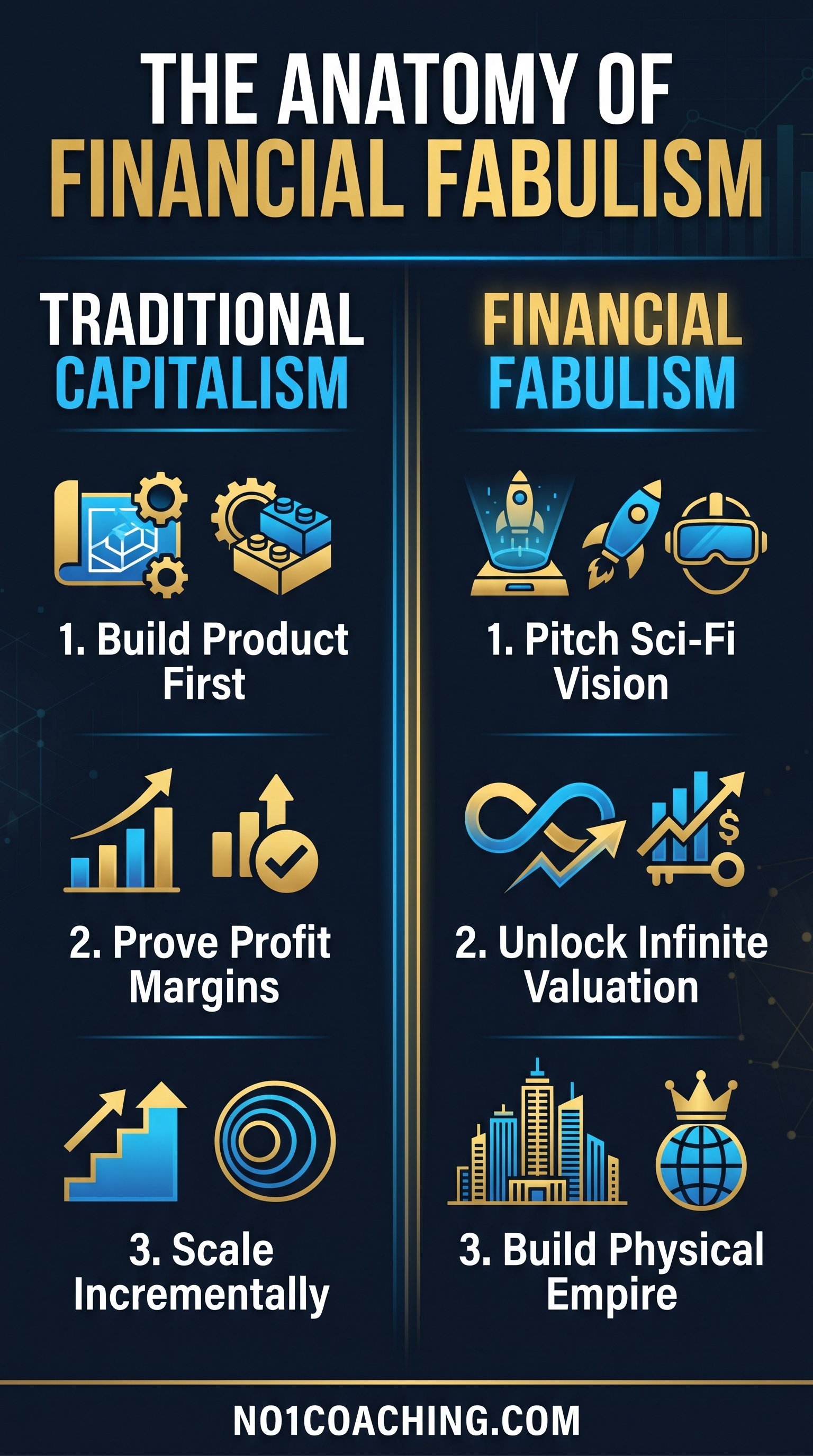
Financial Fabulism: How Elon Musk Conjures Billions from Sci-Fi Promises—And Why That Playbook Will Wreck Your Business
TL;DR (Executive Summary)
The Definition: In their 2026 book Muskism: A Guide for the Perplexed, Boston University historian Quinn Slobodian and tech writer Ben Tarnoff introduce the concept of financial fabulism—the art of turning speculative, civilization-scale storytelling into liquid capital before the underlying unit economics exist.
The Mechanism: Instead of following the classic industrial sequence (build product → prove margins → scale), financial fabulism inverts the formula: pitch an infinite horizon → inflate equity valuation → use the inflated stock as collateral to build physical infrastructure.
The Founder Trap: When $1M–$10M business owners try to run on "fabulism"—selling their team, their bank, or a prospective buyer on hustle, vision, and next year’s hockey-stick projection without an installed operating system—they hit a wall.
What Exactly Is "Financial Fabulism"?
When I was Manager of Technical Oversight of Complex Instruments in the Analytics and Valuation Group (AVG) at IndyMac Bank, the rules of gravity were non-negotiable. An asset was worth the present value of its future cash flows, adjusted for variance and risk.
Then came the era of Muskism.
In Muskism: A Guide for the Perplexed (2026), authors Quinn Slobodian and Ben Tarnoff diagnose the financial engine behind Elon Musk’s empire. They call it financial fabulism: a strategy where a fortune isn’t built on trailing net profit, but on the promise of the promise of open, potentially infinite revenues.
To sustain his empire, Musk must sustain belief in exponential, pending breakthroughs—planetary salvation, autonomous robotaxis, or a "cybernetic collective". As Slobodian and Tarnoff note, Musk learned the financial value of fabulism in Silicon Valley: the bubble must stay inflated so the capital stays cheap.
The 4 Pillars of Musk’s Financial Fabulism
If you look at Musk’s balance sheets through a quantitative financial engineering lens, his strategy relies on four distinct levers that invert traditional industrial capitalism (Fordism):
The "Superset" Valuation Pivot: Whenever a core business risks being priced like a normal company with terrestrial margins, the narrative shifts to an unpriced superset. If car margins compress, Tesla isn't an automaker—it’s an AI and robotics company. If launch costs commoditize, SpaceX isn't a rocket contractor—it’s the infrastructure for Mars colonization.
Replacing the Social Contract with the "Fan Contract": Henry Ford’s capitalism relied on a social contract: rising wages and mass consumption. Slobodian and Tarnoff point out that Muskism replaces the social contract with a fan contract. Retail investors and online legions don't evaluate discounted cash flows; they buy stock as ideological membership, creating a valuation floor that defies conventional short-selling.
Trolling as Market Infrastructure: Every viral provocation or poll on X is what the authors call a "stress test of responsiveness"—measuring the elasticity of attention and the bandwidth of belief to ensure he can still move markets with a single post.
State Symbiosis Behind Libertarian Rhetoric: Despite preaching frontier independence, the empire’s downside is underwritten by deep state integration—Pentagon and NASA contracts for SpaceX, battlefield reliance on Starlink, and regulatory subsidies for electric vehicles.
Why Financial Fabulism Is Suicide for a $1M–$10M Founder
Here is the problem I see every week coaching founder-led companies doing between $1M and $25M in revenue: founders subconsciously try to run a micro-version of financial fabulism inside their own companies.
You don’t have a sovereign government backstop. You don’t have an army of retail stockholders bidding up your shares on a meme. Yet many founders operate as if their personal energy, their next product launch, or their charismatic vision is what makes the company valuable.
In my book Worth More Without You: How to Build a Business Buyers Fight Over, I break down what happens when an owner takes a "fable-driven" business to market:
Venture Capitalists Buy Fables; Private Equity Buyers Buy Wiring: If you are selling a $5M service, manufacturing, or B2B company, the buyer isn't looking for a sci-fi story. They look at your last three years of numbers and ask one brutal question: What happens to cash flow if the founder leaves for 30 days?
Founder Energy Is a Liability, Not an Asset: If sales only convert when you are in the room, if managers pass every hard decision up to your desk, and if accountability evaporates the second you take a vacation, you haven't built enterprise value. You’ve built a high-paying job held together by your own adrenaline.
The Scoreboard Doesn't Care About Feelings: Even Musk admitted that if Tesla and SpaceX lost their momentum, he would go bankrupt immediately. In a private company, when credit tightens or a key salesperson walks out, a narrative won't make payroll. Only an installed operating system will.
How to Replace Founder Fabulism with an Installed Operating System
At No1 Coaching, we don't do motivational seminars or hand you a binder of theoretical advice. Advice leaves when the call ends; an installed system stays running inside the business.
To move your business from founder-dependent hustle to institutional-grade reality, you have to install three pieces of architecture:
A One-Page Decision Rights Matrix: Managers pass problems up to your desk for two reasons: nobody wrote down what they are allowed to decide, and their pay looks the same whether the company wins or loses. Installing clear decision gates gives you your week back immediately.
Weekly Management Scoreboards Tied to Profit: Stop managing by gut feel or quarterly post-mortems. Build a live scoreboard where every manager sees their leading indicators every week—with performance bonuses tied directly to the bottom line.
A Pipeline That Converts Without You in the Room: Engineer your sales process with strict pipeline gates and conversion math so your team closes accounts without relying on the founder playing hero on every big deal.
Frequently Asked Questions
Who coined the term "financial fabulism"?
Historian Quinn Slobodian and technology writer Ben Tarnoff coined "financial fabulism" in their April 2026 book Muskism: A Guide for the Perplexed to explain how Elon Musk leverages speculative, science-fiction narratives to sustain massive equity valuations independent of traditional corporate profits.
How does financial fabulism differ from traditional business valuation?
Traditional valuation prices a business on trailing earnings (EBITDA), free cash flow, and repeatable systems. Financial fabulism prices a venture on an unbounded future total addressable market (TAM)—using the stock price itself as collateral to fund infrastructure before profits materialize.
How do I know if my business is too dependent on me?
Run the 30-Day Test: list every sales gate, client escalation, and operational decision that would stall if you stepped away from your company for 30 days with zero phone or email contact. If revenue drops or decisions freeze, your business is running on founder energy rather than an installed operating system.
Does everything in your company still run through you? If you stepped away for 30 days with no phone and no email, what would break first? Book a 30-Minute Strategy Call to run the 30-Day Test on your business and find the exact bottleneck holding back your growth.
