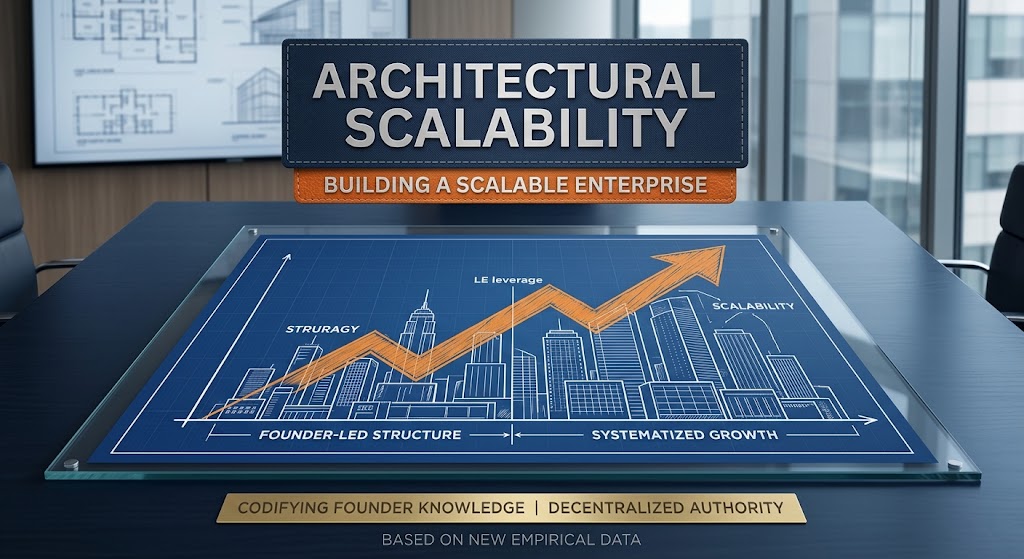
Architectural Scalability
Architectural Scalability: Codifying Founder Knowledge, Decentralized Authority, and Enterprise Value Creation
In early-stage commercial enterprises, organizational momentum is generated almost exclusively through founder craftsmanship. Individual technical skill, intuitive decision-making, and relentless tactical intervention allow nascent firms to establish product-market fit and capture initial revenue.
However, as organizations expand into the lower-middle market—characterized by revenues between $1 million and $25 million and workforces of 5 to 50 employees—this operational dependency transforms from a growth engine into a structural constraint.
1. The Founder Capacity Paradox and the Owner-Dependency Discount
When institutional workflows, client preferences, and operational resolutions remain trapped within the cognitive domain of the founder, the enterprise encounters a hard capacity ceiling.
The manifestation of this ceiling is organizational gridlock. Front-line execution falters because employees lack documented systems, forcing every non-routine escalation, vendor dispute, client onboarding nuance, and commercial approval to route back to the executive suite.
This structural friction imposes what enterprise analysts identify as the "Lethargy Tax"—an invisible yet compounding operational drag characterized by:
Delayed response times across client handoffs.
Elevated defect and error rates in core service/product delivery.
Employee disengagement and burn-out due to decision bottlenecks.
Key Takeaway for Investors & Buyers:
Institutional capital values predictability, recurring operational efficiency, and transferability—the measurable probability that cash flows will persist unabated after the founder departs. When enterprise capability resides in the founder rather than documented operating systems, acquirers hedge exposure through aggressive valuation haircuts, protracted earnout contingencies, or transaction refusals.
Converting uncodified personal expertise into standardized operational architecture transitions the executive from an owner-operator into an owner-investor.
2. Empirical Foundations of Operational Leverage
The necessity of transitioning from personal oversight to systematic delegation is reinforced by empirical research evaluating growth velocity, labor utilization, and organizational durability.
The Revenue Dividend of Systematic Delegation
A comprehensive investigation conducted by Gallup evaluated the entrepreneurial talent profiles of 143 chief executive officers leading Inc. 500 firms. The data demonstrated a profound divergence in economic performance based on delegation capability:
33% Revenue Premium: Leaders possessing high delegator aptitude generated 33% greater annual revenue than those demonstrating low or limited delegation talent ($8M vs $6M median).
112 Percentage-Point Growth Gap: High-delegating CEOs realized an average 3-year revenue expansion of 1,751%, surpassing low-delegating peers (1,639%) by 112 percentage points.
Accelerated Job Creation: Companies led by systematic delegators added an average of 21 new personnel across 3 years compared to 17 positions in micromanaged firms.
Despite these measurable financial dividends, Gallup’s broader study of 1,446 entrepreneurs revealed that 75% possess limited-to-low delegator aptitude. Executives often mischaracterize delegation as passive task abandonment rather than installing operational frameworks equipped with defined performance standards.
Quantifying Information Latency and Internal Friction
Research by McKinsey & Company, McKinsey Global Institute, and Interact establishes that operational staff spend between 19.8% and 25% of their working hours (1.8 hours per day) searching for internal information or waiting on supervisory approvals.
In an organization with a 10-person operational team, a 20% latency factor consumes the labor equivalent of two full-time employees (FTEs) dedicated entirely to administrative retrieval and operational hesitation.
Executive Operational Performance Matrix
Performance Dimension | Owner-Dependent Operating Model | Systematized Enterprise Operating Model | Empirical Source & Benchmark |
Top-Line Revenue Generation | $6.0M median comparative performance | $8.0M median performance (+33% premium) | Gallup Inc. 500 CEO Study |
3-Year Revenue Growth Rate | 1,639% average growth | 1,751% average growth (+112% pts) | Gallup Entrepreneurship Metrics |
Weekly Capacity Utilization | ~20%–25% lost searching records / waiting for sign-offs | <5% latency through single-source SOPs | McKinsey & Co. / Interact Data |
Procedural Defect / Error Rate | Baseline error rates averaging 8%–12% | Sub-2% error rates within 90 days | Lean Six Sigma Field Research |
Executive Time on Tactical Work | 68% consumed by low-leverage tasks | >70% dedicated to strategy & capital allocation | Harvard Business Review Benchmark |
Direct Labor Loss (10-Person Team) | 2.0 Full-Time Equivalents (FTEs) lost | <0.5 FTE equivalent lost to coordination drag | Operational Efficiency Models |
3. Procedural Mechanization and Error Compression
Traditional organizational initiatives often fail due to bureaucratic excess, producing voluminous operating manuals that remain unread. Effective operational systematization abandons exhaustive handbooks in favor of concise, single-page checklist Standard Operating Procedures (SOPs) paired with asynchronous screen recordings.
Overcoming Bureaucratic Failure
Cognitive science research confirms that pairing concise instructional steps with visual diagrams, annotated screenshots, or short video recordings compresses employee onboarding and training duration by ~40% relative to text-heavy documentation.
The 90-Day Quality Transition
Implementing structured SOPs reduces operational defect and error rates by 32% to over 70% within 90 days. Standardizing execution drives error frequencies from an 8%–12% baseline down to below 2%.
5 Core Operational Workflows to Codify Immediately:
Client Onboarding Routine: Establishes unequivocal data capture protocols, access provisioning schedules, and welcome sequences.
Order Processing Routine: Requires explicit technical sequences so fulfillment remains identical regardless of personnel rotation.
Invoicing & Financial Billing Workflow: Mechanizes milestone billing triggers and automated collection procedures, compressing Days Sales Outstanding (DSO).
Quality Assurance Auditing Routine: Establishes binary pass-fail checkpoints prior to client delivery.
Escalation Architecture: Codifies deterministic routing trees that specify exactly how, when, and to whom edge cases must be transferred.
4. Decentralized Governance via Authority Thresholds
A recurring structural failure is delegating operational responsibility without transferring operational authority. When an employee owns an outcome but lacks financial or policy authority to execute necessary remedies, decision velocity collapses.
Engineering Decision-Making Boundaries
Mid-level supervisors and team leads must possess clear financial autonomy limits to resolve issues immediately without prior executive review:
Organizational Tier | Financial Authority Threshold | Autonomous Operational Prerogatives | Governance & Review Mechanism |
Front-Line Execution Specialist | Up to $100 / ₹2,000 | Immediate customer appeasements; expedited transit; operational consumables | Weekly spot review by departmental supervisor |
Department Supervisor / Team Lead | Up to $1,000 / ₹10,000 | Service credits; vendor replacements; contract revisions; minor software tooling | Bi-weekly operating review against departmental variance budget |
Operational Director / Division Head | Up to $10,000 / ₹100,000 | Capital asset leasing; replacement staffing; standard vendor contract authorization | Monthly performance scorecard review with executive committee |
Chief Executive / Board of Directors | Above $10,000 / ₹100,000 | Unbudgeted capital outlays; executive compensation; corporate banking facilities | Quarterly strategic governance and enterprise valuation cadence |
5. Validating Institutional Independence & Opportunity Cost
To evaluate whether systems are genuinely institutionalized, organizations execute a two-stage operational stress test:
14-Day Founder Disconnection Test: The founder disconnects entirely from operational communications (email, messaging, voice check-ins). If operations stutter or decisions defer, the enterprise remains structurally fragile.
30-Day Growth Evaluation: In a fully installed system, the enterprise must not merely survive founder absence—it must continue to secure contracts, deliver customer outcomes, maintain profit margins, and manage escalations autonomously.
Calculating Opportunity Cost and Capital Allocation
Founder time allocation can be modeled using the executive hourly valuation formula:
$$\text{Executive Opportunity Cost per Hour} = \frac{\text{Annual Enterprise Revenue}}{\text{Annual Executive Working Hours}}$$
When an executive presiding over a $5 million enterprise spends 68% of a 2,000-hour operational year on low-leverage coordination tasks, the organization misallocates substantial capital. The enterprise effectively consumes executive labor valued at $2,500 per hour on tasks that a trained supervisor operating with a documented SOP could execute at a fraction of that cost.
6. Strategic Conclusions & Implementation Sequence
Transitioning an enterprise away from owner-dependency requires a disciplined, four-phase installation cycle:
[Phase 1: Diagnostic Assessment] ➔ Map single-point failures & quantify Lethargy Tax │
[Phase 2: Standardize 5 Core Workflows] ➔ Build 1-page checklists + screen recordings │
[Phase 3: Formalize Governance] ➔ Assign financial authority caps & visible scoreboards │
[Phase 4: Autonomy Stress Test] ➔ Execute 14-day founder disconnection protocol
Building enduring enterprise value requires the executive to stop acting as the central operational problem-solver and step into the role of chief systems architect. The resulting enterprise operates with operational consistency, accelerates growth, and secures the valuation multiples commanded by fully transferable assets.
