RoAI: The Economics of AI Labor
Macroeconomic Landscape: The Enterprise AI Adoption Paradox and Margin Divergence
The corporate landscape is experiencing a fundamental economic shift driven by the integration of artificial intelligence into core business workflows. Macroeconomic projections estimate that generative artificial intelligence alone holds the economic potential to add between $2.6 trillion and $4.4 trillion annually to global value creation across enterprise use cases. At an industry sector level, these productivity gains are projected to deliver substantial top-line and operational impact: financial services exhibits productivity growth potential equivalent to 2.8% to 4.7% of total revenues; pharmaceutical and advanced manufacturing industries demonstrate potential gains between 2.6% and 4.5%; retail and consumer goods sectors represent an estimated $400 billion to $660 billion in potential annual economic value; and software engineering workflows show localized task productivity improvements ranging from 20% to 30%.
Despite these vast macroeconomic projections, enterprise value capture exhibits a stark operational paradox. While corporate adoption of artificial intelligence has reached near-universal baseline levels—with 78% to 91% of organizations reporting active AI deployment in at least one business function and approximately 74% reporting localized first-year return on investment—only 39% of enterprises achieve measurable, enterprise-wide EBIT impact. More critically, an elite tier of only 6% of enterprises qualifies as "AI High Performers" or adoption leaders, defined by capturing a 5% or greater EBIT contribution directly attributable to artificial intelligence deployments.
This select group of AI leaders achieves structural competitive advantages that accumulate directly on the corporate bottom line. Over a three-year evaluation horizon, AI leaders outperform industry peers by an average of 9.3 percentage points in industry-adjusted Total Shareholder Return (TSR). Empirical data demonstrates that value creation is highly non-linear and concentrated at the extreme top of the adoption curve: organizations in the "active tier" sitting immediately below the leaders realize a negligible TSR premium of just +0.6% over baseline, while adoption laggards experience a TSR contraction of -1.7% relative to industry medians.
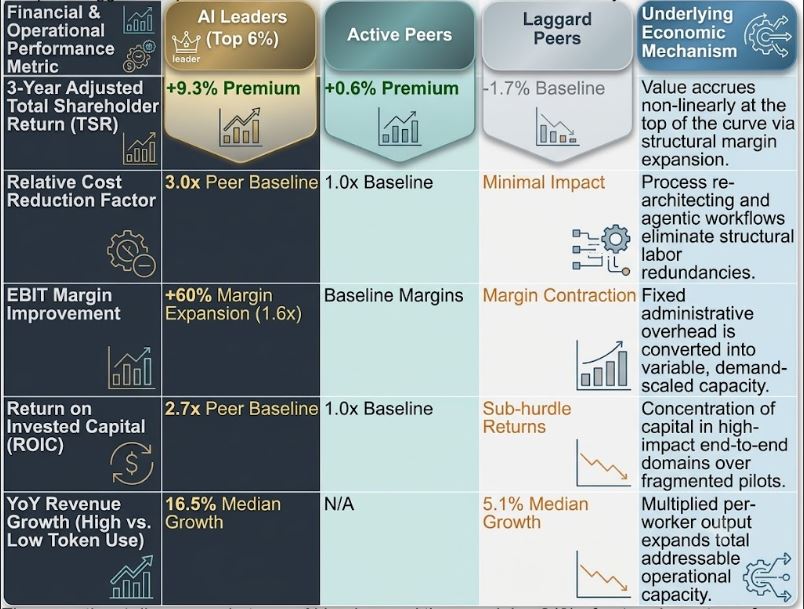
The operational divergence between AI leaders and the remaining 94% of enterprises stems from opposing implementation philosophies. Unsuccessful implementations treat artificial intelligence as a software add-on or marginal overlay superimposed upon legacy organizational structures. Conversely, market leaders treat AI as core operational infrastructure, pairing technological deployment with fundamental workflow re-engineering, metered token cost accounting, and finance-led governance frameworks. Furthermore, empirical studies examining corporate token consumption reveal that technology companies occupying the highest quintile of productive token usage generate a median year-over-year revenue growth of 16.5%, compared to 5.1% for organizations in the lowest usage quintile.
The 10-20-70 Capital Allocation Framework and the Transformation Flywheel
Capturing sustainable financial returns from artificial intelligence mandates strict adherence to a disciplined resource allocation model known as the 10-20-70 rule. Analysis of long-term enterprise transformation programs indicates that bottom-line value creation requires allocating 10% of total effort and capital to underlying algorithms and foundation models, 20% to supporting data engineering and technology infrastructure, and 70% to organizational redesign, process simplification, role restructuring, and workforce upskilling. Enterprise initiatives that underinvest in the 70% human and operational component remain perpetually confined to pilot programs that fail to deliver measurable financial impact to the P&L.
Executing an AI-first cost strategy requires navigating a multi-year investment cycle. Unlike traditional software implementations, comprehensive AI transformations rarely achieve financial breakeven within a standard 12-month fiscal budget. The initial net cash curve dips negative as upfront investments in model fine-tuning, architecture migration, and change management precede the realization of cumulative efficiency gains. This temporary cash runway deficit often creates strategic hesitation among risk-averse executive teams.
To resolve this funding gap, leading enterprises establish a self-sustaining capital flywheel. These organizations initiate multi-phased cost transformation programs that combine traditional structural efficiency levers with targeted AI automation. Traditional cost management mechanisms—such as zero-based budgeting, supplier base rationalization, product and service specification reviews, and corporate layer flattening—generate rapid capital savings ranging between 5% and 25% within 3 to 12 months. This liberated cash flow directly funds the technical infrastructure, specialist talent acquisition, and workflow re-engineering required for deep AI integration.
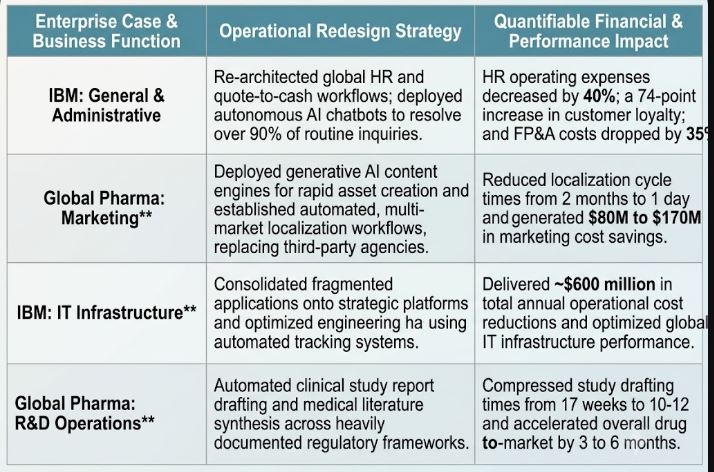
This structural realigning alters the behavior of operating expenses. By shifting core operations from manual labor pools to automated agentic networks, enterprises convert fixed administrative overhead into variable operational capacity. Consequently, as transaction volumes expand, intelligent software systems absorb operational growth without requiring a linear increase in corporate headcount, permanently lowering the firm's structural cost floor.
.
Token Economics and the Return on AI (RoAI) Financial Framework
As enterprise software models evolve from fixed per-seat subscription models to metered usage architectures, corporate execution becomes directly linked to computational token consumption. Tokens—the basic units of text, code, or structured data processed by large language models and autonomous agentic loops—represent both an operational expense and a direct measure of business throughput.
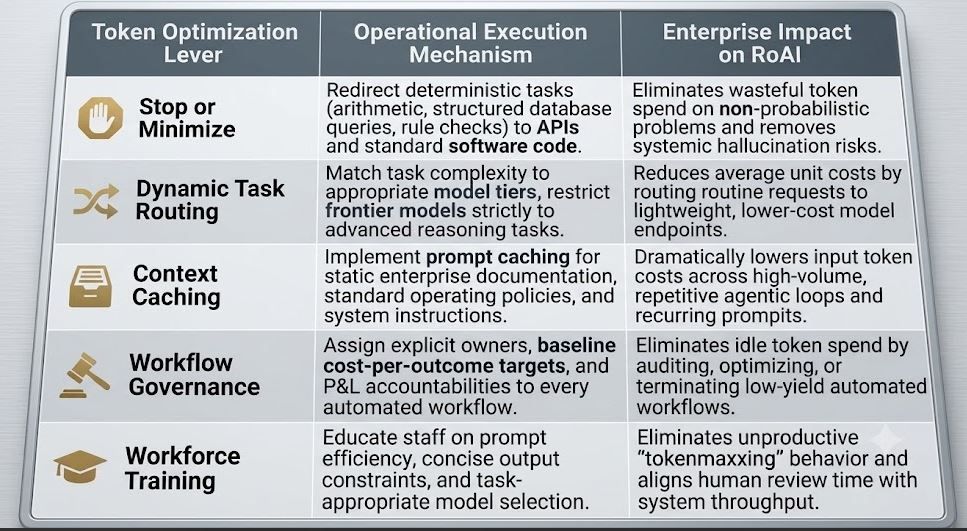
Unmanaged token consumption poses severe risks to corporate operating margins. Unlike legacy cloud infrastructure where marginal hosting costs scale sublinearly with user volume, AI inference expenses scale linearly with prompt length, context window size, query complexity, and continuous reasoning iteration loops. While gross margins for traditional enterprise SaaS average between 65% and 80%, gross margins for unoptimized AI-native applications compress to between 50% and 65% due to ongoing model inference costs.
To enforce rigorous financial control, executive leadership must implement and evaluate the Return on AI (RoAI) metric at a granular workflow level:
\text{RoAI} = \frac{\text{Economic Return}}{\text{Cost of Human Intelligence} + \text{Cost of Token[span_81](start_span)[span_81](end_span)s}}
Optimizing RoAI requires comprehensive accounting across both the financial numerator (the net economic value created by the outcome) and the full operational denominator (the sum of human review labor, prompt management, and computational token expenditure). Corporate financial governance requires allocating token expenditures across three distinct statement lines rather than consolidating consumption inside general IT hosting accounts:
Capital Expenditure (Capex): Token consumption dedicated to building core organizational AI infrastructure, fine-tuning domain-specific models, engineering agentic frameworks, and re-architecting cross-functional business processes. These investments behave like capitalized software assets or specialized production equipment that expands long-term operational capacity.
Operational Expenditure (Opex): Tokens consumed during routine internal business execution—such as automated code generation, document extraction, marketing asset drafting, and financial modeling. These costs are managed through functional operating budgets governed by strict productivity output targets.
Cost of Goods Sold (COGS): Tokens consumed directly within products, digital platforms, or client service solutions delivered to external customers. Tracking unit token COGS on a product-by-product basis is vital to prevent gross margin erosion as client usage scales.
Organizational Execution: Overcoming Execution Friction, "Workslop," and Agentic Unit Economics
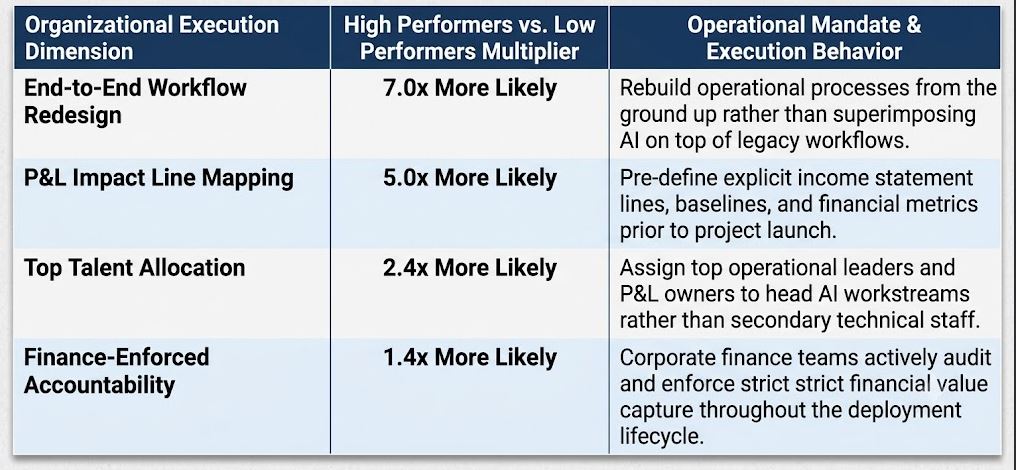
The primary constraints preventing enterprises from scaling artificial intelligence are organizational rather than technological. While technical considerations such as model latency, context limits, and pipeline integration remain relevant, high-performing CEOs focus on resolving internal execution friction. These organizational bottlenecks include vague linkages between AI metrics and P&L line items, misaligned middle management incentives, and structural resistance to workflow redesign.
High-performing enterprises display distinct operational execution differences compared to low-performing peers across four primary organizational dimensions:
An emerging operational challenge in unmanaged deployments is the friction generated by low-quality, automated content, referred to as "workslop". While individual knowledge workers save an average of 2.2 hours per week using basic generative AI tools, and senior knowledge workers recover 10 to 12 hours per week, ungoverned implementations create widespread operational inefficiencies.
Approximately 40% of corporate employees report receiving unverified, poorly structured AI-generated deliverables from colleagues. Reviewing, correcting, or rewriting this substandard output consumes nearly 2 hours per incident, resulting in an estimated productivity loss of $186 per employee per month. For an enterprise with 10,000 employees, ungoverned AI usage generates over $9 million in annual wasted labor, emphasizing the critical need for strict quality controls and explicit workflow governance.
When implemented with rigorous governance, autonomous agentic workflows achieve significant unit-economic improvements over human-only baselines:
Customer Service Ticket Resolution: Cost-per-task drops from $4.18 per human-handled interaction to $0.46 per agentic resolution—representing a 9x unit cost reduction and achieving complete capital payback in 4.1 months.
Code Review Pull Requests: Cost-per-task drops from $48.00 in senior engineering labor time to $0.72 per automated agentic review—representing a 66x unit cost reduction and achieving complete capital payback in 9.3 months.
To manage these economics, leading organizations establish a centralized Transformation Office led by a Chief Transformation Officer. Operating on agile 12-week capital allocation cycles, the Transformation Office continuously reviews project performance against baseline P&L targets. Initiatives demonstrating high RoAI receive accelerated capital allocation, while underperforming projects are paused or restructured before consuming excess resources.
Strategic Roadmap: Operationalizing RoAI and Transitioning to Scalable Enterprise Value
Transitioning an enterprise from unstructured AI experimentation to a high-return operating model requires a disciplined four-step execution roadmap:
Phase 1: Capital Concentration in High-Impact End-to-End Domains
Organizations must eliminate fragmented, cross-departmental pilot programs that dilute capital and management focus. Leadership must concentrate resources on three to five core operational domains—such as procurement, customer service, supply chain planning, or software engineering—where end-to-end workflow automation directly impacts major P&L line items.
Phase 2: Execution of the 10-20-70 Process Re-Engineering Mandate
In accordance with the 10-20-70 capital allocation framework, organizations must direct 70% of total transformation effort to process simplification, workforce upskilling, role redesign, and organizational alignment. Completely rebuilding business processes around agentic capabilities ensures that technical capacity translates directly into bottom-line margin expansion.
Phase 3: Institutionalization of Metered Token Financial Accounting
Corporate finance must establish metered token accounting across all operating divisions, categorizing computational expenditures into Capital Expenditure, Operational Expenditure, and Cost of Goods Sold accounts. Establishing cost-per-outcome metrics and tracking RoAI across all automated workflows prevents uncontrolled usage and protects gross margins.
Phase 4: Finance-Led Governance and Dynamic 12-Week Allocation Cycles
Executive leadership must institute finance-led oversight managed by a central Transformation Office. Empowering corporate finance to validate operational baselines, monitor real-time cost reductions, enforce P&L accountability, and reallocate capital dynamically every 12 weeks eliminates low-yield projects and compounds capital into high-return initiatives.
Navigating this structural transformation requires specialized strategic leadership, financial engineering, and execution frameworks. For mid-market and growth-stage enterprises, overcoming founder-led operational bottlenecks to establish scalable, independent operating systems is a primary milestone.
Advisory and execution frameworks, such as those provided by No1 Coaching & Consulting, assist executive teams in installing structured business operating systems. By integrating performance coaching, revenue engineering, and workflow re-engineering with AI implementation strategies, these frameworks bridge the gap between high-level technology planning and bottom-line value capture. This enables leadership teams to resolve operational friction, optimize computational token expenditures, and build resilient organizations that run, scale, and generate value independently.
Strategic Outlook: The Horizon of Token-Based Enterprise Competition
The global enterprise landscape is entering an era defined by metered computational competition. As corporate intelligence becomes increasingly digitized, abundant, and metered, competitive advantage will no longer accrue to organizations that merely deploy off-the-shelf models or expand total technology budgets.
Sustainable market leadership will belong to enterprises that maximize Return on AI by combining disciplined token financial accounting with comprehensive business process re-engineering. By utilizing early operational efficiency gains to fund multi-year transformations, enforcing strict P&L line accountability, and allocating 70% of organizational energy to human and workflow redesign, enterprise leaders build self-funding operational flywheels that deliver structural margin expansion, superior return on invested capital, and compounding long-term shareholder value.
Works cited
1. The Cost of Caution with AI Investments, https://www.bcg.com/publications/2026/building-business-value-with-ai-investment 2. Return on AI: What CEOs Need to Know About the True Cost of Artificial Intelligence, https://www.bcg.com/publications/2026/how-ceos-can-optimize-ai-token-costs 3. AI ROI by Industry: What McKinsey, BCG, and Real Deployments Show (April 2026), https://aiindustryguide.com/cross-vertical/roi-patterns/ 4. AI in the workplace: A report for 2025 - McKinsey, https://www.mckinsey.com/capabilities/tech-and-ai/our-insights/superagency-in-the-workplace-empowering-people-to-unlock-ais-full-potential-at-work 5. The economic potential of generative AI: The next productivity frontier - YouTube, https://www.youtube.com/watch?v=4-Hk2zUz5xs 6. Challenges in calculating the ROI to Generative AI for financial institutions. - Columbia SIPA, https://www.sipa.columbia.edu/sites/default/files/2024-05/For_Publication_Boehmer.pdf 7. State of AI 2025: Adoption, ROI and Scale | PUNKU.AI, https://www.punku.ai/blog/state-of-ai-2024-enterprise-adoption 8. AI Productivity Statistics 2026: Time Saved, ROI & Real Data - AI Business Weekly, https://aibusinessweekly.net/p/ai-productivity-statistics 9. AI Talk Is Cheap. Value Creation Is Rare. - Boston Consulting Group, https://www.bcg.com/publications/2026/how-ai-leaders-create-competitive-advantage 10. How Leaders Build an AI-First Cost Advantage | BCG, https://www.bcg.com/publications/2026/how-leaders-build-an-ai-first-cost-advantage 11. CEOs Are Starting to See Value from AI. Now Comes Execution. - Boston Consulting Group, https://www.bcg.com/publications/2026/how-ceos-scale-ai-value 12. Cost Management and Cost Advantage Strategy | BCG, https://www.bcg.com/capabilities/cost-management 13. Library | Caversham House, https://cavershamhouse.com/library.html 14. Entrepreneurship 101 - Apple Podcasts, https://podcasts.apple.com/dk/podcast/entrepreneurship-101/id1860792968 15. Entrepreneurship 101 - Simplecast, https://feeds.simplecast.com/HNJw59BL 16. No1 Coaching - 2026 Company Profile & Competitors - Tracxn, https://tracxn.com/d/companies/no1-coaching/__pTbsdNWhRqdsJhYSmdkeZonD3SvEKpPVYM1PnpHlQqo
