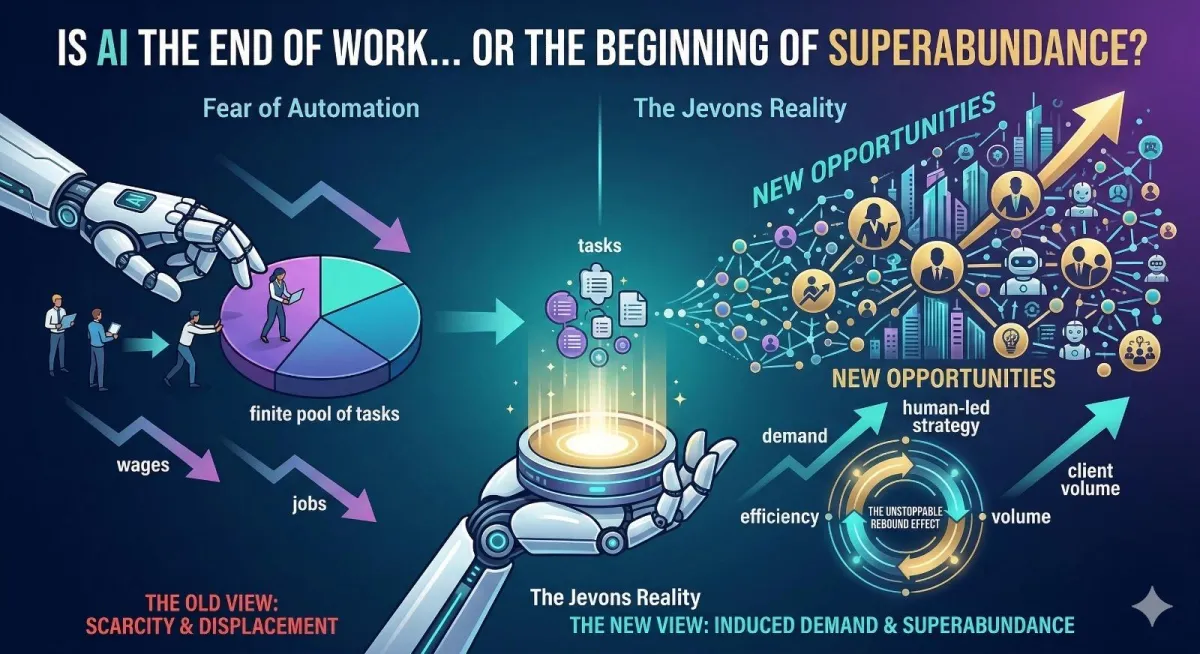
The AI Scarcity Myth: Why Jevons, Simon, and SuperAbundance Prove Universal Basic Income Is the Wrong Solution
We are being told a consistent, terrifying story about Artificial Intelligence: It is coming for your job, your industry, and eventually, the entire economy. The narrative arc is predictable: Efficiency gains will make human labor redundant. Massive unemployment follows. Therefore, we must decouple income from work and institute a Universal Basic Income (UBI) to prevent societal collapse.
It is a coherent story. It is also entirely wrong.
This "technological unemployment" argument is built on a fundamental misunderstanding of history and dynamic economic forces. It is rooted in scarcity thinking. It assumes that there is a finite, fixed amount of "work" to be done in the world.
At No1Coaching, we don't teach scarcity; we architect scaling. To understand how AI actually interacts with the human economy, we must ignore the doomsday headlines and look at three unstoppable economic principles—Jevons, Simon, and SuperAbundance.
Together, they prove that AI isn't eliminating work; it is creating an explosion of demand that will make UBI not only unnecessary but obsolete.
The Mechanic: Jevons and the Paradox of Efficiency
The fear of AI is actually ancient. In 1865, economist William Stanley Jevons addressed a similar panic in Britain regarding coal. The common wisdom was that James Watt's new, more efficient steam engine would reduce coal consumption, preserving Britain's finite supply.
Jevons argued the opposite: "...It is a confusion of ideas to suppose that the economical use of fuel is equivalent to diminished consumption. The very contrary is the truth."
He was right. By making coal power incredibly efficient and cheap, Watt didn't destroy the coal market; he unlocked it. Industries that could never afford power suddenly could. The entire British economy scaled, demanding exponentially more coal.
This is Jevons' Paradox, the cornerstone of "induced demand": As the efficiency with which a resource is used increases, the total consumption of that resource increases rather than decreases.
AI is the Jevons Paradox applied to intelligence.
The fear is that if AI completes a task in 1 hour instead of 10 hours, the human worker becomes obsolete. The Jevons Reality is that by dropping the unit cost of "intelligence" and cognitive labor by 90%, we won't do the same amount of work with fewer people. We will create 1,000x more projects.
Digital spreadsheets didn't eliminate accountants; they made complex financial modeling accessible to every small business, creating a booming industry. AI will handle legal work, architecture, coding, and coaching.
The Catalyst: Julian Simon and the Ultimate Resource
If Jevons provides the dynamic mechanic, Julian Simon provides the catalyst. In his masterpiece, The Ultimate Resource, Simon argued that human ingenuity is the "ultimate resource" because it has an uncanny ability to turn "finite" matter into unlimited functional utility.
Every time we encounter a limit (e.g., "we are running out of coal"), human ingenuity creates a new solution (e.g., "use oil, or nuclear, or solar, or engineer 10x efficiency").
AI is the ultimate accelerator of the Ultimate Resource.
AI doesn't work against humans; it works for human ingenuity. If human creativity is the bottleneck, AI is the pump. Simon's work reinforces Jevons: as AI makes old problems easy to solve, our ingenuity will immediately identify new, more complex problems that were previously economically impossible to tackle.
The barrier to entry for solving global challenges, starting high-ticket service brands, or launching an energy startup has just collapsed.
The Outcome: Tupy & Pooley and SuperAbundance
Where does this collision of AI efficiency and induced demand lead us? To a destination defined by Marian Tupy and Gale Pooley in SuperAbundance.
They argue that true wealth is measured not in dollars, but in "Time Price"—the time it takes for an average person to earn the money to buy something. They document how innovation consistently drives the time price of essentials toward zero.
AI will apply SuperAbundance to the cost of living.
When AI optimizes manufacturing, healthcare, education, legal services, and energy production, the Time Price of a middle-class existence will plummet. If the cost of living drops faster than wages, everyone experiences a "natural" basic income through increased purchasing power. The "safety floor" isn't a government subsidy; it is an economic reality driven by efficiency.
Why UBI Is the Wrong Question
The argument for UBI assumes a static, stagnant world where innovation kills opportunity. The triad of Jevons, Simon, and Tupy/Pooley presents a dynamic, cascading world:
AI makes solving problems efficient (Simon).
Efficient problem-solving makes the solution cheap (Jevons).
Cheap solutions induce 1000x more demand (Jevons/Simon).
This explosion of creation makes everything abundant and forces the cost of living toward zero (SuperAbundance).
In this future, we don't run out of work; we run out of human "Architects" and "Auditors" to direct AI systems.
UBI is a safety net for a world that doesn't exist. It is built on the false promise of static stability. What the world needs is not a check to stay stationary; it needs the tools and high-level coaching to manage the coming SuperAbundance.
The question isn't, "How will we survive without jobs?" The question for every entrepreneur is: "How will I manage 10x the client load when AI allows me to deliver a 5-star experience at scale?"
The future isn't jobless. It's human-led.
Let's build it.
