The AI-Powered Pipeline: Moving from "Prompting" to Automated High-Ticket Growth
If you are treating AI as just a faster way to write emails or brainstorm blog posts, you are leaving massive amounts of revenue on the table.
Most business owners and high-ticket coaches are stuck in the "assistant" phase of AI. They log in to a dashboard, type a prompt, and receive a slightly robotic response. It saves a few minutes, sure, but it doesn't scale your operations, and it certainly doesn't close more deals.
To achieve true scale, you need to transition from using AI as a glorified typewriter to deploying it as an autonomous engine that drives your business forward. Here is how you graduate from basic prompts to building systems that nurture leads, handle objections, and optimize your coaching operations around the clock.
The Shift: From Static Automations to Autonomous Agents
For years, we’ve relied on linear automations to run our businesses—think of an integration that moves a lead from a Facebook ad into your CRM (like GoHighLevel) and triggers a generic welcome email. It’s useful, but it’s static. If the lead asks a complex question in response, the automation breaks, and a human has to step in.
The game has completely changed with the introduction of AI Agents.
An agent isn't just a chatbot; it’s a dynamic system equipped with three things:
A Brain: A powerful language model (like Claude or Gemini) capable of reasoning.
Memory: The ability to remember past interactions and the context of the deal.
Tools: The permission to execute actions, like reading your calendar, updating a pipeline stage, or sending a highly personalized SMS.
Instead of a rigid "If X, then Y" workflow, an AI agent can evaluate a prospect's response, identify their specific objections, and determine the best course of action to move them toward a booked call.
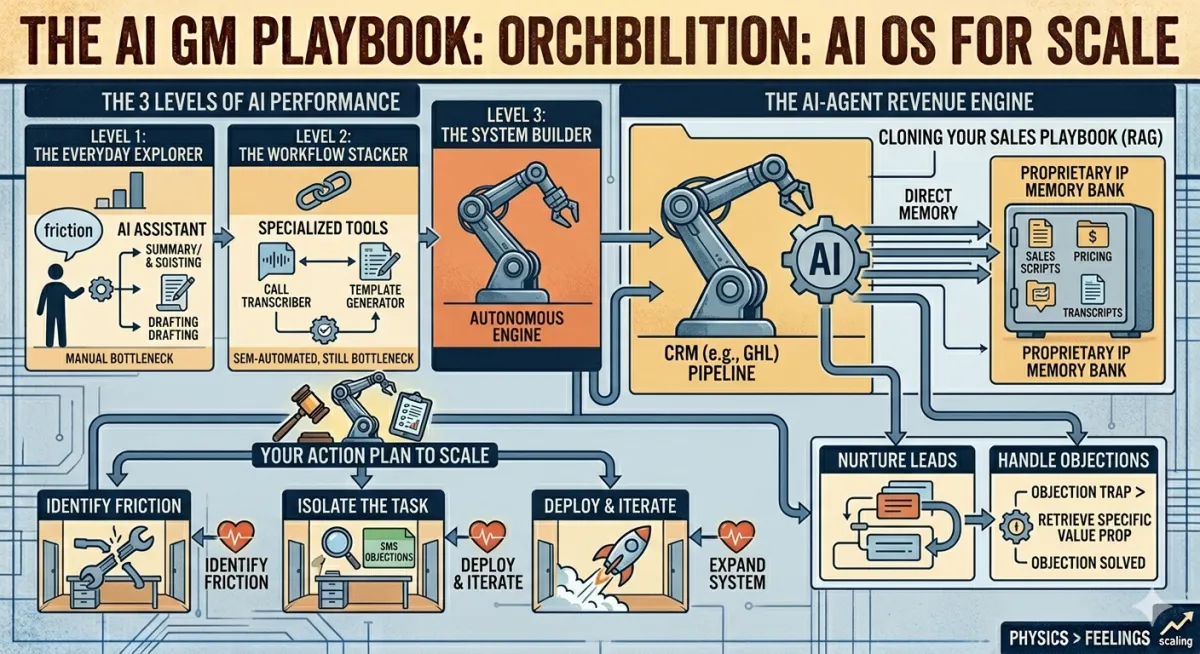
Cloning Your Sales Playbook (The Power of RAG)
One of the biggest complaints from coaches and high-ticket closers is, "AI just doesn't sound like me, and it doesn't know my offers."
This is where a concept called Retrieval-Augmented Generation (RAG) comes in. In plain English, this means giving your AI its own dedicated memory bank filled with your proprietary intellectual property.
Instead of relying on the AI's generic knowledge of "how to sell," you connect it to your specific data. You can upload your winning sales scripts, your pricing sheets, your objection-handling frameworks, and transcripts of your best coaching calls.
When a prospect asks, "How is this different from the other coaching programs I've tried?" your system doesn't search the internet for a generic answer. It retrieves your specific value proposition and delivers it in your exact tone of voice. You aren't just using AI; you are cloning your highest-performing sales rep.
The 3 Levels of AI Performance
To scale your coaching business, you need to honestly assess where you currently sit and aim for the next tier of integration.
Level 1: The Everyday Explorer You use AI to eliminate friction in your day. You use it to summarize long documents, draft presentation outlines, or refine your marketing copy. It saves you an hour a day, but it requires your constant manual input.
Level 2: The Workflow Stacker. You are starting to connect the dots. You use specialized tools to process information faster. For example, feeding a transcript of a client onboarding call into an AI to automatically generate a custom 90-day performance plan and instantly format it into an email draft. You are saving hours, but you are still the bottleneck, pushing the buttons.
Level 3: The System Builder. You are removing yourself from the fulfillment and nurturing loops. You build workflows where an AI agent monitors your CRM. When a new high-ticket lead comes in, the agent researches their company, drafts a hyper-personalized outreach message, handles the initial back-and-forth qualification, and only drops it on your radar when a high-intent call is booked on your calendar.
Your Action Plan to Scale
Do not try to build a massive, complex AI infrastructure on day one. Complexity is the enemy of execution.
Identify the Friction: Where is your team (or where are you) wasting the most time? Is it a lead qualification? Follow-up? Gathering resources for active coaching clients?
Isolate the Task: Pick one single bottleneck. Let’s say it’s objection handling via SMS in your CRM.
Deploy and Iterate: Set up a simple AI workflow tailored to handle that one specific task. Feed it your best responses. Monitor its performance, correct its mistakes, and let it learn.
Once that single pipeline is running flawlessly, move to the next bottleneck. Step by step, you aren't just adopting new technology—you are building a scalable, high-performance operating system for your business.
