Stop Prompting, Start Managing: The Blueprint for a High-Ticket AI Workforce
The era of treating AI as a glorified chatbot is over. For high-ticket operators and businesses scaling aggressively, dumping paragraphs of text into a single chat window is like trying to coach a championship team by yelling random instructions from the parking lot. Eventually, the system burns out, loses context, and fails to execute.
The most expensive mistake business owners make today isn't choosing the wrong AI model; it’s misdiagnosing where their systems are failing. When an output misses the mark, the amateur instinct is to endlessly rewrite the prompt. The professional instinct is to check the architecture.
If you want to build a truly agentic workflow—one that scales revenue without scaling your headcount—you have to stop acting like a prompt engineer and start acting like a general manager. Here is the framework for structuring, isolating, and orchestrating a high-performance digital workforce.
1. Map the Playbook: Understanding Your AI Stack
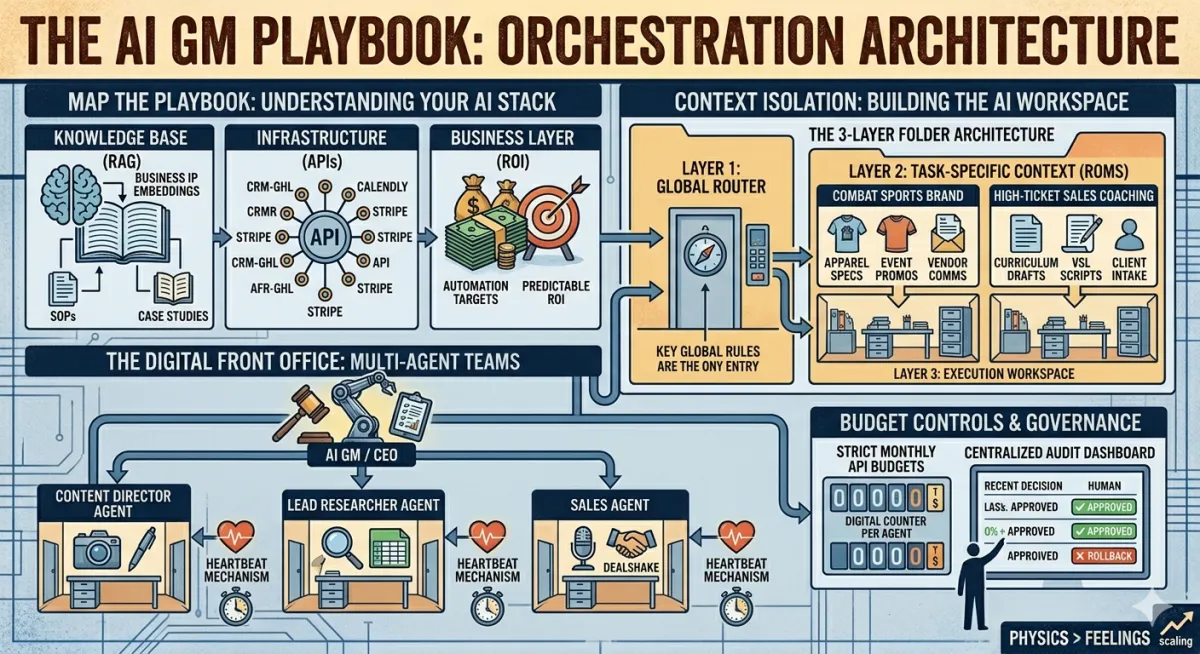
Before you can deploy autonomous agents, you need a structural map of the technology. The AI ecosystem isn't a single tool; it is a multi-layered stack. Most operators get bogged down in debates over which model is the "smartest" (e.g., Claude vs. Gemini). But the foundation of a scalable business doesn't rest on the model alone—it relies on the infrastructure that connects it.
To stop relying on blind trial-and-error, categorize your AI operations into these critical areas:
The Knowledge Base (RAG & Embeddings): How you inject your specific business IP into the AI so it stops giving generic, internet-scraped advice.
The Infrastructure (APIs & Function Calling): The digital bridges connecting your AI to your actual business tools, like routing lead data directly into platforms like GoHighLevel.
The Business Layer (ROI & Strategy): The overarching lens through which all technical decisions must be filtered. If a tool doesn't automate a specific workflow or predictably drive ROI, it doesn't make the roster.
The highest leverage lies in moving away from isolated chatbots toward Orchestration—building systems that operate autonomously in the background.
2. Context Isolation: Building the AI Workspace
When you feed an AI your entire business history at once, it rapidly exhausts its "context window" (its short-term memory). It starts hallucinating, confusing tasks, and running up API costs.
The solution is to move away from bespoke, code-heavy routing and leverage a simple, powerful concept: the 3-Layer Folder Architecture. Treat your file directory as the AI's physical facility.
Layer 1: The Map (Global Router): A master document at the root of your workspace. This serves as the floor plan, providing the AI with its overarching rules and naming conventions before it does any work.
Layer 2: The Rooms (Task-Specific Context): Dedicated sub-folders containing precise instructions for distinct tasks.
Layer 3: The Workspace (The Content): Where the actual day-to-day drafting and execution happens.
Why this matters for scaling: Because this system is entirely modular, it creates strict context isolation. You can have one branch of your architecture dedicated strictly to scaling a combat sports brand—housing apparel specs, event promos, and vendor communications. Simultaneously, a completely separate branch can manage your high-ticket sales coaching—containing your curriculum drafts, VSL scripts, and client intake protocols.
When the AI "walks" into the sales folder, it only reads the rules for high-ticket sales. It seamlessly adapts its tone and toolkit based on where it is standing, eliminating cross-contamination.
3. The Digital Front Office: Multi-Agent Teams
The final evolution of this framework is orchestration. Open-source management tools are now making it possible to run AI not as a solitary assistant, but as a structured corporate team.
Instead of managing tasks, you manage agents.
The Organizational Chart: You establish a core company mission and deploy an "AI CEO," which then delegates to specialized, subordinate agents (a Content Director, a Lead Researcher, etc.).
The Heartbeat System: To address the chronic issue of AI "memory loss," structured agent teams use a heartbeat mechanism. They wake up on a set schedule, review their specific folder contexts and past project history, execute their targeted tasks, and then go back to sleep. This builds compounding, long-term memory while drastically reducing token costs.
Budget Controls & Governance: High-performance systems require guardrails. Assign strict monthly API budgets to specific agents to prevent infinite loops, and maintain a centralized dashboard where human operators can audit decisions, roll back mistakes, or approve critical actions before they go live.
The Bottom Line
Success in the next iteration of business won’t come from knowing the most AI tools. It will come from understanding how to connect these fundamental elements into a cohesive, compounding system.
By defining your tech stack, isolating your context into strictly managed workspaces, and orchestrating multi-agent teams with clear governance, you stop playing with AI—and start employing it.
